

Public Ledgers and Transparency in Tokenized Platforms: 15 Essential Authoritative Mechanisms
Introduction
Understanding public ledgers and transparency in tokenized platforms is essential when evaluating blockchain-based financial infrastructure. As tokenization expands into investment markets, real-world assets, and digital securities, the underlying ledger architecture becomes a defining factor in how transparency actually functions in practice.
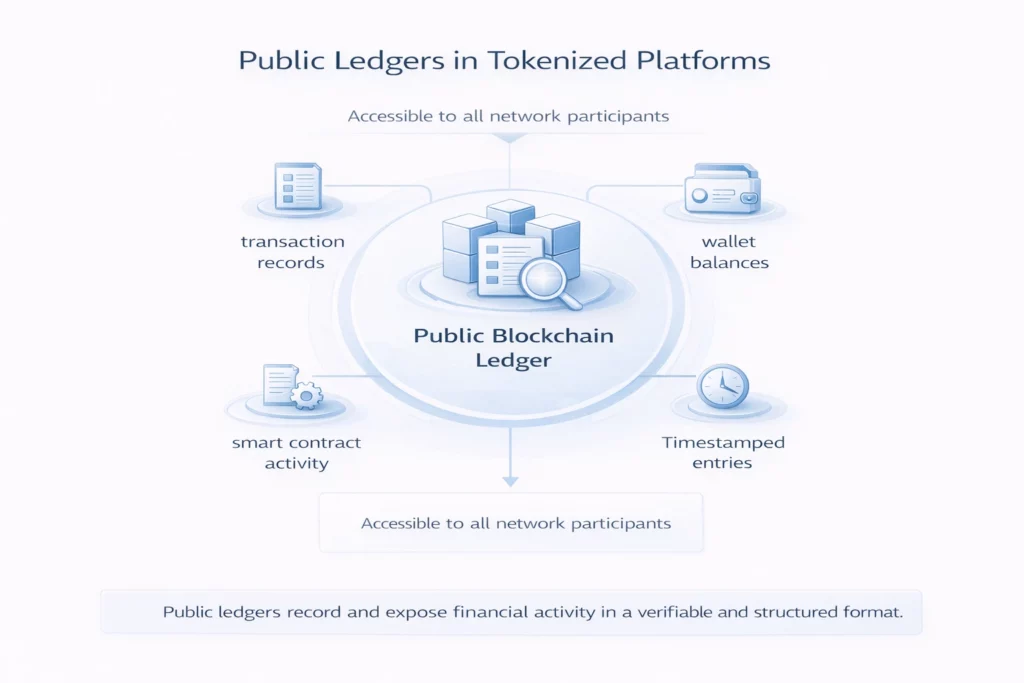
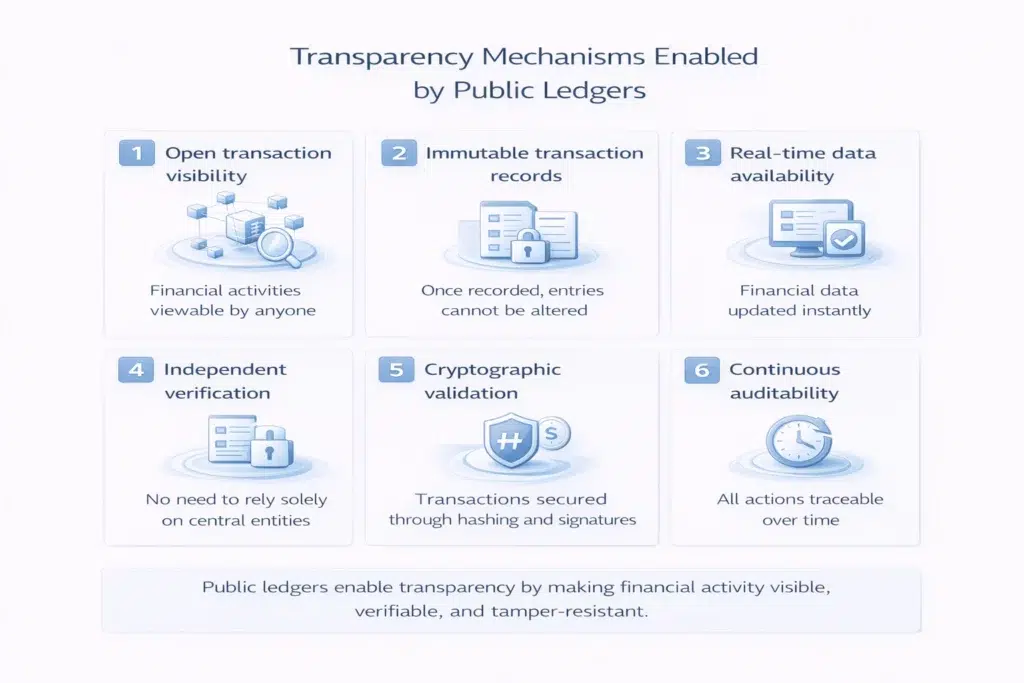
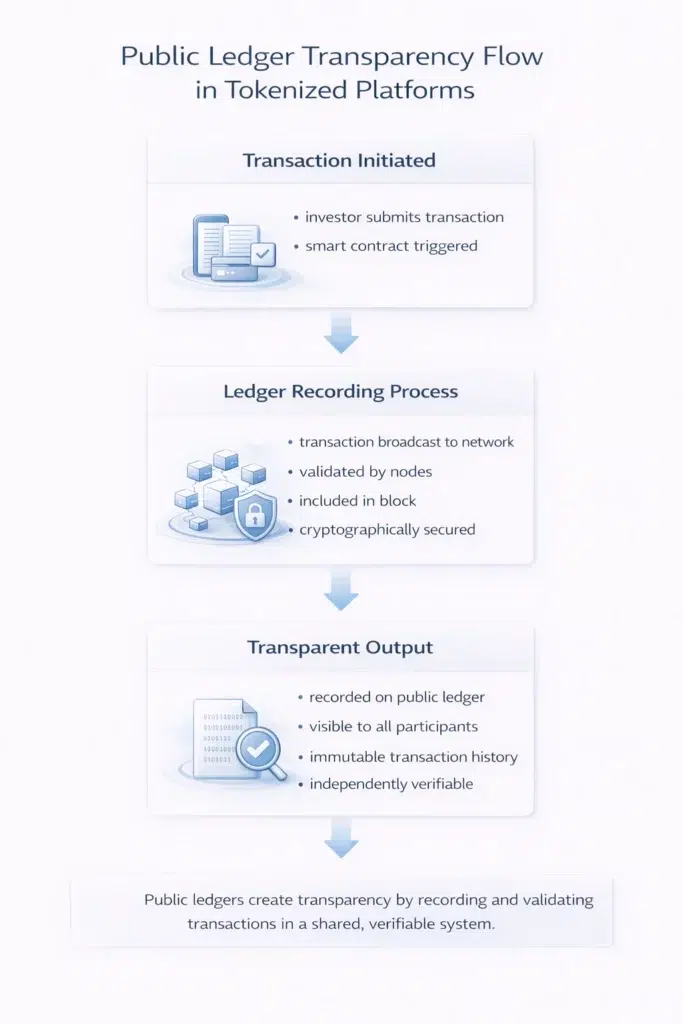
Public ledgers record transactions in a distributed, cryptographically secured format that allows independent verification without relying solely on centralized institutions. In tokenized platforms, this infrastructure forms the backbone of transaction traceability, auditability, and operational visibility.
However, transparency at the ledger level should not be misunderstood. Public ledger transparency does not automatically ensure regulatory compliance, eliminate financial risk, or guarantee operational stability. It represents one structural layer within a broader system that includes governance, legal frameworks, and supervisory oversight.
For foundational context within the Infrastructure & Transparency pillar, see what is on-chain transparency, what is proof of reserve in blockchain systems, and how tokenized investment platforms are built.
This article explores public ledgers and transparency in tokenized platforms through fifteen essential mechanisms, focusing on technical structure, institutional implications, and realistic limitations.
In Simple Terms
Public ledgers are systems that:
- record transactions across a distributed network
- use cryptographic validation to secure data
- create traceable transaction histories
- allow independent verification without centralized approval
Public ledgers and transparency in tokenized platforms improve visibility and auditability. At the same time, they do not remove legal obligations, governance responsibilities, or market-related risks.
Mechanism 1: Distributed Ledger Replication
A core mechanism behind public ledgers and transparency in tokenized platforms is distributed replication.
Unlike centralized databases controlled by a single authority, public blockchains replicate ledger data across multiple independent nodes. Each node maintains a synchronized copy of the transaction history, allowing the system to function without relying on a single controlling entity.
This structure enhances transparency by:
- reducing single-point control
- allowing independent validation
- preventing unilateral data alteration
Distributed replication strengthens system resilience, though it does not remove the need for governance, regulation, or accountability frameworks.
Mechanism 2: Cryptographic Hash Linking
Public ledgers rely on cryptographic hash functions to connect blocks sequentially.
Each block contains transaction data, a timestamp, and a reference to the previous block’s hash. This linking creates a chain structure where altering one block would require recalculating all subsequent blocks.
Through this mechanism, public ledgers and transparency in tokenized platforms gain strong audit integrity. Historical records remain verifiable over time, which is particularly important in financial environments where traceability matters.
Mechanism 3: Consensus Validation
Transparency is not only about recording transactions but also about validating them.
Consensus mechanisms ensure that transactions meet protocol rules before being added to the ledger. While the specific method may vary across networks, the goal remains consistent: to confirm authenticity and maintain order.
Consensus validation supports:
- transaction authenticity
- prevention of double spending
- consistent transaction ordering
This contributes to the trust architecture of public ledgers and transparency in tokenized platforms, even though it does not replace legal enforcement.
Mechanism 4: Public Wallet Address Visibility
Wallet address transparency is one of the most visible aspects of blockchain systems.
Using blockchain explorers, observers can:
- review wallet balances
- trace token transfers
- monitor transaction histories
This supports reserve verification models such as proof of reserve. However, wallet transparency does not necessarily reveal identity, which introduces both privacy benefits and interpretational limits.
Mechanism 5: Immutable Transaction History
Immutability is central to public ledgers and transparency in tokenized platforms.
Once transactions are confirmed, they become part of a permanent record. Instead of modifying past data, corrections are recorded as new transactions.
This approach enhances auditability and accountability. At the same time, it introduces complexity when addressing errors, since incorrect transactions cannot simply be deleted.
Mechanism 6: Smart Contract Execution Logs
Tokenized platforms rely heavily on smart contracts to automate financial processes.
These contracts generate:
- execution logs
- event emissions
- state updates
All of this data is recorded on-chain and can be independently analyzed. For deeper insight, see how smart contracts support investment infrastructure.
This extends transparency beyond simple transactions into programmable system behavior.
Mechanism 7: Timestamping and Block Sequencing
Each transaction is timestamped and placed within a sequential block structure.
This allows:
- verification of timing
- reconstruction of activity history
- tracking of governance execution
Timestamp transparency becomes particularly relevant in investment systems where timing can influence financial outcomes and governance decisions.
Mechanism 8: Token Supply Transparency
Public ledgers allow verification of token supply changes.
Observers can track:
- minting events
- burning events
- circulating supply adjustments
This transparency supports accountability and helps validate claims about token economics within a platform.
Mechanism 9: Treasury Flow Monitoring
Treasury wallets often hold funds for operations, governance, or investments.
Public ledgers enable:
- real-time monitoring of treasury movements
- tracking of large transfers
- verification of allocation patterns
For broader infrastructure context, see how tokenized investment platforms are built.
This visibility improves accountability but does not automatically prevent misuse.
Mechanism 10: Open Data Accessibility via Blockchain Explorers
Blockchain explorers provide user-friendly access to public ledger data.
They allow users to:
- search transaction hashes
- review contract activity
- monitor wallet interactions
These tools make public ledgers and transparency in tokenized platforms accessible even to non-technical users, although interpreting the data still requires some understanding.
Mechanism 11: Merkle Tree Data Integrity
Merkle trees organize data into verifiable structures.
They are used to:
- aggregate large datasets
- provide inclusion proofs
- maintain integrity without exposing full data
This is especially relevant in reserve verification systems where transparency must be balanced with privacy.
Mechanism 12: Cross-Platform Interoperability
Tokenized platforms increasingly operate across multiple blockchains.
Interoperability allows:
- asset bridging
- multi-chain token issuance
- cross-network verification
This expands transparency but also introduces complexity in maintaining consistent visibility across systems.
Mechanism 13: Audit Trail Permanence
Public ledgers create permanent audit trails.
This allows:
- long-term analysis
- forensic investigation
- historical accountability
Permanent records strengthen trust but also require careful system design to handle errors and corrections.
Mechanism 14: Permissionless Verification
Public blockchains allow anyone to verify transactions without needing approval.
This reduces reliance on centralized reporting and enables broader transparency across participants.
However, it does not remove the need for regulatory supervision or legal accountability.
Mechanism 15: Real-Time Monitoring Potential
Public ledger data can be monitored continuously.
Systems can:
- detect anomalies
- flag unusual transactions
- analyze behavior patterns
For related insights, see AI in risk management infrastructure.
This capability strengthens oversight but depends on the quality of analytical tools used.
Public Ledger vs Private Ledger Clarification
Not all ledgers are public.
Private or permissioned systems restrict access, while public ledgers allow broad visibility. For comparison, see on-chain vs off-chain transparency.
This distinction is important when evaluating transparency claims.
Regulatory and Supervisory Perspective
Regulators evaluate transparency within enforceability frameworks.
Institutions such as the Bank for International Settlements, International Monetary Fund, and OECD emphasize traceability, monitoring, and governance integration.
Public ledgers support these goals but do not replace compliance obligations.
Limitations and Structural Considerations
Public ledger transparency has limitations:
- data complexity
- pseudonymous identities
- off-chain dependencies
- privacy trade-offs
- interpretation challenges
For deeper analysis, see challenges of on-chain transparency.
Institutional Evaluation Criteria
Institutions assess:
- verifiability
- reliability
- legal integration
- supervisory compatibility
- operational resilience
Transparency is only one layer within a broader system.
Frequently Asked Questions
What is a public ledger?
A distributed database that records transactions in a publicly verifiable format.
How do public ledgers improve transparency?
They allow independent verification of transactions and system activity.
Are public ledgers fully transparent?
They provide transaction visibility, but identity and legal context may remain hidden.
Can they replace audits?
No. Audits cover broader financial and legal elements.
How do regulators view them?
As supportive tools, not replacements for compliance frameworks.
Conclusion
Public ledgers and transparency in tokenized platforms rely on fifteen structural mechanisms that enable visibility, auditability, and accountability.
These mechanisms improve how financial activity can be observed and verified. At the same time, they do not remove risk, governance requirements, or regulatory obligations.
Effective transparency depends on how ledger systems are integrated with legal, operational, and supervisory frameworks.
Educational Disclaimer
This article is for educational purposes only and does not constitute financial, legal, or investment advice.