


What Is On-Chain Transparency? 12 Essential Foundations
This article is part of the broader Investment Infrastructure educational framework, explaining what is on-chain transparency across twelve essential foundations including ledger structure, cryptographic auditability, smart contract visibility, proof of reserve integration, regulatory perspective, technical limitations, and institutional adoption.
Educational Notice
This article is provided for informational and educational purposes only. It does not constitute legal, financial, or investment advice. Transparency mechanisms vary by blockchain design, jurisdiction, and regulatory context. Professional consultation should be sought before engaging with blockchain-based investment platforms.
Introduction
Understanding what is on-chain transparency is fundamental when evaluating blockchain-based financial systems, tokenized investment platforms, and digital asset infrastructure. As distributed ledger technologies expanded into investment environments, transparency became one of their most discussed structural characteristics. However, what is on-chain transparency is often misunderstood or oversimplified in ways that create unrealistic expectations about what blockchain visibility can and cannot achieve.
At its core, what is on-chain transparency refers to the ability to view, verify, and trace transactions, balances, and smart contract interactions directly on a public blockchain ledger (a distributed, cryptographically secured database maintained simultaneously across multiple computers, where records are practically immutable once confirmed). Unlike traditional financial systems that rely on internal reporting and restricted disclosures, on-chain systems allow independent participants to observe activity in real time through publicly accessible data.
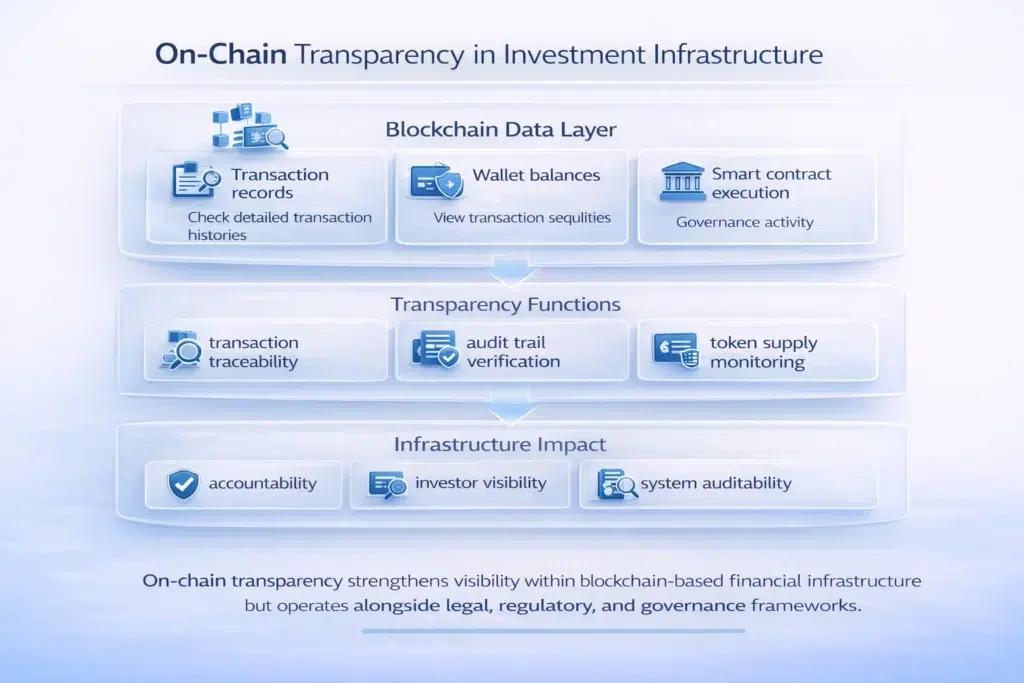
In tokenized finance, what is on-chain transparency becomes especially relevant because it forms the visibility layer of investment infrastructure. It enables transaction traceability, supports accountability mechanisms, and strengthens auditability. However, transparency alone does not guarantee regulatory compliance, eliminate fraud risk, or ensure financial solvency. This article explains what is on-chain transparency through twelve essential foundations, focusing on technical structure, institutional implications, and balanced risk awareness.
For comparison with off-chain approaches, see On-Chain vs Off-Chain Transparency. For proof of reserve context, see What Is Proof of Reserve in Blockchain Systems? The Bank for International Settlements (BIS) has emphasized transparency and traceability in digital finance infrastructure.
In Simple Terms: What Is On-Chain Transparency?
Here is the clearest way to think about what is on-chain transparency. The old way of financial record-keeping is like a Private Notebook. Only you and the bank can read it. If the bank makes a mistake or changes a number, you have to trust them when they tell you everything is fine. You have no independent way to verify the entries. Your only option is faith in the institution.
On-chain transparency is like a Giant Glass Billboard in the town square. Every time money moves, it is written on the billboard in permanent ink. Anyone can walk up and check the math at any time. The billboard does not belong to a bank. It belongs to the whole town. What is on-chain transparency is the structural principle behind that billboard: Don’t Trust, Verify. You do not have to take anyone’s word for what happened. You can read the billboard yourself.
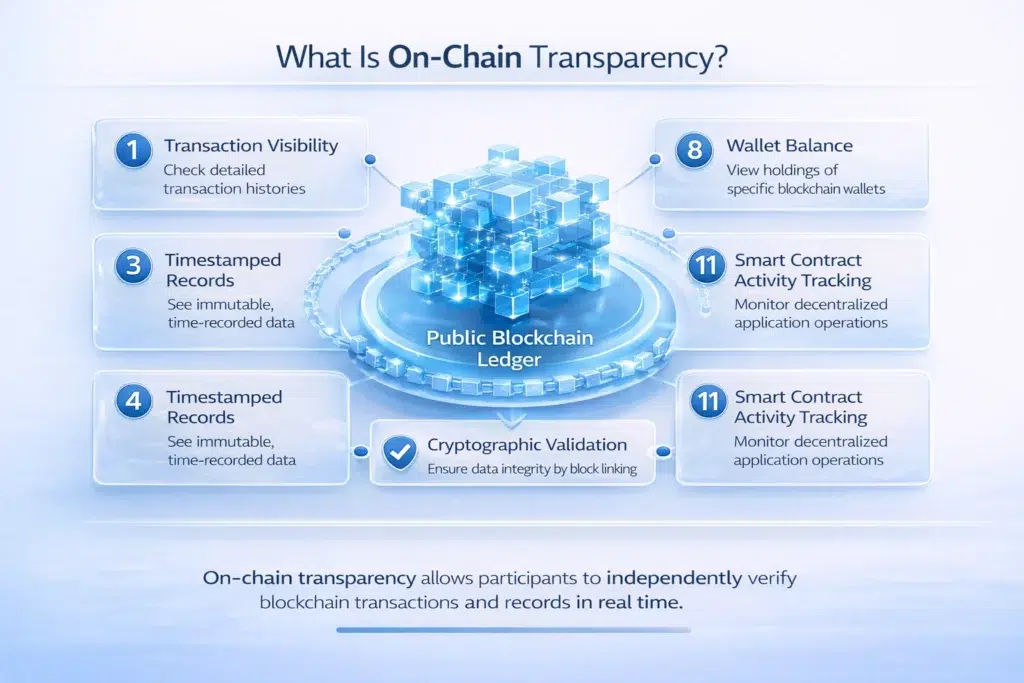
What is on-chain transparency means: transactions are recorded on a public blockchain, wallet balances can be independently verified, smart contract activity is visible to network participants, and records are timestamped and cryptographically secured. It increases visibility within blockchain systems. It does not remove operational, legal, or market risk. The billboard shows what moved. It does not explain why it moved, whether it should have moved, or whether the entity behind the wallet is financially solvent.
Key Terms: A Visual Glossary
Five terms are essential for understanding what is on-chain transparency:
Ledger: A record book of financial transactions. In blockchain, the ledger is distributed across thousands of computers simultaneously rather than held by one central institution.
Hash: A unique mathematical fingerprint of a piece of data. Changing even one character in a transaction record changes its hash entirely, making tampering immediately detectable.
Node: One of the computers participating in the blockchain network, maintaining an identical copy of the full transaction ledger.
Smart Contract: A self-executing program deployed on the blockchain that automatically implements predefined conditions when triggered. Its code and execution records are publicly visible on-chain.
Block: A group of validated transactions bundled together and added to the blockchain in sequence. Each block is cryptographically linked to the one before it, creating an unbroken chain.
Foundation 1: Defining What Is On-Chain Transparency
To clearly answer what is on-chain transparency, it is necessary to define it without exaggeration or ideological framing. On-chain transparency refers to the public visibility of data recorded directly on a blockchain. This includes transaction histories, wallet balances, contract executions, and governance interactions, depending on the blockchain design. In public blockchain networks, ledger entries are distributed across nodes, validated through consensus mechanisms (the protocols by which network participants agree on which transactions are valid), recorded in sequential blocks, and cryptographically linked so that altering any historical entry would invalidate all subsequent records.
When discussing what is on-chain transparency, it is critical to distinguish between transparency and endorsement. Public visibility does not imply regulatory approval, financial reliability, or ethical legitimacy. It simply means the data is accessible and independently verifiable. A blockchain can be fully transparent about a fraudulent transaction. Transparency reveals what happened. Governance determines whether it should have.
Foundation 2: How Public Blockchains Enable Transparency
Understanding what is on-chain transparency requires examining the mechanics of public blockchains. Public blockchains operate through Distributed Ledger Technology (DLT: a database architecture where identical copies of a transaction record are maintained simultaneously across multiple independent computers, eliminating the single point of control that characterizes traditional centralized databases). Instead of relying on one central database, multiple independent nodes maintain synchronized copies of the ledger. Transactions are grouped into blocks and validated through consensus mechanisms before being permanently added to the chain.
Key structural features enabling what is on-chain transparency include: open ledger access (anyone with internet access can read the chain), Transaction Hash Identifiers (unique cryptographic fingerprints that allow any specific transaction to be located and verified), public wallet addresses (account identifiers that allow balance and history verification without requiring permission), block timestamps (permanent records of when each transaction was confirmed), and immutable record sequencing (the cryptographic linking that makes retroactive alteration detectable). For deeper infrastructure context, see Public Ledgers and Transparency in Tokenized Platforms.
Foundation 3: On-Chain Data Structures and Auditability
Another essential dimension of what is on-chain transparency is auditability. Blockchain systems generate cryptographic records that include transaction hashes, sender and recipient addresses, token transfer amounts, and block inclusion timestamps. Each transaction becomes part of a verifiable audit trail. Since blocks are cryptographically linked, altering historical data would require recomputing the cryptographic proof for every subsequent block across the majority of the network simultaneously, a task that is computationally infeasible on major public blockchains.
This structural design enables independent transaction tracing (any observer can follow the path of funds across addresses), verification of asset transfers (the movement of tokens can be confirmed without accessing internal systems), and historical reconstruction of activity (the complete transaction history is permanently available). On-chain auditability strengthens oversight capacity. However, interpreting blockchain data often requires technical tools and analytical expertise. Raw transaction data without analytical context is the billboard with the writing, but you still need to be able to read the language. See How Proof of Reserve Is Verified On-Chain for a practical application of this auditability.
Foundation 4: On-Chain vs Off-Chain Transparency
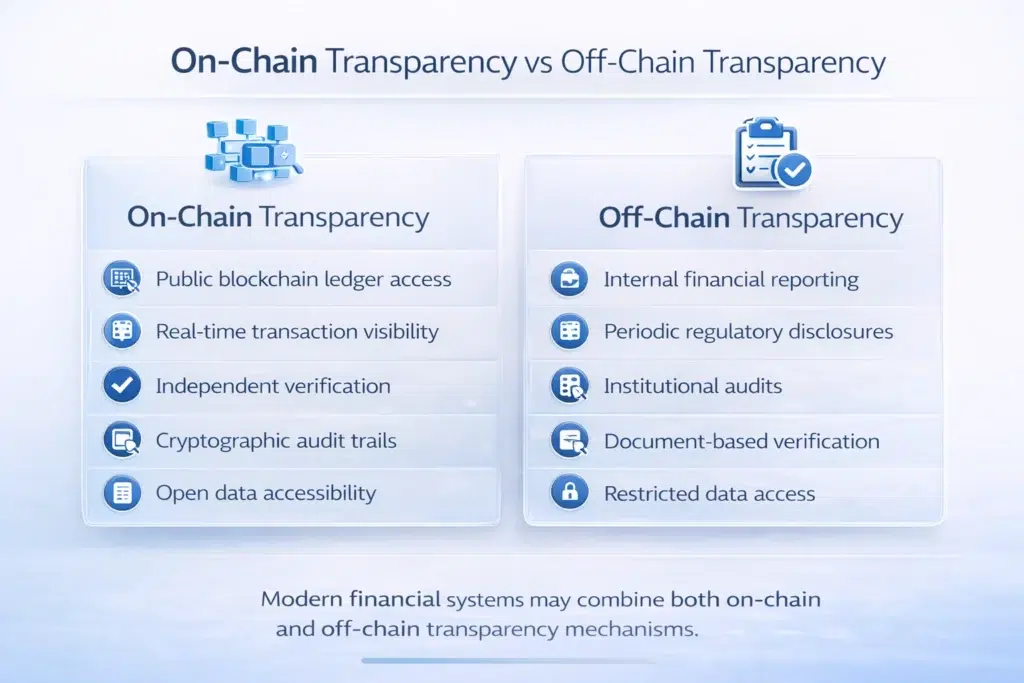
A structured explanation of what is on-chain transparency must include comparison with off-chain transparency. Off-chain transparency typically involves internal financial reporting, regulatory filings, audited statements, and restricted disclosures reviewed by qualified professionals. On-chain transparency involves public ledger access, real-time transaction visibility, independent verification through cryptographic proofs, and continuous rather than periodic updating.
| Dimension | On-Chain Transparency | Off-Chain Transparency |
|---|---|---|
| Data Access | Public blockchain, open to all | Internal systems, restricted access |
| Verification | Independent, cryptographic | Trusted intermediary or auditor |
| Frequency | Continuous, real-time | Periodic (quarterly/annually) |
| Auditability | Cryptographic, immutable trail | Document-based, subject to revision |
| Accessibility | Open to all observers | Restricted to authorized stakeholders |
Both models may coexist within modern financial systems. What is on-chain transparency does not eliminate the need for off-chain reporting. For the complete structural comparison across 14 dimensions, see On-Chain vs Off-Chain Transparency.
Foundation 5: The Role of On-Chain Transparency in Tokenized Finance
In tokenized environments, what is on-chain transparency becomes particularly relevant. Tokenized finance involves representing ownership rights or asset interests through blockchain-based tokens that may correspond to real-world assets, financial instruments, or governance rights. On-chain transparency supports tokenized finance by enabling real-time token supply verification (preventing double-spending, where the same asset is claimed by multiple parties simultaneously), transaction monitoring across ownership transfers, governance proposal tracking (recording votes and decisions on-chain), and treasury movement visibility (showing how platform funds are allocated and spent).
However, tokenized finance transparency also depends on legal enforceability and regulatory alignment beyond blockchain visibility alone. The billboard shows that ownership transferred. The legal system determines whether that transfer was valid and enforceable. For asset representation context, see How Real-World Assets Are Represented on Blockchain.
Foundation 6: Relationship Between On-Chain Transparency and Proof of Reserve
To understand what is on-chain transparency, it is helpful to examine its relationship to Proof of Reserve mechanisms (verification systems that confirm the real-world assets backing on-chain claims actually exist and are held in regulated custody). Proof of Reserve relies fundamentally on blockchain visibility to verify that asset balances exist on-chain. Without transparent ledger access, independent reserve verification would not be possible because there would be no publicly accessible record of what the platform claims to hold.
On-chain transparency provides wallet-level balance visibility, transaction traceability, and independent audit potential that Proof of Reserve systems leverage to demonstrate asset backing. Transparency is broader than reserve verification: it applies to all recorded blockchain activity, not only asset custody. See What Is Proof of Reserve in Blockchain Systems? and How Proof of Reserve Is Verified On-Chain.
Foundation 7: How Smart Contracts Support Transparency
Smart contracts play an important role in clarifying what is on-chain transparency. Smart contracts are programmable code deployed on blockchain networks that automatically execute when predefined conditions are met, without requiring human intermediaries. Their logic and execution outcomes may be publicly visible on the blockchain, including public contract code access (anyone can read the rules the contract will enforce), event logs (automatic records generated when the contract executes), execution timestamps, and automated rule enforcement that cannot be selectively applied or overridden by a platform operator.
Smart contract transparency can strengthen predictability and accountability by making the rules governing an investment structure publicly verifiable rather than depending on institutional promises. If the contract code says income will be distributed proportionally to token holders when X condition is met, that rule is enforced automatically and visibly. However, smart contract transparency requires that the code is understandable and has been independently verified for security vulnerabilities. See On-Chain Transparency Explained for infrastructure-level context.
Foundation 8: Regulatory and Supervisory Perspective
A balanced explanation of what is on-chain transparency requires consideration of regulatory perspectives. Supervisory bodies focus on traceability (the ability to follow financial flows from origin to destination), audit trails (permanent records that investigators can examine retrospectively), AML (Anti-Money Laundering: the regulatory requirement to detect and prevent financial crimes) monitoring capabilities, and risk oversight. The BIS has emphasized that on-chain transparency may support supervisory goals by improving data visibility across digital finance infrastructure. The IMF highlights the importance of aligning technological innovation with regulatory supervision frameworks. The OECD has examined blockchain governance and transparency integration across jurisdictions.
On-chain transparency may support supervisory goals by improving traceability compared with opaque off-chain systems. However, it does not replace licensing requirements, compliance frameworks, or regulatory enforcement. A fully transparent blockchain record of an unlicensed securities offering is still evidence of a regulatory violation, not a defense against one. For compliance context, see Why Compliance Matters in Tokenized Finance.
Foundation 9: On-Chain Transparency in Action
Understanding what is on-chain transparency is strengthened by examining how institutional actors are applying it in practice. JP Morgan’s Onyx platform (JPMorgan’s blockchain-based infrastructure for wholesale payment settlement and digital asset collateral management) is one of the most widely cited examples of institutional-grade on-chain transparency implementation. Onyx uses distributed ledger technology to settle intraday repo transactions (short-term borrowing arrangements backed by securities) with real-time visibility across counterparties, reducing settlement risk and improving capital efficiency compared with traditional T+2 settlement cycles.
Similarly, institutional bond issuances on platforms like HSBC Orion and various central bank digital currency (CBDC) pilots demonstrate that what is on-chain transparency is no longer a theoretical concept. It is operational infrastructure at some of the world’s largest financial institutions. These implementations confirm that the Town Square Billboard model is being adopted where the stakes and the scrutiny are highest, not just in retail crypto markets.
Foundation 10: Accountability Implications
Understanding what is on-chain transparency includes recognizing its accountability implications. Transparency may reduce Information Asymmetry (the condition where one party in a financial relationship has access to significantly more or better information than another, which enables exploitation) by allowing independent transaction review, governance process visibility, public treasury tracking, and historical record verification. Because records are timestamped and immutable, participants can assess whether governance rules were followed and whether funds were deployed as promised.
However, accountability requires enforceability. Transparent data alone does not create legal liability or guarantee corrective action. The billboard shows that a rule was broken. The legal system determines what happens next. What is on-chain transparency provides the evidence layer for accountability. Governance frameworks and regulatory enforcement provide the consequence layer. See Transparency Reduces Risk in Tokenized Assets for the risk reduction implications.
Foundation 11: Technical Limitations of On-Chain Transparency
A complete analysis of what is on-chain transparency must acknowledge technical limitations. These include data complexity (raw blockchain data is technically dense and requires specialized blockchain explorer tools and analytical software to interpret meaningfully for most users), blockchain explorer interpretation challenges (the same data can yield different conclusions depending on the analytical framework applied), Pseudonymous Address Identification (linking specific wallet addresses to real-world identities requires Chain Analysis techniques and is not guaranteed), off-chain activity exclusion (what is on-chain transparency shows only what is recorded on the blockchain, not liabilities or obligations held in traditional legal systems), and high data volume (major public blockchains process millions of transactions daily, making manual review impossible).
Transparency does not automatically equal clarity. The billboard is always lit, but you need to be able to read what is written on it. Institutions and individual investors both require analytical tools and technical expertise to extract meaningful insight from blockchain data. The raw visibility of what is on-chain transparency is a necessary but not sufficient condition for genuine financial accountability.
Foundation 12: Privacy, Institutional Integration, and What On-Chain Transparency Is Not
An institutional understanding of what is on-chain transparency must address privacy considerations. Public blockchains expose transaction histories, but participants often use pseudonymous addresses. While this structure supports transparency at the transaction level, it may complicate identity verification for compliance purposes. Investment systems must balance personal data protection requirements (particularly under frameworks like the EU’s GDPR), strategic commercial confidentiality, regulatory disclosure requirements, and public auditability. Privacy-Enhancing Technologies (PETs: cryptographic tools such as zero-knowledge proofs that allow verification without full data disclosure) are increasingly being explored to resolve this tension.
In tokenized investment infrastructure, what is on-chain transparency interacts with custody systems, compliance modules, governance frameworks, and AI-driven monitoring systems. For broader infrastructure context, see How Tokenized Investment Platforms Are Built and On-Chain vs Off-Chain Asset Tokenization Models.
Finally, it is essential to be clear about what on-chain transparency is not. It is not a guarantee of financial solvency (a platform can be fully transparent about transactions while being insolvent off-chain). It is not a substitute for legal enforceability (visible records of ownership mean nothing without legal systems that recognize and enforce those ownership rights). It is not fraud prevention (bad actors can transact transparently). And it is not compliance (regulatory obligations require far more than public ledger visibility). Transparency enhances oversight capacity. Trust depends on enforceability, governance discipline, and regulatory alignment. The billboard shows what happened. Everything else requires the legal and governance framework around it.
Frequently Asked Questions
What is on-chain transparency?
What is on-chain transparency refers to the public visibility of transactions, balances, and smart contract interactions recorded directly on a blockchain ledger. It is the Town Square Billboard model: every time money moves on the blockchain, it is recorded in permanent ink that anyone can verify independently. It increases visibility within blockchain systems but does not remove operational, legal, or market risk.
How does on-chain transparency work technically?
What is on-chain transparency works through distributed ledger technology: transactions are validated by consensus across multiple independent nodes, grouped into cryptographically linked blocks, and permanently recorded on a public chain accessible to any observer. Cryptographic hashing makes retroactive alteration practically impossible. Anyone can verify transaction authenticity without requiring access to internal systems or institutional permission.
Is on-chain transparency better than traditional financial reporting?
What is on-chain transparency offers real-time, continuous, cryptographically verifiable visibility that traditional periodic reporting cannot match in speed. Traditional reporting offers comprehensive liability disclosure, legal accountability structures, management narrative, and regulatory enforceability that blockchain records alone cannot provide. Both have strengths. The most effective financial infrastructure integrates both rather than choosing between them.
Does on-chain transparency eliminate fraud?
No. What is on-chain transparency improves traceability and makes certain fraud patterns detectable retrospectively, but it does not eliminate operational or legal risks. A fraudulent transaction is visible on-chain. The blockchain records that it happened. Detecting it, prosecuting it, and recovering funds still requires human governance, legal frameworks, and regulatory enforcement. Transparency provides the evidence. Justice requires more than evidence.
How do regulators view on-chain transparency?
Regulators view what is on-chain transparency as potentially supportive of oversight goals when integrated with compliance and supervisory frameworks. The BIS, IMF, and OECD all recognize that on-chain visibility can enhance traceability and audit capacity. However, regulators consistently emphasize that transparency must be combined with licensing requirements, formal disclosure obligations, and enforcement frameworks. Visibility is a tool for oversight, not a substitute for it.
What is on-chain transparency NOT?
What is on-chain transparency is not a guarantee of solvency (off-chain liabilities remain invisible), not a substitute for legal enforceability (ownership rights require legal recognition), not fraud prevention (bad actors can transact visibly), and not regulatory compliance (regulatory frameworks require far more than ledger visibility). The billboard shows what happened. Governance, law, and enforcement determine what it means and what happens next.
Conclusion
Understanding what is on-chain transparency requires evaluating it as a structural visibility mechanism embedded within blockchain systems, not as a guarantee of safety, compliance, or financial health. Across twelve essential foundations, this article has examined the definition and mechanics of on-chain transparency, how public blockchains enable it, its auditability structure, its relationship with off-chain reporting, its role in tokenized finance, its connection to Proof of Reserve, smart contract integration, regulatory perspectives, accountability implications, technical limitations, privacy considerations, and institutional adoption.
The Town Square Billboard is powerful precisely because it belongs to everyone and can be verified by anyone. What is on-chain transparency is the structural principle that makes that possible in financial systems. Its effectiveness depends on disciplined system design, legal enforceability, and integration with broader governance and compliance frameworks. The billboard illuminates what happened. The legal and governance infrastructure around it determines what that means, and what comes next.
Sources and Regulatory References
- Bank for International Settlements (BIS): https://www.bis.org
- International Monetary Fund (IMF): https://www.imf.org
- Organisation for Economic Co-operation and Development (OECD): https://www.oecd.org
Educational Disclaimer
This article is provided for educational purposes only and does not constitute legal, financial, or investment advice. Transparency mechanisms vary by blockchain design, jurisdiction, and regulatory context. Professional consultation should be sought before engaging with blockchain-based investment platforms.
Last updated: March 2026
Explore Investment Infrastructure
- On-Chain Transparency Explained
- What Is Proof of Reserve in Blockchain Systems?
- How Proof of Reserve Is Verified On-Chain
- On-Chain vs Off-Chain Transparency
- On-Chain vs Off-Chain Asset Tokenization Models
- Transparency Reduces Risk in Tokenized Assets (cluster)
- Public Ledgers and Transparency in Tokenized Platforms (cluster)
- How Real-World Assets Are Represented on Blockchain (cross-pillar)
- Why Compliance Matters in Tokenized Finance (cross-pillar)
- Investment Infrastructure Hub