


How Smart Contracts Support Investment Infrastructure: 12 Essential Robust Mechanisms
Introduction
Understanding how smart contracts support investment infrastructure requires examining their technical role within blockchain-based financial systems. Smart contracts are programmable code deployed on blockchain networks that automatically execute predefined rules when specific conditions are met. In tokenized investment platforms, they operate as execution engines for transactions, governance processes, treasury management, and compliance logic.
The question of how smart contracts support investment infrastructure is not really about technological novelty. It is about structural integration. Smart contracts change how instructions are enforced, how transactions are validated, and how operational processes are recorded. They contribute to automation and transparency, but they do not eliminate legal obligations, regulatory requirements, or operational risk.
Within the Infrastructure & Transparency pillar, smart contracts function as a core operational layer. For broader context, see what is on-chain transparency, how tokenized investment platforms are built, and what is proof of reserve in blockchain systems.
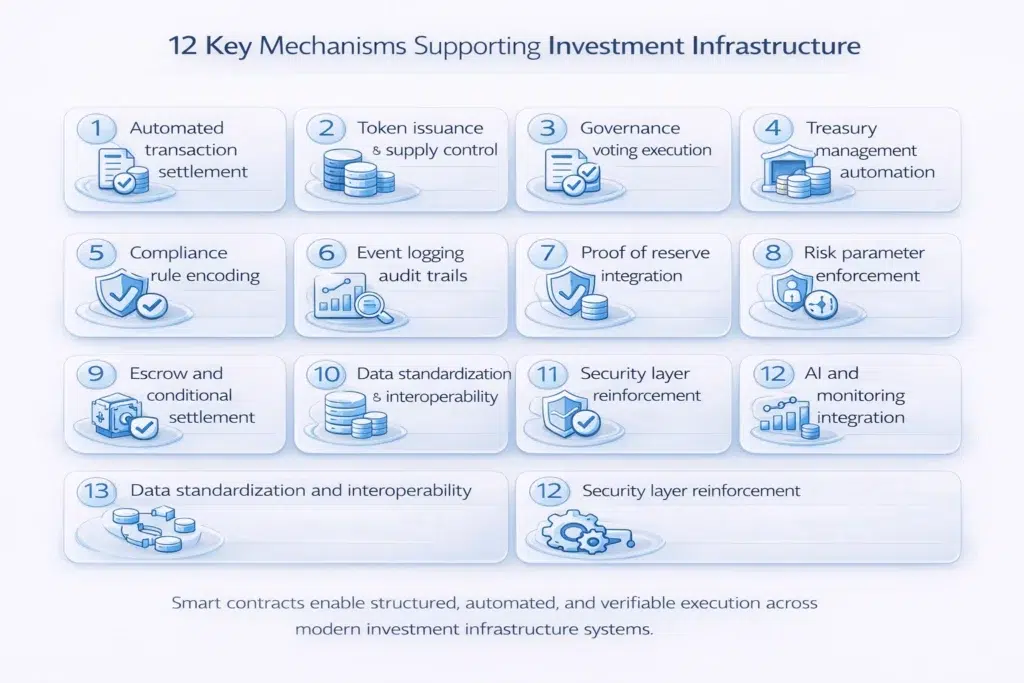
This article explains how smart contracts support investment infrastructure through twelve structured mechanisms while maintaining an institutional, compliance-aware perspective.
In Simple Terms
Smart contracts:
- automatically execute predefined rules
- record outcomes on a blockchain
- reduce reliance on manual processing
- create verifiable execution logs
They enhance operational transparency but do not replace governance, regulation, or legal enforceability.
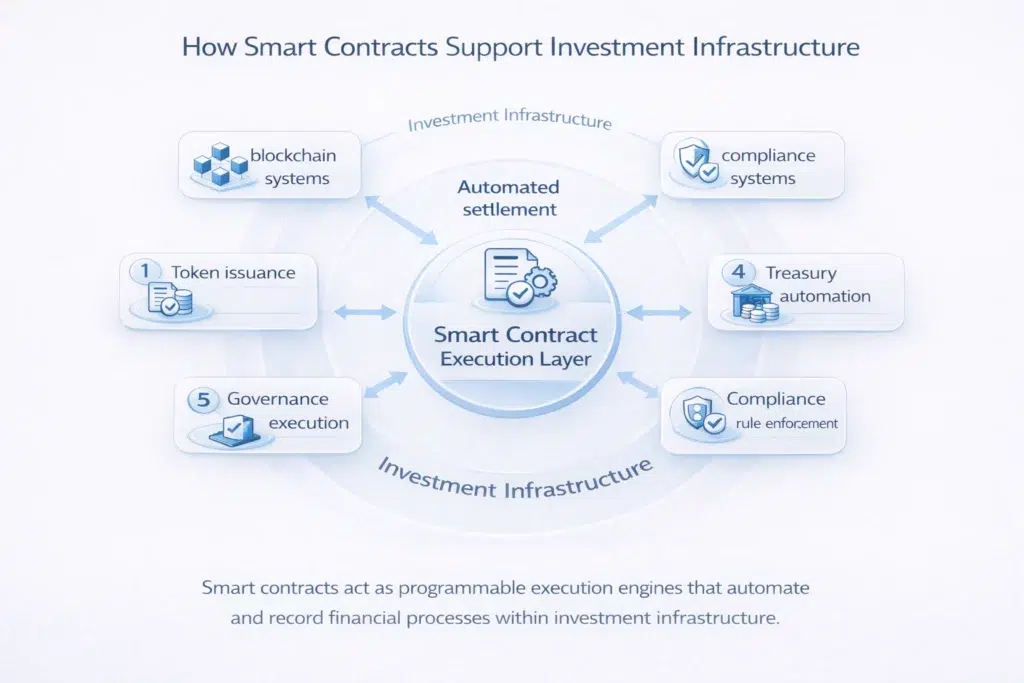
Mechanism 1: Automated Transaction Settlement
The first mechanism explaining how smart contracts support investment infrastructure is automated settlement.
In traditional investment systems, settlement often requires intermediaries to confirm transactions, reconcile records, and update ledgers. Smart contracts embed settlement logic directly into blockchain code.
When predefined conditions are met, such as signature verification or asset availability, the contract executes automatically. This reduces manual processing layers and creates deterministic outcomes.
Automation enhances consistency and reduces certain operational delays. However, automated execution does not remove the need for dispute resolution mechanisms outside the blockchain.
Mechanism 2: Token Issuance and Supply Control
Tokenized investment platforms often represent asset interests through digital tokens.
A second mechanism clarifying how smart contracts support investment infrastructure is programmable token issuance and supply control. Smart contracts can define:
- maximum token supply
- minting permissions
- burning mechanisms
- transfer rules
Because issuance logic is embedded in code, observers can review the contract parameters. This transparency strengthens accountability in tokenized platform architecture.
For structural architecture context, see how tokenized investment platforms are built.
Mechanism 3: Transparent Governance Voting Execution
Governance processes in tokenized investment systems may rely on smart contract-based voting modules.
Understanding how smart contracts support investment infrastructure includes examining governance automation. Smart contracts can:
- register proposals
- record votes
- calculate quorum
- execute approved actions
Execution logs are recorded on-chain, enabling independent verification. While governance transparency improves, enforceability still depends on legal and jurisdictional recognition.
Mechanism 4: Treasury Management Automation
Treasury management is another area where smart contracts support investment infrastructure.
Smart contracts can enforce:
- multi-signature requirements
- spending thresholds
- governance-triggered fund releases
- conditional transfers
By encoding treasury rules, platforms reduce discretionary execution risk. For broader security context, see security layers in tokenized investment platforms.
Automation strengthens traceability but does not eliminate governance misconfiguration risk.
Mechanism 5: Compliance Rule Encoding
A significant mechanism explaining how smart contracts support investment infrastructure is programmable compliance.
Smart contracts can include logic such as:
- whitelisting approved participants
- restricting transfers to compliant addresses
- blocking transactions from specific jurisdictions
- enforcing holding limits
While such rules enhance structured enforcement, they cannot independently replace regulatory supervision or legal licensing requirements.
Compliance logic encoded in smart contracts must align with off-chain legal obligations. For broader regulatory context, see why compliance is essential in tokenized finance.
Mechanism 6: Event Logging and Audit Trails
Smart contracts emit event logs during execution.
These logs create structured audit trails that support understanding how smart contracts support investment infrastructure. Each execution step, state change, or token transfer can be recorded on-chain.
For transparency foundations, see what is on-chain transparency.
Event logs provide data for independent analysis, but interpreting complex smart contract interactions may require technical expertise.
Mechanism 7: Proof of Reserve Integration
Smart contracts can integrate with reserve verification systems.
In platforms implementing reserve transparency, contracts may:
- publish wallet addresses
- verify asset balances
- automate reporting triggers
This integration supports reserve validation mechanisms discussed in what is proof of reserve in blockchain systems.
Smart contracts enhance procedural consistency but do not confirm the completeness of off-chain liabilities.
Mechanism 8: Risk Parameter Enforcement
Risk management can be embedded into smart contract logic.
Examples include:
- collateral ratio requirements
- liquidation thresholds
- margin enforcement rules
- automated asset transfers upon breach
These mechanisms help explain how smart contracts support investment infrastructure by embedding predefined safeguards.
However, risk models depend on accurate data inputs. Smart contracts execute logic deterministically but do not assess economic reasonableness beyond coded parameters.
Mechanism 9: Escrow and Conditional Settlement
Smart contracts can function as escrow agents.
Conditional logic enables:
- release of funds upon milestone verification
- time-based transfers
- multi-party approval mechanisms
In investment systems, escrow contracts may reduce certain counterparty risks by ensuring that funds are only released when predefined conditions are satisfied.
This mechanism strengthens procedural reliability but must be legally recognized to ensure enforceability beyond blockchain records.
Mechanism 10: Data Standardization and Interoperability
Standardized smart contract interfaces promote interoperability.
In explaining how smart contracts support investment infrastructure, data standardization is critical. Structured interfaces allow:
- integration with analytics tools
- compatibility across wallets
- cross-platform coordination
Standardization enhances ecosystem cohesion but depends on protocol adoption and governance alignment.
Mechanism 11: Security Layer Reinforcement
Security is central to infrastructure stability.
Smart contracts support investment infrastructure by:
- enforcing deterministic execution
- reducing discretionary intervention
- creating predictable operational flows
However, smart contracts introduce coding risks. Vulnerabilities, logic flaws, or inadequate audits can compromise security.
Platforms often rely on independent code audits and testing to mitigate these risks.
Mechanism 12: AI and Monitoring Integration
Modern infrastructure increasingly integrates smart contracts with monitoring systems.
Automated analytics tools can:
- monitor contract interactions
- detect abnormal transaction patterns
- flag risk parameter breaches
For related discussion, see AI in risk management infrastructure.
This integration explains how smart contracts support investment infrastructure by producing structured data suitable for automated oversight.
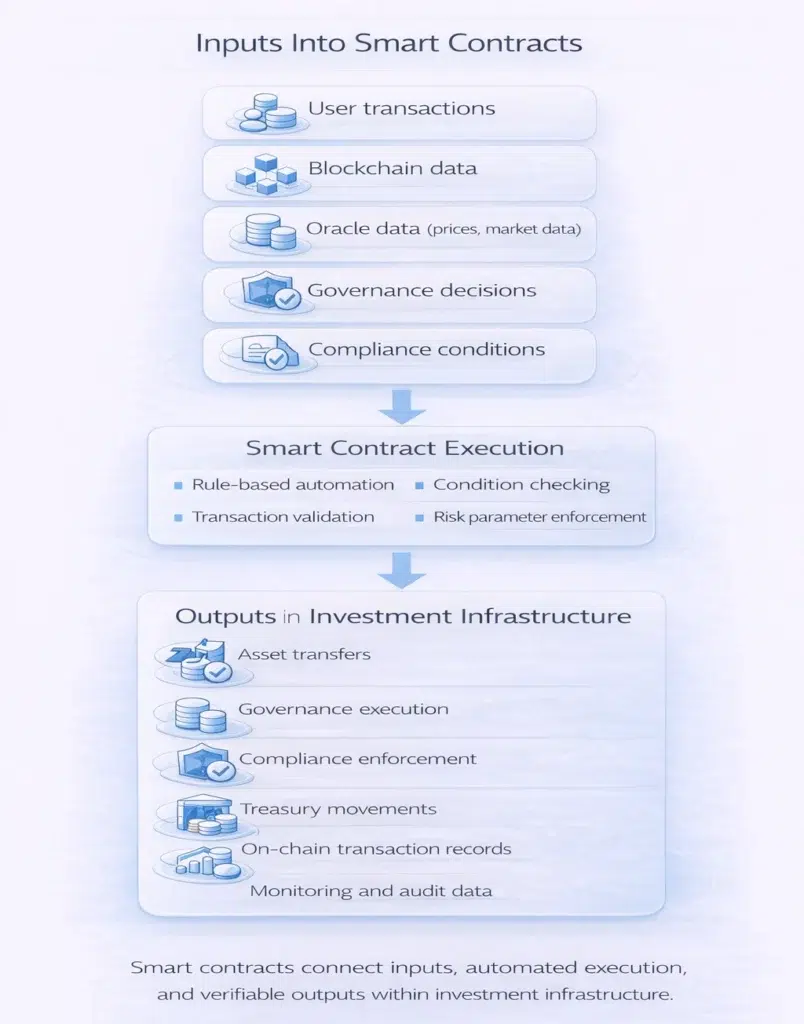
Smart Contracts vs Traditional Contracting Systems
Traditional contracts are legal documents enforced through courts and regulatory systems.
Smart contracts differ by:
- executing automatically
- recording results on-chain
- relying on deterministic code
They do not replace legal contracts. In many jurisdictions, legal agreements remain necessary to define enforceable rights and obligations.
Smart contracts support operational execution but must align with legal frameworks.
Regulatory and Supervisory Perspective
Regulators evaluate smart contract systems within broader financial supervision contexts.
The Bank for International Settlements emphasizes risk monitoring and governance integration in digital finance.
The International Monetary Fund highlights supervisory alignment in technological innovation.
The OECD has examined governance and compliance implications of blockchain systems.
Smart contracts may enhance auditability and traceability, but they do not substitute licensing, disclosure, or regulatory oversight.
Limitations and Structural Risks
While explaining how smart contracts support investment infrastructure, structural risks must also be acknowledged:
- coding errors
- governance misconfiguration
- oracle data dependency
- legal ambiguity
- upgrade limitations
Smart contracts execute code as written. If flawed logic is deployed, unintended consequences may occur.
Operational resilience depends on rigorous testing, audits, and governance oversight.
Institutional Evaluation Criteria
Institutions assessing smart contract-based infrastructure typically consider:
- code audit quality
- execution transparency
- integration with compliance systems
- legal enforceability
- operational reliability
Smart contracts are evaluated as part of a layered infrastructure model rather than as standalone solutions.
Frequently Asked Questions
How do smart contracts support investment infrastructure?
They automate settlement, enforce governance rules, encode compliance logic, and generate transparent execution logs.
Do smart contracts replace legal contracts?
No. Legal agreements remain necessary for enforceable rights and regulatory compliance.
Are smart contracts automatically compliant?
No. Compliance depends on jurisdictional laws and supervisory frameworks beyond code execution.
Can smart contracts eliminate fraud risk?
They reduce certain operational risks but do not eliminate governance or legal risks.
How do regulators view smart contract systems?
Regulators assess them within broader compliance, risk management, and supervisory contexts.
Conclusion
Understanding how smart contracts support investment infrastructure requires analyzing twelve structured mechanisms, including automated settlement, governance execution, treasury management, compliance encoding, risk parameter enforcement, and audit trail generation.
Smart contracts strengthen operational efficiency and transparency within blockchain-based investment infrastructure. They provide deterministic execution and verifiable records.
However, they do not eliminate governance complexity, regulatory obligations, or market risk. Effective deployment depends on disciplined design, legal alignment, code audits, and integration with supervisory frameworks.
Educational Disclaimer
This article is provided for informational and educational purposes only. It does not constitute legal, financial, or investment advice. Smart contract implementation risks and regulatory obligations vary by jurisdiction and platform design. Professional consultation should be sought before participating in blockchain-based investment systems.