

How Real-World Assets Are Represented on Blockchain: Legal and Technical Structure Explained
This article is part of the broader Real-World Assets educational framework, explaining how real-world assets are represented on blockchain through the coordinated mapping of legal ownership systems and digital token infrastructure.
Educational Notice
This article is provided for informational and educational purposes only. It does not constitute financial, legal, or investment advice. Regulatory treatment of real-world asset tokenization varies by jurisdiction and asset classification.
Introduction: The Translation Layer
Every skeptic asks the same question: how does a physical building actually get inside a digital token? The honest answer is that it does not. Understanding how real-world assets are represented on blockchain requires recognizing what is and is not happening: blockchain does not transfer a physical or legally recognized asset onto a ledger. Instead, it records a digital representation of ownership rights, while the underlying asset remains governed by established legal systems such as property law, securities regulation, and contract law.
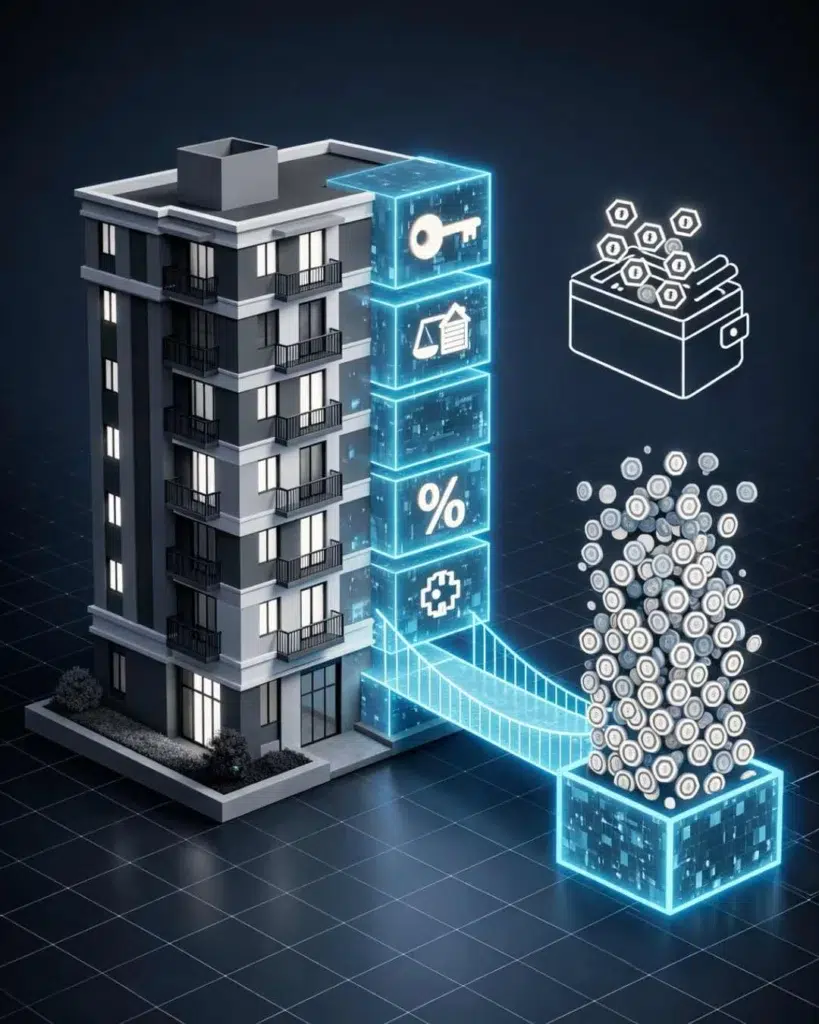
Think of how real-world assets are represented on blockchain as a Digital Twin: a precise digital mapping that reflects the legal reality of the physical world. The building stays in its jurisdiction. The gold bar stays in its vault. The blockchain holds the thread that connects your digital token to the legal documentation that makes your ownership real and enforceable.
This creates a synchronized dual-layer model. The Legal Ownership Layer defines and enforces ownership rights. The Blockchain Representation Layer digitally records and tracks ownership changes. Neither layer replaces the other. Both are necessary for how real-world assets are represented on blockchain to produce enforceable digital ownership.
If you are new to the foundational concepts, these articles provide useful context:
- What Are Real-World Assets?
- What Is Asset Tokenization? A Beginner-Friendly Explanation
- How Real-World Asset Tokenization Works Step by Step
The Bank for International Settlements (BIS) has emphasized that distributed ledger technologies function as infrastructure enhancements to existing financial systems, not replacements for them. That principle is the foundation of how real-world assets are represented on blockchain in every institutional-grade system built today.
In Simple Terms: How Real-World Assets Are Represented on Blockchain
How real-world assets are represented on blockchain comes down to four coordinated elements: digital tokens reflect legally recognized ownership rights, the asset remains in the real world governed by law, blockchain records who owns the token and every transfer, and smart contracts manage the transfer logic and distribution rules. Blockchain enhances transparency and efficiency. Legal systems preserve enforceability. The representation is only as strong as the legal structure beneath it.
The Legal Layer vs the Blockchain Layer
Understanding how real-world assets are represented on blockchain begins with clearly distinguishing what each layer does and does not do.
| Legal Ownership Layer | Blockchain Representation Layer |
|---|---|
| Property registry holds authoritative title | Token ledger records digital ownership |
| Securities clearing system governs financial instruments | Wallet records reflect token holdings |
| Custodian documentation confirms asset existence | On-chain transaction history provides audit trail |
| Legal transfer documentation authorizes ownership change | Smart contract executes token transfer logic |
| Court-enforceable rights determine ownership in disputes | Cryptographic verification confirms transaction integrity |
The 4 Technical Building Blocks: How Real-World Assets Are Represented on Blockchain
Building Block 1: The Token Standard (The Blueprint)
The first technical element of how real-world assets are represented on blockchain is the Token Standard (a technical specification that defines how a token behaves on a blockchain network, what rules govern its transfers, and what data it can carry). Choosing the right standard is the equivalent of choosing the right type of legal instrument for a financial transaction.
Two primary standards apply to RWA tokenization. ERC-20 (Ethereum Request for Comments 20, the standard for fungible tokens where every token is identical and interchangeable) is used for Liquidity Slices: situations where the asset has been divided into identical fractional units that all represent the same underlying rights. If you own 100 tokens and I own 100 tokens in the same ERC-20 structure, our tokens are economically identical. ERC-721 (the standard for non-fungible tokens where each token is unique and not interchangeable with any other) is used for Individualization: situations where one specific token represents one specific unique asset, such as a single property deed or a specific piece of art. These are not interchangeable with any other token in the same way that your apartment title is not interchangeable with your neighbor’s.
Advanced standards such as ERC-1400 and ERC-3643 (security token standards with built-in transfer restrictions and compliance enforcement) are specifically designed for how real-world assets are represented on blockchain in regulated environments, where Identity-Gating (the enforcement of KYC and AML checks before any token transfer is permitted) must be enforced at the protocol level.
Building Block 2: The Metadata (The Digital Filing Cabinet)
Tokens alone are not enough to establish how real-world assets are represented on blockchain in an enforceable way. Each token must be connected to Metadata (the digital filing cabinet that holds all the documentation linking the token to its real-world asset): the property deed, photos of the physical asset, independent valuation reports, audit certifications, Assay Metadata (the immutable purity and serial record for tokenized metals), insurance certificates, and compliance documentation.
This metadata is typically stored using IPFS (InterPlanetary File System, a decentralized file storage system that assigns a unique cryptographic hash to each file, ensuring that the document cannot be altered without changing its identifier) or equivalent decentralized storage. The token’s smart contract references the IPFS hash, creating a permanent, tamper-evident link between the digital token and its legal documentation. If anyone changes the documentation, the hash changes, and the discrepancy is immediately detectable.
Building Block 3: The Legal Wrap (The SPV Operating Agreement as Code)
The legal foundation of how real-world assets are represented on blockchain is the SPV (Special Purpose Vehicle, a dedicated legal entity created to hold one specific asset). The SPV legally owns the asset. Investors hold economic rights through tokens representing their proportional interest in the SPV. Blockchain records token ownership. Legal documentation links the SPV to the blockchain issuance.
The most important legal document in this structure is the SPV’s Operating Agreement: the document that defines exactly what token holders own, what rights they hold, how income is distributed, and how decisions are made. Think of the Operating Agreement as the Legal Software of the ownership structure. Just as a smart contract encodes the digital rules of token behavior, the Operating Agreement encodes the legal rules of ownership rights. One operates in code. The other operates in law. Together, they define the full scope of how real-world assets are represented on blockchain with enforceability.
The World Bank has consistently emphasized that secure property rights and ownership systems are foundational to financial stability. Without the SPV and its Operating Agreement at the legal layer, how real-world assets are represented on blockchain produces tokens with no legally enforceable backing.
Building Block 4: The Smart Contract and Event Triggers (The Automated Manager)
The smart contract is the Automated Manager of how real-world assets are represented on blockchain. It automates token issuance, enforces Identity-Gating (only Whitelisted wallets that have passed KYC and AML verification can hold or receive tokens), executes ownership transfers, and manages Event Triggers (predefined rules that automatically update the representation when a real-world event occurs).
Event Triggers are what make the representation dynamic rather than static. When a tenant pays monthly rent, the smart contract routes the NOI (Net Operating Income, total rent minus operating expenses) proportionally to verified token holders’ wallets without manual intervention. When an independent appraiser updates the property valuation, an Oracle feeds that data to the contract and the token’s NAV (Net Asset Value) updates automatically. When a token transfer is attempted, the smart contract checks the buyer’s Whitelist status before permitting the transaction. The representation is not a one-time photograph of the asset. It is a continuously synchronized mirror of the asset’s real-world state.
The U.S. Securities and Exchange Commission (SEC) has clarified that digital tokens representing financial interests remain subject to securities regulation regardless of their technical structure. The European Securities and Markets Authority (ESMA) has examined distributed ledger technologies in financial markets, highlighting the importance of governance and operational safeguards. For verification architecture detail, see Who Verifies Real-World Assets in Tokenized Systems.
The Complete Representation Model: How Real-World Assets Are Represented on Blockchain
The full picture of how real-world assets are represented on blockchain combines all four building blocks into one coordinated system. Step by step: the underlying asset is legally verified and confirmed to exist within a recognized ownership framework. The SPV is created to hold legal title, providing Insolvency Remoteness. Token standards are selected (ERC-20 for fungible fractions, ERC-721 for unique assets, or ERC-1400/3643 for regulated permissioned securities). Metadata documenting the asset is stored in decentralized storage with a cryptographic hash linking it to the token. The smart contract is deployed with Event Triggers for income distribution, Identity-Gating for compliance, and transfer logic for ownership changes. Tokens are issued to verified, Whitelisted investors. Ongoing Oracle synchronization keeps the digital representation aligned with the physical and legal reality.
The International Monetary Fund (IMF) has noted that digital transformation in financial systems requires strong coordination between technological systems and regulatory frameworks. This is precisely what how real-world assets are represented on blockchain must achieve: the digital and legal systems staying synchronized, with the legal layer always as the Golden Record of authoritative ownership. For custody safeguarding context, see Custody Models Used in Real-World Asset Tokenization.
Applied Example: Tokenized Commercial Property
To make how real-world assets are represented on blockchain concrete, consider a commercial building. The property is legally registered in the local land registry, confirming clean title. An SPV is created to hold legal title, with an Operating Agreement defining all token holder rights. 10,000 ERC-1400 tokens are issued, each representing a 0.01% Allocated interest in the SPV. Metadata including the title deed, property photos, and most recent independent valuation is stored on IPFS with its hash referenced by the smart contract. Blockchain records all token transfers with Identity-Gating enforcing that only verified wallets can participate. Event Triggers route monthly NOI distributions automatically. The building remains governed by property law. The token represents legally structured economic ownership of the SPV that holds it.
Risks and Operational Considerations
Understanding how real-world assets are represented on blockchain requires balanced evaluation of where the system is vulnerable. Synchronization Risk arises when legal registry updates and blockchain records fall out of alignment, potentially creating disputes about true ownership. Regulatory Risk reflects that jurisdiction determines how the token representation is legally classified, and frameworks continue to evolve. Custody Risk means the underlying asset safeguarding remains critical: if the SPV’s documentation is incomplete or the custodian fails, the digital representation loses its anchor. Smart Contract Risk involves programming errors in Event Triggers or transfer logic that may affect operational reliability. Legal Recognition Risk exists in jurisdictions that do not yet recognize blockchain records independently of traditional legal documentation.
Infrastructure design must address all five through governance, audit, and compliance alignment. For compliance frameworks, see Why Compliance Matters in Tokenized Finance.
FAQ: How Real-World Assets Are Represented on Blockchain
How are real-world assets represented on blockchain?
How real-world assets are represented on blockchain is through digital tokens that reflect legally recognized ownership rights while the asset remains governed by traditional legal systems. The representation uses four building blocks: a Token Standard defining token behavior, Metadata linking the token to its legal documentation, an SPV with Operating Agreement creating the legal wrap, and a Smart Contract with Event Triggers managing dynamic updates.
What is the difference between ERC-20 and ERC-721 in RWA tokenization?
ERC-20 creates fungible Liquidity Slices: identical, interchangeable tokens representing fractional interests in an asset. ERC-721 creates unique, non-fungible tokens where one token equals one specific unique asset. The choice between them depends on whether the asset is being divided into equal fractional shares (ERC-20) or represented as a single unique instrument (ERC-721).
What is Identity-Gating in tokenized asset representation?
Identity-Gating is the enforcement of KYC (Know Your Customer) and AML (Anti-Money Laundering) compliance at the token transfer level. Standards such as ERC-1400 and ERC-3643 build Identity-Gating directly into the smart contract, so that only Whitelisted wallets (wallets whose holders have passed identity verification) can receive tokens. This makes the compliance layer programmable and continuous rather than a one-time onboarding check.
Does blockchain replace property registries?
No. Blockchain records digital ownership representation but does not replace land registries or legal ownership systems. The legal registry holds the Golden Record: the authoritative source of property ownership that courts enforce. Blockchain mirrors that legal reality. If the two records ever conflict, the legal registry prevails.
What are Event Triggers in RWA smart contracts?
Event Triggers are predefined rules in a smart contract that automatically execute actions when a real-world event occurs. When rent is paid, the smart contract distributes NOI proportionally. When a valuation is updated via Oracle, the NAV reflects the new figure. When a transfer is attempted, the smart contract checks Whitelist status. Event Triggers make how real-world assets are represented on blockchain dynamic: a continuously updated mirror of reality rather than a static snapshot.
Conclusion
How real-world assets are represented on blockchain requires recognizing the coordinated interaction between four technical building blocks and the legal systems beneath them. The Token Standard defines the asset’s digital structure. The Metadata Digital Filing Cabinet connects the token to its legal documentation. The SPV with Operating Agreement creates the enforceable Legal Wrap. The Smart Contract with Event Triggers manages dynamic, ongoing representation.
Blockchain functions as an infrastructure extension of traditional ownership systems, not a replacement for them. How real-world assets are represented on blockchain is always a synchronized mirror of legal reality: transparent, efficient, and programmable on the digital side, enforceable and authoritative on the legal side. The Digital Twin is only as valuable as the real-world asset it reflects.
Sources and Regulatory References
- Bank for International Settlements (BIS): https://www.bis.org
- World Bank Financial Sector: https://www.worldbank.org
- International Monetary Fund (IMF): https://www.imf.org
- U.S. Securities and Exchange Commission (SEC): https://www.sec.gov
- European Securities and Markets Authority (ESMA): https://www.esma.europa.eu
Educational Disclaimer
This article is provided for educational purposes only and does not constitute financial, legal, or investment advice. Regulatory treatment of real-world asset tokenization varies by jurisdiction and asset classification.
Last updated: March 2026
Explore Real-World Asset Tokenization
- Real-World Asset Tokenization Explained
- What Is Asset Tokenization? A Beginner-Friendly Explanation
- How Real-World Asset Tokenization Works Step by Step
- On-Chain vs Off-Chain Asset Tokenization Models
- Who Verifies Real-World Assets in Tokenized Systems
- Benefits and Risks of RWA Tokenization (cluster)
- On-Chain Transparency Explained (cross-pillar)
- What Is Proof of Reserve (cross-pillar)
- Why Compliance Matters in Tokenized Finance (cross-pillar)
- Real-World Assets Hub