


Why Infrastructure Design Matters in Tokenized Finance: 12 Critical Strategic Implications
Introduction
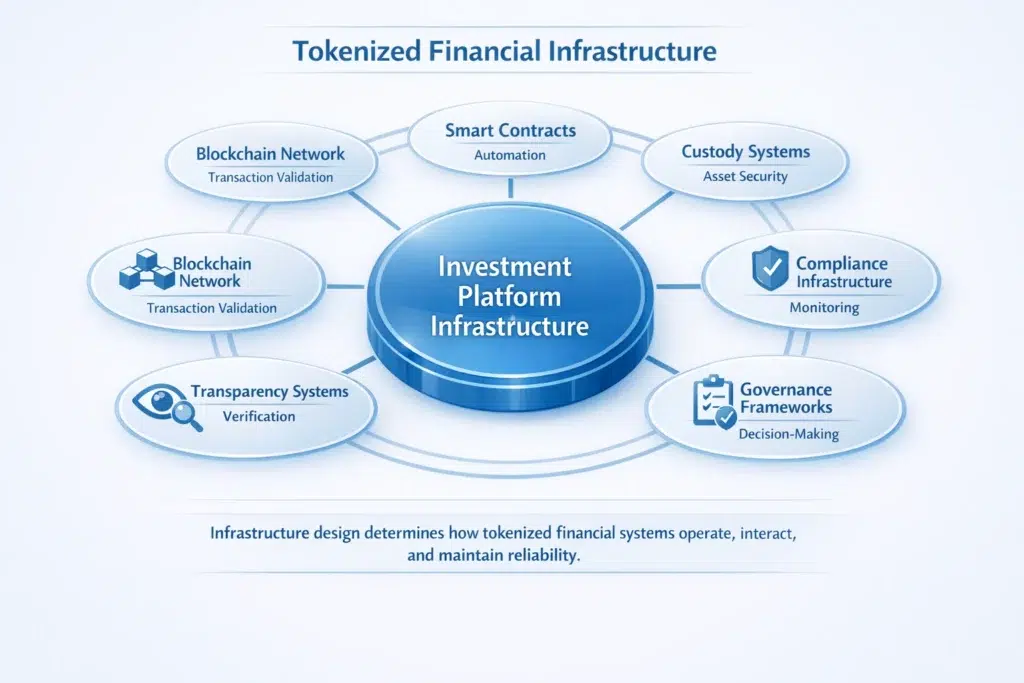
Understanding why infrastructure design matters in tokenized finance begins with a practical question: what actually allows a blockchain-based financial system to function reliably over time? Tokenized investment platforms do not rely on a single technology layer. They combine distributed ledger systems, smart contracts, custody models, transaction monitoring tools, governance mechanisms, and compliance infrastructure within one operating environment. Whether that environment remains stable, transparent, and usable depends largely on infrastructure design.
This topic sits within the broader tokenized investment infrastructure pillar, where platform architecture is examined as a foundational part of blockchain-based financial systems.
In traditional markets, infrastructure is often distributed across institutions. Clearing houses, custodians, reporting entities, exchanges, and administrative intermediaries all perform separate functions. In tokenized finance, many of those functions are translated into digital systems and embedded into platform architecture. That changes the role of infrastructure. It is no longer just operational support in the background. It becomes part of the core logic through which transactions are validated, ownership is represented, decisions are executed, and records are maintained.
That is why infrastructure design matters in tokenized finance at a strategic level. Blockchain-based financial systems operate as interconnected environments rather than isolated tools. A weakness in one layer can affect the reliability of others. A governance mechanism may depend on smart contract execution. A transparency system may depend on ledger design and data visibility. A compliance process may depend on whether monitoring tools can be integrated into transactional workflows. Infrastructure design shapes those relationships from the start.
To understand the broader architecture behind these systems, see How Tokenized Investment Platforms Are Built. For a more detailed breakdown of individual layers, see Core Components of a Tokenized Investment Platform, Smart Contracts in Tokenized Investment Infrastructure, and Security Layers in Tokenized Investment Platforms.
Transparency and verification also interact directly with infrastructure design. For related context, see What Is On-Chain Transparency? and What Is Proof of Reserve in Blockchain Systems?.
This article explains why infrastructure design matters in tokenized finance by examining twelve strategic implications that influence system reliability, security, transparency, governance, and institutional compatibility.
In Simple Terms
Infrastructure design determines how a tokenized financial platform actually works in practice.
When infrastructure is well designed, transactions can be processed accurately, digital assets can be managed more securely, governance rules can be enforced automatically, and transparency tools can support independent verification. Compliance systems can also operate more effectively when they are built into the platform instead of added later as an afterthought.
When infrastructure is weak, the opposite tends to happen. Processes become fragmented, controls are harder to enforce, and operational vulnerabilities become more difficult to manage. In tokenized finance, infrastructure is not a secondary technical detail. It is part of the system’s functional foundation.
Strategic Implications of Infrastructure Design in Tokenized Finance
Implication 1: Infrastructure Determines System Reliability
The first reason why infrastructure design matters in tokenized finance is system reliability.
Tokenized platforms rely on distributed networks that process transactions continuously. That sounds straightforward in theory, but in practice reliability depends on whether the infrastructure can maintain consistent validation, synchronized data, and uninterrupted service under changing conditions. If the architecture is weak, even ordinary transaction activity can create instability. If it is strong, the platform is better positioned to maintain consistent operations across different levels of demand.
Reliable infrastructure supports:
- stable network validation
- predictable transaction settlement
- continuous access to platform services
Because distributed systems must keep records aligned across multiple participants or nodes, infrastructure design has a direct effect on operational resilience. Reliability is not only about uptime. It also concerns whether the system can maintain integrity when transaction volume rises or when conditions become less predictable.
Implication 2: Infrastructure Architecture Enables Security Design
Security is another major reason why infrastructure design matters in tokenized finance.
In blockchain-based financial systems, security cannot be treated as a separate layer added after deployment. It needs to be integrated into the architecture from the beginning. Access controls, cryptographic protections, contract execution rules, permission structures, and monitoring systems all depend on how infrastructure is arranged and connected.
Security layers embedded within infrastructure may include:
- smart contract audit mechanisms
- access control systems
- custody protection models
- monitoring and alerting tools
For a deeper discussion of these safeguards, see Security Layers in Tokenized Investment Platforms.
Infrastructure design therefore determines not only whether protections exist, but whether they work together in a coherent way. Security becomes much harder to manage when core system components were not designed to support it from the outset.
Implication 3: Infrastructure Enables Automated Financial Execution
Another reason why infrastructure design matters in tokenized finance is its role in automation.
Tokenized platforms often rely on programmable infrastructure where smart contracts execute predefined financial rules. Those rules may govern transfers, treasury functions, token issuance, settlement conditions, or the execution of governance outcomes. The ability to automate these processes depends on whether the surrounding infrastructure can support reliable contract deployment, execution, and verification.
Smart contract infrastructure may support:
- automated transaction execution
- rule-based asset transfers
- programmable governance processes
Further explanation can be found in Smart Contracts in Tokenized Investment Infrastructure.
Automation can reduce manual intervention, but only when the infrastructure around it is designed carefully. Otherwise, the presence of automation may simply accelerate poorly designed processes instead of improving them.
Implication 4: Infrastructure Supports Asset Tokenization
Asset representation is another area where infrastructure design matters in tokenized finance.
In tokenized systems, tokenization converts traditional assets or rights into digitally represented units that can be issued, transferred, and tracked on blockchain-based infrastructure. That process requires more than a token standard alone. It depends on issuance mechanisms, transfer logic, ownership records, and administrative controls that are all supported by infrastructure architecture.
Tokenization infrastructure may support:
- digital asset issuance
- fractional ownership representation
- token transfer management
These functions are important because tokenized finance is not only about digitizing value. It is about building systems that can manage digitally represented rights in a way that remains operationally coherent and auditable.
Implication 5: Infrastructure Enables Transparent Financial Records
Transparency is often described as one of the defining strengths of blockchain systems, which is another reason why infrastructure design matters in tokenized finance.
Distributed ledgers can create visible, timestamped, and verifiable records of transactions. But transparency is not automatic in every practical sense. Infrastructure design determines what data is recorded, how that data is structured, and whether it can be accessed or interpreted effectively by relevant participants.
For deeper analysis of this topic, see What Is On-Chain Transparency?.
In other words, transparent infrastructure is not only about storing records on a blockchain. It is about designing a system where financial activity can be traced and examined in a meaningful way.
Implication 6: Infrastructure Supports Verification Systems
Verification mechanisms further illustrate why infrastructure design matters in tokenized finance.
Some platforms may incorporate reserve verification systems or other mechanisms that help observers assess whether digital assets correspond to stated reserves, balances, or structural backing arrangements. These mechanisms rely on infrastructure that can support accurate data generation, record consistency, and cryptographic validation.
Proof-of-reserve systems are one example. For more detail, see What Is Proof of Reserve in Blockchain Systems?.
Verification frameworks strengthen transparency and accountability, but only when infrastructure is capable of supporting them in a reliable and coherent manner.
Implication 7: Infrastructure Enables Governance Coordination
Governance coordination is another important reason why infrastructure design matters in tokenized finance.
Many tokenized investment platforms include governance systems through which participants can submit proposals, vote, and trigger predefined actions. These processes are not only legal or organizational in nature. They also depend on infrastructure. Proposal systems, voting mechanisms, execution logic, and access rights all need a technical framework that can record decisions and apply them consistently.
Infrastructure may support governance by enabling:
- proposal submission systems
- voting mechanisms
- automated decision execution
In some contexts, these structures resemble DAO-style governance models, where collective decision-making is coordinated through coded rules and digital participation. For broader context, see What Is a DAO in Investment Structures?.
Good infrastructure helps governance processes remain consistent. Weak infrastructure makes governance harder to administer and harder to trust.
Implication 8: Infrastructure Enables Compliance Monitoring
Regulatory monitoring is another reason why infrastructure design matters in tokenized finance.
Platforms operating in digital financial environments may need to integrate identity verification, transaction review, monitoring logic, and reporting tools into the system itself. If infrastructure does not support those functions, compliance becomes fragmented or heavily manual, which can weaken operational oversight.
Compliance infrastructure may include:
- identity verification systems
- transaction monitoring tools
- reporting mechanisms
Infrastructure design determines whether these processes can operate effectively alongside blockchain transaction flows. For broader context, see Why Compliance Matters in Tokenized Finance.
This becomes especially important when tokenized platforms aim to interact with more formal regulatory or institutional environments.
Implication 9: Infrastructure Supports Risk Monitoring
Risk monitoring is another critical implication of infrastructure design in tokenized finance.
Digital financial systems may incorporate tools that examine blockchain transaction data, identify unusual patterns, and support operational oversight. These tools are only as effective as the infrastructure around them. Monitoring systems require access to the right data, consistent inputs, and architectural compatibility with other platform components.
Monitoring infrastructure can support:
- anomaly detection
- transaction analytics
- operational oversight
In some cases, these functions may also involve advanced analytics. For further explanation, see AI in Risk Management Infrastructure.
When infrastructure supports risk monitoring effectively, it becomes easier to maintain platform stability and identify operational weaknesses early.
Implication 10: Infrastructure Enables Interoperability
Interoperability is another reason why infrastructure design matters in tokenized finance.
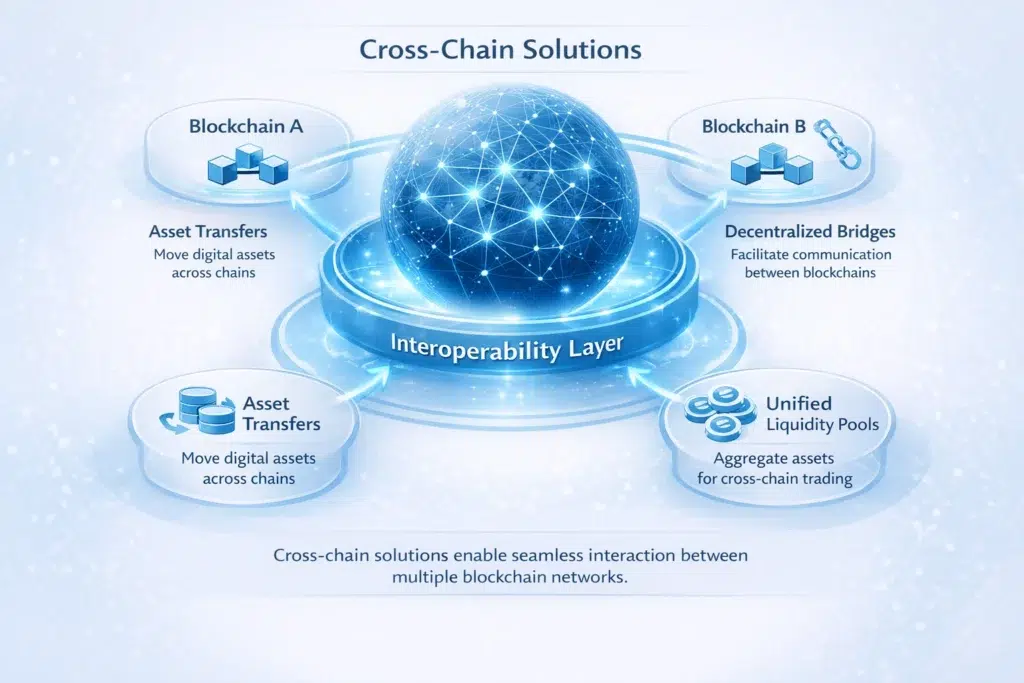
Tokenized platforms rarely operate in complete isolation. They often need to connect with exchanges, custody tools, reporting environments, identity verification providers, data sources, and other external systems. Those interactions depend on APIs, communication standards, and system compatibility.
Infrastructure therefore needs to support:
- application programming interfaces (APIs)
- cross-platform communication protocols
- interoperability standards
If interoperability is weak, tokenized systems may struggle to connect with the broader financial environment. If it is well designed, the platform becomes easier to integrate into surrounding operational ecosystems.
Implication 11: Infrastructure Determines System Scalability
Scalability represents another major implication of why infrastructure design matters in tokenized finance.
Blockchain networks and digital platforms must often handle increasing transaction volumes as participation grows. Infrastructure architecture determines how efficiently the system can expand without introducing unacceptable latency, performance degradation, or operational instability.
Scalability considerations include:
- transaction throughput
- network latency
- computational capacity
Infrastructure that cannot scale effectively may limit platform growth, reduce usability, and create friction for both participants and administrators. This is one reason infrastructure design has strategic importance rather than merely technical importance.
Implication 12: Infrastructure Determines Institutional Compatibility
Institutional compatibility represents a final reason why infrastructure design matters in tokenized finance.
Institutional participants and regulators tend to assess financial infrastructure through practical criteria such as reliability, transparency, governance integration, reporting capability, and compliance alignment. Infrastructure architecture therefore influences whether a tokenized platform can operate in ways that are compatible with more formal financial environments.
Infrastructure may need to support:
- verifiable transaction records
- audit compatibility
- regulatory reporting mechanisms
International organizations including the Bank for International Settlements (BIS), the International Monetary Fund (IMF), and the Organisation for Economic Co-operation and Development (OECD) have examined how blockchain infrastructure interacts with financial regulation and institutional oversight.
In practice, infrastructure design affects whether tokenized systems remain isolated technical experiments or become structurally compatible with broader financial frameworks.
Why Infrastructure Design Is a Strategic Issue
Understanding why infrastructure design matters in tokenized finance requires looking beyond isolated technical features. Infrastructure is strategic because it shapes how the entire system behaves under real operating conditions.
Failures in infrastructure can create broader risks. Vulnerabilities in custody design, execution logic, governance coordination, or monitoring architecture may lead to disruptions, weak controls, or reduced operational trust. In tokenized systems, those risks are often interconnected rather than isolated.
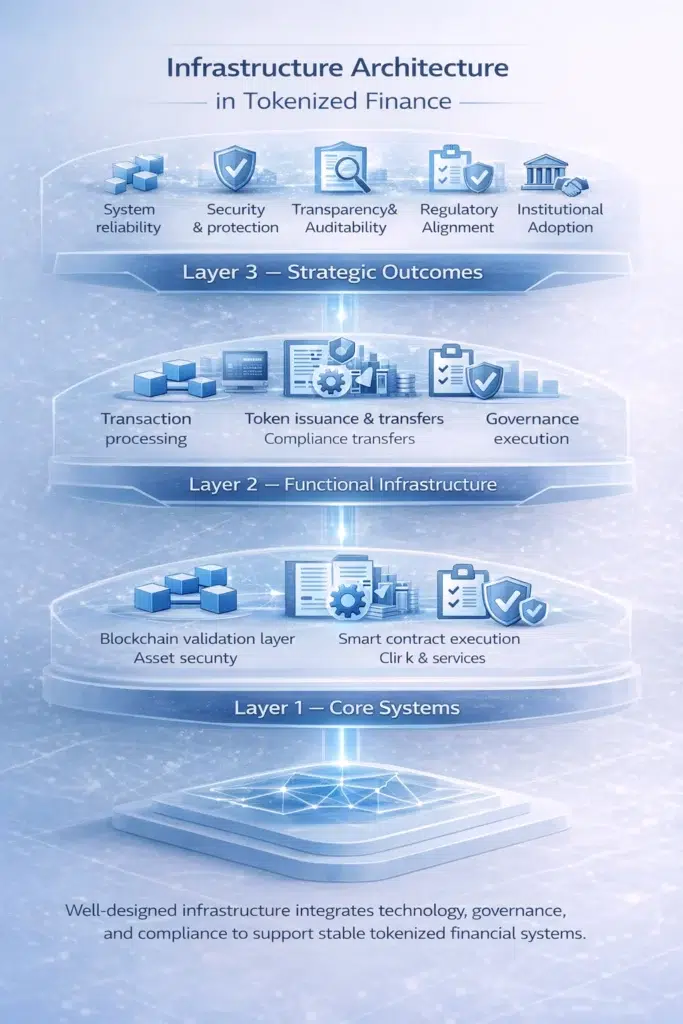
That is why infrastructure design should be understood as part of the system’s strategic foundation. Well-designed infrastructure integrates security safeguards, transparency mechanisms, monitoring tools, governance processes, and compliance layers into one coherent framework.
Institutional Perspective
Institutions evaluating tokenized financial infrastructure typically focus on operational and structural questions rather than promotional claims.
These may include:
- infrastructure reliability
- transparency architecture
- security protections
- governance integration
- compliance monitoring
Organizations such as the BIS and IMF have studied how blockchain systems may affect financial infrastructure and regulatory oversight. Their work consistently highlights the importance of governance, transparency, risk controls, and institutional integration when evaluating digital financial environments.
Explore Infrastructure Design in More Detail
- How Tokenized Investment Platforms Are Built
- Core Components of a Tokenized Investment Platform
- Smart Contracts in Tokenized Investment Infrastructure
- Security Layers in Tokenized Investment Platforms
Related Infrastructure and Governance Topics
- What Is On-Chain Transparency?
- What Is Proof of Reserve in Blockchain Systems?
- AI in Risk Management Infrastructure
- What Is a DAO in Investment Structures?
- Why Compliance Matters in Tokenized Finance
Frequently Asked Questions
Why does infrastructure design matter in tokenized finance?
Infrastructure design determines how transactions are processed, how assets are represented, how governance operates, how monitoring functions are integrated, and how transparency mechanisms work in practice.
What infrastructure supports tokenized investment platforms?
Tokenized platforms may rely on blockchain networks, smart contracts, custody systems, monitoring tools, compliance layers, governance mechanisms, and data integration frameworks.
How do smart contracts influence infrastructure?
Smart contracts automate predefined financial rules, but their reliability depends on the infrastructure that supports deployment, execution, auditing, and system integration.
Can poor infrastructure design create financial risks?
Yes. Weak infrastructure architecture may introduce vulnerabilities affecting reliability, security, governance execution, monitoring capability, and operational continuity.
How do regulators and institutions evaluate blockchain infrastructure?
They often examine transparency systems, governance controls, monitoring capability, operational safeguards, record verification, and compatibility with reporting and compliance expectations.
Conclusion
Understanding why infrastructure design matters in tokenized finance requires examining the interconnected layers that support blockchain-based financial systems. These layers influence transaction validation, asset representation, automation, governance coordination, verification, monitoring, and institutional compatibility.
Well-designed infrastructure allows tokenized investment platforms to function with greater reliability, clarity, and structural coherence. Poorly designed infrastructure does the opposite. It increases friction, weakens control, and makes the system harder to trust.
For that reason, infrastructure design should be treated as a foundational strategic issue in tokenized finance rather than a secondary technical consideration.
Educational Disclaimer
This article is provided for informational and educational purposes only. It does not constitute financial, legal, or investment advice. Infrastructure design and regulatory treatment vary depending on jurisdiction and implementation structure. Professional consultation should be sought before participating in blockchain-based investment systems.