


Security Layers in Tokenized Investment Platforms: 16 Critical Robust Safeguards
Introduction
Understanding security layers in tokenized investment platforms is essential for evaluating how blockchain-based financial infrastructure protects digital assets, transaction integrity, and governance systems. Tokenized investment platforms combine distributed ledger technology, smart contract automation, custody infrastructure, and compliance mechanisms into a unified investment environment.
Because these platforms manage financial transactions and digital asset ownership, security architecture must address multiple categories of risk. These risks may include smart contract vulnerabilities, unauthorized access, network disruptions, data manipulation, and operational failures. To mitigate such risks, tokenized platforms implement multiple protective mechanisms distributed across different layers of the infrastructure.
Unlike traditional financial systems that rely primarily on institutional intermediaries to maintain security, blockchain-based investment infrastructure integrates cryptographic protection, automated contract logic, distributed network validation, and monitoring tools directly into the system design. These mechanisms collectively form the security layers in tokenized investment platforms that protect the operational environment.
Understanding security layers in tokenized investment platforms also requires examining how these safeguards interact with platform architecture and governance frameworks. Security protections must operate alongside transaction validation systems, compliance infrastructure, and monitoring tools.
For broader context on tokenized platform architecture, see how tokenized investment platforms are built.
Additional platform components related to security layers in tokenized investment platforms are explained in core components of tokenized investment platforms, smart contract infrastructure, and why infrastructure design matters in tokenized finance.
Transparency and verification mechanisms that interact with security infrastructure include on-chain transparency and proof-of-reserve systems.
This article explains security layers in tokenized investment platforms by examining sixteen safeguards that collectively support secure operation of blockchain-based investment systems.
In Simple Terms
Security in tokenized investment systems does not rely on a single protective mechanism.
Instead, security layers in tokenized investment platforms combine multiple safeguards such as:
- blockchain network protection
- smart contract code auditing
- digital asset custody systems
- identity verification mechanisms
- transaction monitoring infrastructure
- governance safeguards
Each safeguard protects a different part of the platform. Together they form the security architecture protecting tokenized investment infrastructure.
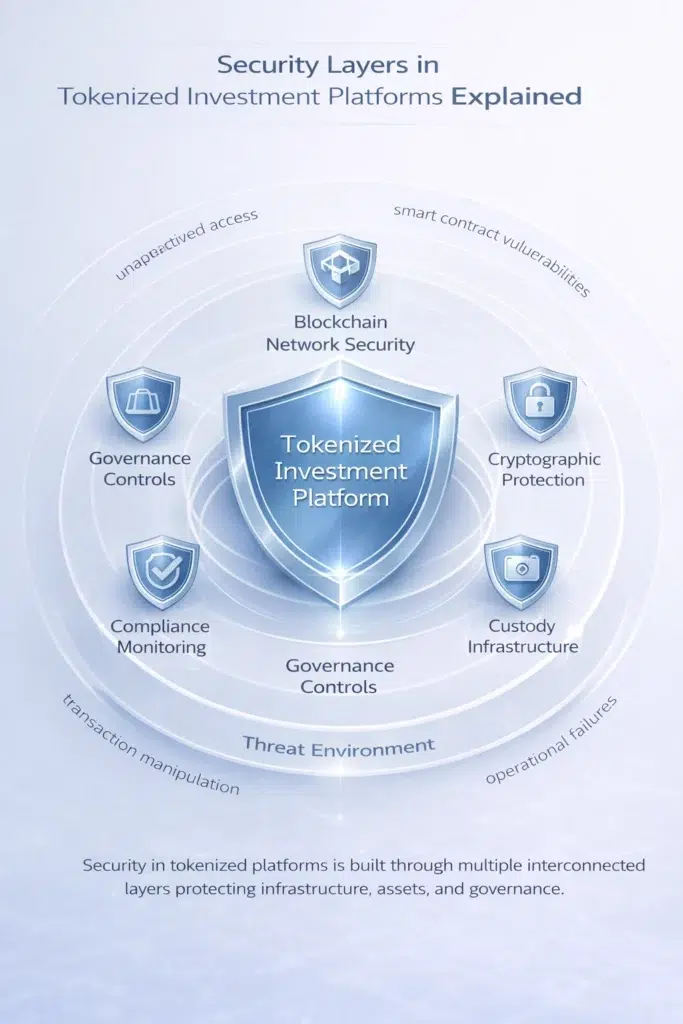
Security Layers in Tokenized Investment Platforms
Safeguard 1: Blockchain Network Security
The foundation of security layers in tokenized investment platforms begins with the blockchain network itself.
Blockchain networks rely on distributed validation systems where multiple nodes confirm transactions. Consensus mechanisms ensure that transactions cannot be altered once recorded in the ledger.
Because the ledger is distributed across many nodes, it becomes significantly more difficult for a single actor to manipulate transaction records.
This distributed design forms the structural foundation of blockchain financial system security.
Safeguard 2: Cryptographic Transaction Integrity
Cryptographic systems represent another essential component of security layers in tokenized investment platforms.
Transactions are authenticated using digital signatures generated by private keys. These cryptographic signatures verify that the transaction originated from the authorized account holder.
Additionally, hashing algorithms ensure that transaction data cannot be modified without detection.
These cryptographic protections maintain data integrity throughout the blockchain infrastructure.
Safeguard 3: Smart Contract Code Audits
Smart contracts play a critical role in tokenized platforms, which is why security layers in tokenized investment platforms often include formal code audits.
Code audits involve independent security specialists reviewing the contract code to identify vulnerabilities before deployment.
These reviews may identify issues such as:
- logic errors
- access control weaknesses
- reentrancy vulnerabilities
Smart contract auditing helps reduce the risk of unintended contract behavior. For further context, see smart contract infrastructure.
Safeguard 4: Smart Contract Access Controls
Access control mechanisms represent another critical safeguard within security layers in tokenized investment platforms.
Smart contracts may contain administrative functions that control upgrades, parameter adjustments, or governance execution.
Access control systems ensure that only authorized participants can execute these administrative actions.
These protections help prevent unauthorized modifications to platform logic.
Safeguard 5: Multi-Signature Authorization
Multi-signature authorization mechanisms strengthen security layers in tokenized investment platforms by requiring multiple approvals before executing certain transactions.
For example, treasury transfers may require approval from multiple signatories before funds are moved.
This safeguard prevents a single compromised account from executing high-value transactions.
Multi-signature authorization therefore acts as a governance-level protection mechanism.
Safeguard 6: Digital Asset Custody Security
Asset custody systems represent another essential component of security layers in tokenized investment platforms.
Custody infrastructure protects private keys that control digital asset ownership.
Security mechanisms may include:
- hardware security modules
- multi-party computation systems
- secure key storage environments
Institutional custody systems often incorporate additional safeguards designed to protect digital asset access.
Safeguard 7: Identity Verification Systems
Identity verification mechanisms can also support security layers in tokenized investment platforms.
Platforms may integrate identity verification systems that validate user eligibility before granting access to certain investment functions.
These systems help prevent unauthorized access and support regulatory compliance requirements.
Safeguard 8: Compliance and Regulatory Monitoring
Regulatory monitoring plays an important role in security layers in tokenized investment platforms.
Compliance systems may track transaction activity to detect suspicious patterns or unauthorized transactions.
Monitoring infrastructure may support regulatory requirements such as anti-money laundering procedures and reporting obligations.
These compliance safeguards strengthen the legal integrity of tokenized investment systems.
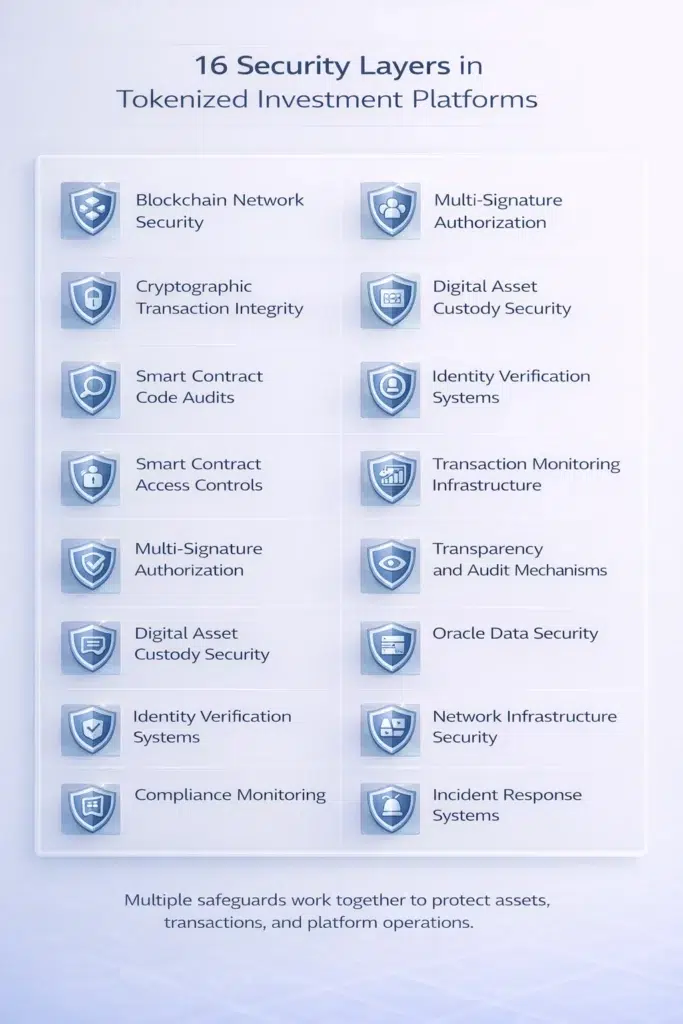
Safeguard 9: Transaction Monitoring Infrastructure
Transaction monitoring tools represent another protective element within security layers in tokenized investment platforms.
Blockchain analytics systems analyze transaction flows to identify unusual activity.
Monitoring tools may detect:
- abnormal transaction patterns
- rapid asset transfers
- suspicious address activity
These tools allow platforms to investigate potential security incidents.
Safeguard 10: Transparency and Audit Mechanisms
Transparency mechanisms contribute to security layers in tokenized investment platforms by enabling independent verification of transaction records.
Public blockchain ledgers allow observers to review transaction histories directly.
For further discussion, see on-chain transparency.
Additionally, verification systems such as proof-of-reserve mechanisms may help demonstrate asset backing.
These transparency systems create verifiable audit trails.
Safeguard 11: Oracle Data Security
Some smart contracts depend on external data sources to execute financial logic. These external systems are known as oracles.
Oracle security therefore forms part of security layers in tokenized investment platforms.
Secure oracle systems verify external data before transmitting it to smart contracts.
Because incorrect data could trigger unintended contract execution, oracle reliability is a critical infrastructure concern.
Safeguard 12: Network Infrastructure Security
Network infrastructure protections represent another element of security layers in tokenized investment platforms.
Blockchain nodes must maintain reliable connectivity to validate transactions and synchronize data across the network.
Security measures may include:
- node monitoring systems
- infrastructure redundancy
- network performance protection
These safeguards help maintain operational stability.
Safeguard 13: Platform Access Management
Access management systems control who can interact with platform infrastructure.
Within security layers in tokenized investment platforms, access management may include:
- role-based permissions
- authentication procedures
- account recovery safeguards
Access control helps prevent unauthorized users from interacting with sensitive platform functions.
Safeguard 14: Automated Risk Monitoring Systems
Advanced monitoring tools support security layers in tokenized investment platforms by analyzing operational data.
Some platforms integrate artificial intelligence tools that analyze blockchain transaction activity. For further context, see AI in risk management infrastructure.
Safeguard 15: Incident Response and Recovery Systems
Incident response systems represent another essential safeguard within security layers in tokenized investment platforms.
Platforms must prepare procedures for responding to security incidents, including system failures or attempted attacks.
Safeguard 16: Governance Security Controls
Governance safeguards protect decision-making mechanisms within tokenized platforms.
Within security layers in tokenized investment platforms, governance security may include proposal validation systems, voting integrity mechanisms, and rule enforcement.
Why Multi-Layer Security Matters
Understanding security layers in tokenized investment platforms requires recognizing that financial infrastructure faces multiple categories of risk.
These risks may involve technical vulnerabilities, operational failures, governance manipulation, and regulatory compliance failures.
Because risks originate from different areas, security architecture must address multiple layers simultaneously.
For broader discussion, see infrastructure design in tokenized finance.
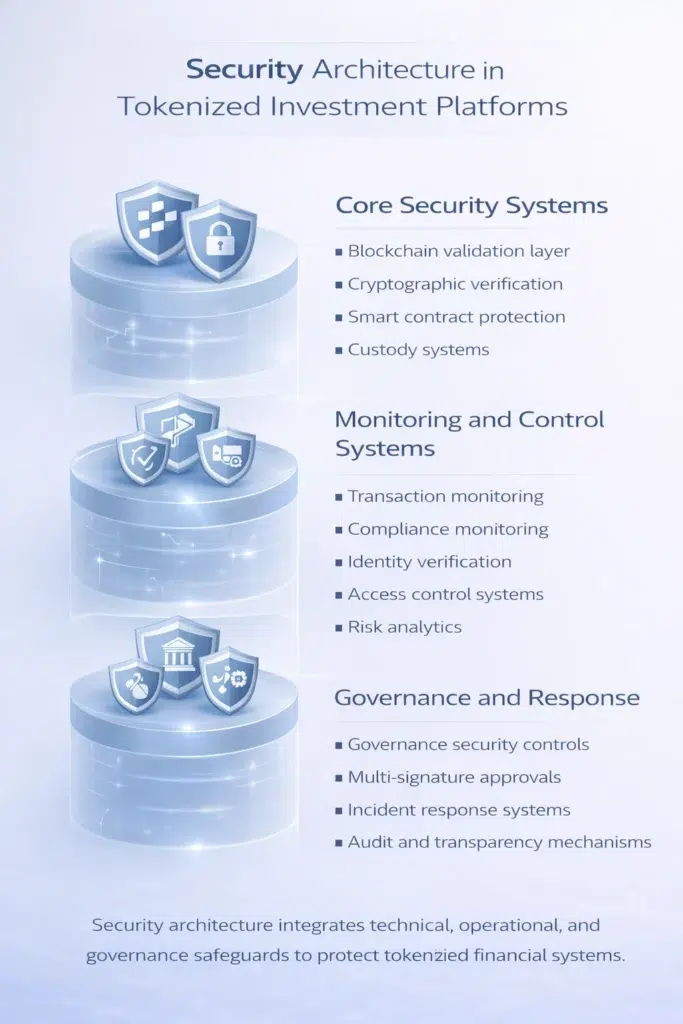
Institutional Perspective
Institutions evaluating security layers in tokenized investment platforms typically examine several factors.
- smart contract audit practices
- custody infrastructure reliability
- monitoring systems
- governance security mechanisms
- regulatory compliance integration
Global institutions such as Bank for International Settlements, International Monetary Fund, and OECD have studied blockchain infrastructure risks.
Conclusion
Security layers in tokenized investment platforms form a multi-dimensional protective architecture that supports secure operation of blockchain-based financial systems.
Educational Disclaimer
This article is provided for educational purposes only and does not constitute financial, legal, or investment advice.