


How AI Is Used in Investment Infrastructure: 14 Essential Strategic Applications
This article is the cornerstone guide of the Investment Infrastructure pillar, explaining how AI is used in investment infrastructure across fourteen strategic applications from financial data analysis and fraud detection to ESG data processing, legacy system modernization, predictive analytics, and blockchain transaction oversight.
Educational Notice
This article is provided for informational and educational purposes only. It does not constitute legal, financial, or investment advice. The design and implementation of AI systems within financial infrastructure vary by jurisdiction and institutional framework. Professional advice should be sought before relying on any financial technology system.
Introduction
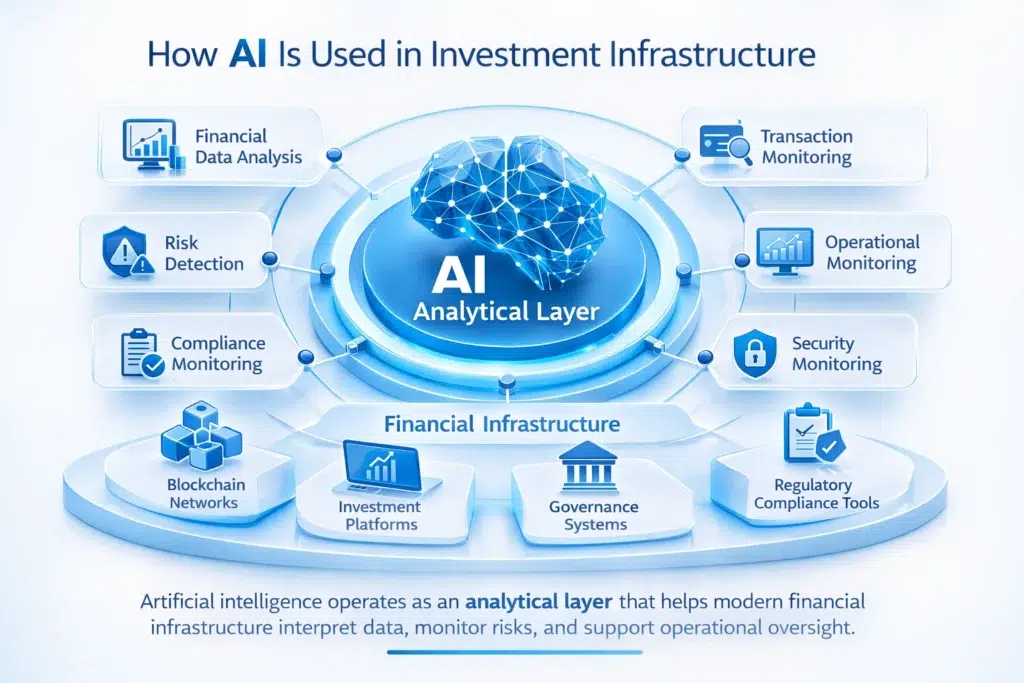
Understanding how AI is used in investment infrastructure requires examining how artificial intelligence technologies operate within modern financial systems. This is not a story about replacing human judgment with machines. It is a story about how analytical tools are being woven into the fabric of financial infrastructure to handle data volumes, monitoring tasks, and pattern recognition at scales no human team could sustain alone.
Artificial intelligence does not function as an isolated technology within financial platforms. Instead, how AI is used in investment infrastructure is best understood as a set of specialized applications, each addressing a specific operational need: monitoring transactions, analyzing risk signals, processing compliance data, evaluating portfolios, modernizing legacy systems, and processing ESG (Environmental, Social, and Governance: a framework for evaluating a company or investment’s non-financial impact and sustainability credentials) data that institutional investors now demand at scale.
For the broader environment where these systems operate, see the Investment Infrastructure pillar. For how AI compares with traditional systems, see AI vs Rule-Based Systems in Investment Platforms. For risk-specific applications, see What Role Does AI Play in Risk Management Infrastructure? For transparency requirements, see Why AI Requires Transparency in Financial Infrastructure.
The Bank for International Settlements (BIS) and the IMF have both published research examining how AI and digital technologies influence financial stability and infrastructure governance. Their consistent message is that understanding how AI is used in investment infrastructure is essential for responsible institutional adoption.
In Simple Terms: How AI Is Used in Investment Infrastructure
Here is the clearest way to think about how AI is used in investment infrastructure. Before AI, a large financial institution operated like a giant Paper Filing Cabinet. If you needed to find a specific risk signal buried somewhere in a million transaction records, you had to hire ten people to physically search through a thousand folders. It was slow, people got tired, and they missed things. The cabinet held all the information but it could not think.
AI transforms that filing cabinet into a Smart Digital Brain. The system reads every folder instantly. But more importantly, it does not just find things when you ask it to. It proactively tells you: “These five folders over here look suspicious. The pattern across accounts 312, 517, and 891 matches a fraud signature from six months ago. You should check them now.” The infrastructure has not just become faster. It has become intelligent.
How AI is used in investment infrastructure can be summarized simply: AI helps financial platforms analyze financial data, monitor transactions and system activity, detect operational risks, support compliance monitoring, process ESG signals, modernize legacy systems, and improve oversight consistency. AI does not replace governance or regulatory oversight. It amplifies the analytical capacity of the institutions that maintain them, turning a passive filing cabinet into an active analytical partner.
How AI Is Used in Investment Infrastructure: 14 Strategic Applications
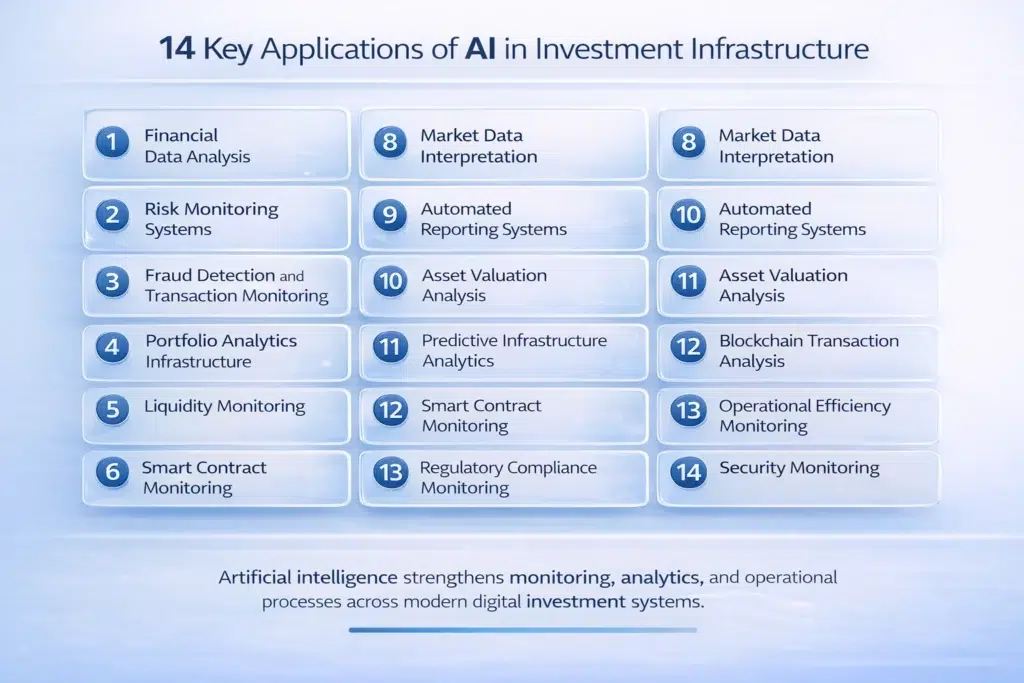
Application 1: Financial Data Analysis
Financial systems generate enormous volumes of data from trading activity, transaction flows, blockchain records, market feeds, and operational systems every second. Understanding how AI is used in investment infrastructure begins here, because data analysis is the foundation on which all other applications rest. Machine learning models (AI systems that improve their analytical accuracy by learning from new data rather than following fixed rules) can identify patterns, anomalies, and trends across datasets that are too large and fast-moving for manual review. This data processing capability makes how AI is used in investment infrastructure fundamentally different from traditional analytics, which relied on humans to define what patterns to look for in advance.
Application 2: Risk Monitoring Systems
Risk monitoring is a central component of financial infrastructure. AI models can analyze transaction activity, liquidity changes, and market signals to identify emerging risk patterns across fraud risk, market risk, liquidity risk, cybersecurity risk, and operational risk simultaneously. A real-world example of how AI is used in investment infrastructure at institutional scale is BlackRock’s Aladdin system (Aladdin: Asset, Liability, Debt, and Derivative Investment Network, a risk management and operating platform used by BlackRock and hundreds of institutional clients to monitor portfolio risk across trillions in assets). Aladdin processes enormous volumes of market and portfolio data daily to generate risk signals that portfolio managers use for decision-making. This demonstrates how AI is used in investment infrastructure not as a theoretical concept but as operational infrastructure at the highest institutional levels. For a deeper analysis of AI risk functions, see What Role Does AI Play in Risk Management Infrastructure?
Application 3: Fraud Detection and Transaction Monitoring
Financial systems must monitor transactions continuously to detect suspicious behavior, potential fraud, and money laundering patterns. How AI is used in investment infrastructure for fraud detection involves analyzing transaction patterns and Behavioral Signals (patterns of account or transaction behavior that deviate significantly from established baselines) across large datasets that rule-based systems cannot monitor comprehensively. AI fraud detection identifies complex multi-step patterns that evolve over time, unlike fixed rules that only flag pre-defined conditions. A rule might flag any transaction over a threshold. An AI model might flag a sequence of small transactions across multiple accounts at unusual hours that individually appear normal but collectively signal structured fraud.
Application 4: Portfolio Analytics Infrastructure
Investment platforms manage diversified portfolios across multiple assets and markets. How AI is used in investment infrastructure for portfolio analytics involves analyzing portfolio exposure, tracking asset allocation patterns, and evaluating Asset Correlations (statistical relationships between different investment returns that determine how much diversification a portfolio actually provides) across changing market conditions. These systems provide continuous analytical visibility into portfolio risk profiles that traditional periodic reporting cannot match in speed or granularity.
Application 5: Liquidity Monitoring
Liquidity management plays an essential role in financial stability. AI models can analyze transaction volumes, market flows, and capital movement patterns to identify Liquidity Stress Signals (indicators suggesting that an institution may struggle to meet short-term financial obligations) before they escalate into operational crises. These insights help platforms detect liquidity imbalances earlier than traditional monitoring methods, giving risk teams time to respond rather than react. The 2008 financial crisis demonstrated how rapidly liquidity stress can cascade through interconnected financial systems when early warning systems fail.
Application 6: Smart Contract Monitoring
Blockchain-based investment systems rely on Smart Contracts (self-executing programs on a blockchain that automatically implement predefined conditions without human intermediaries) to automate financial processes. How AI is used in investment infrastructure for smart contract monitoring involves analyzing execution logs and on-chain activity to detect unusual patterns, unexpected triggering conditions, or potential vulnerabilities before they cause financial harm. These systems frequently operate alongside transparency frameworks. For context, see On-Chain Transparency Explained and the Smart Contract glossary term.
Application 7: Regulatory Compliance Monitoring and RegTech
Investment platforms must comply with financial regulations, reporting standards, and transaction monitoring requirements across multiple jurisdictions. RegTech (Regulatory Technology: the application of AI to help financial institutions meet regulatory compliance requirements more efficiently and accurately) is one of the fastest-growing dimensions of how AI is used in investment infrastructure. AI compliance systems analyze large volumes of transaction data, flag AML (Anti-Money Laundering) and KYC (Know Your Customer: identity verification requirements for financial system participants) anomalies for human review, and maintain consistent monitoring across datasets that would overwhelm manual compliance teams. AI supports compliance teams but does not replace regulatory obligations or governance oversight. For regulatory context, see Why Compliance Matters in Tokenized Finance.
Application 8: Market Data Interpretation
Modern investment infrastructure relies on real-time financial data streams from multiple exchanges, OTC (Over-the-Counter: direct trading between parties without a centralized exchange) markets, and blockchain networks simultaneously. AI systems can analyze market activity across multiple data sources and identify patterns that may indicate emerging trends, volatility signals, or structural market shifts. These analytical models assist infrastructure systems in interpreting large volumes of market information faster than human analysts can process manually, particularly in high-frequency trading environments where milliseconds matter.
Application 9: Automated Reporting Systems
Financial institutions must regularly generate operational, risk, and regulatory reports. How AI is used in investment infrastructure for automated reporting involves organizing datasets, classifying transactions, and producing structured outputs that meet regulatory formatting requirements. AI reduces the manual effort involved in report generation and improves consistency across reporting periods, reducing the risk of human error in compliance-critical documents. This is particularly valuable for institutions operating across multiple regulatory jurisdictions with different reporting standards and deadlines.
Application 10: Asset Valuation Analysis
Asset valuation requires analyzing multiple variables including historical performance, market comparable data, income projections, and macroeconomic context. How AI is used in investment infrastructure for valuation analysis involves processing these multi-variable datasets and generating analytical outputs that support human valuation decisions. These models must be used cautiously because financial markets remain unpredictable and model outputs are probabilistic estimates, not certainties. AI hallucinations (fabricated outputs confidently presented as fact) represent a particular risk for any AI system involved in valuation or reporting functions.
Application 11: Predictive Infrastructure Analytics
Some AI systems use Predictive Analytics (the use of historical data patterns to generate probabilistic forecasts about future events) to anticipate market volatility, liquidity changes, or operational stress before they materialize. This is the shift from reactive monitoring (seeing that a crash happened) to predictive monitoring (seeing the signals that lead to a crash 48 hours before it happens). Predictive models may provide Early Warning Signals (patterns that have historically preceded stress events) that give risk teams actionable advance notice. These models must always account for Model Drift (degradation of predictive accuracy as market conditions change from those the model was trained on).
Application 12: Blockchain Transaction Analysis
AI can analyze blockchain transaction activity to identify patterns across decentralized networks that may indicate fraud, market manipulation, or compliance concerns. These systems monitor wallet behavior, transaction flows, and asset movements within blockchain environments. Transparency tools such as Proof of Reserve mechanisms complement AI analysis by providing verifiable records of asset reserves, creating an end-to-end picture of both the underlying data and the analytical layer examining it.
Application 13: Modernizing Legacy Infrastructure with AI
Most institutional investors and financial firms are not starting from scratch. They are adding AI capabilities to Legacy Infrastructure (existing older financial systems, often built on technology decades old, that remain operationally critical but lack modern data processing capabilities). How AI is used in investment infrastructure in this context is less about replacing the old system and more about building a modern analytical layer on top of it: connecting legacy transaction systems to AI monitoring tools through APIs (Application Programming Interfaces: standardized connection points that allow different software systems to exchange data), enabling modern risk analytics and fraud detection without requiring a full system replacement. This Legacy Integration approach is the most common real-world path to AI adoption in institutional finance.
Application 14: AI in ESG Data Processing
Institutional investment is increasingly governed by ESG (Environmental, Social, and Governance) criteria. Asset managers, sovereign wealth funds, and pension funds must now evaluate thousands of corporate sustainability reports, regulatory filings, supply chain disclosures, and third-party ESG ratings. How AI is used in investment infrastructure for ESG data processing involves analyzing these large, heterogeneous (mixed-format, mixed-source) datasets to extract genuine sustainability signals. AI can identify discrepancies between self-reported ESG claims and independent data sources (energy records, supply chain data, regulatory violations), providing institutional investors with a more objective analytical foundation for ESG-based allocation decisions than manual review could achieve at scale.
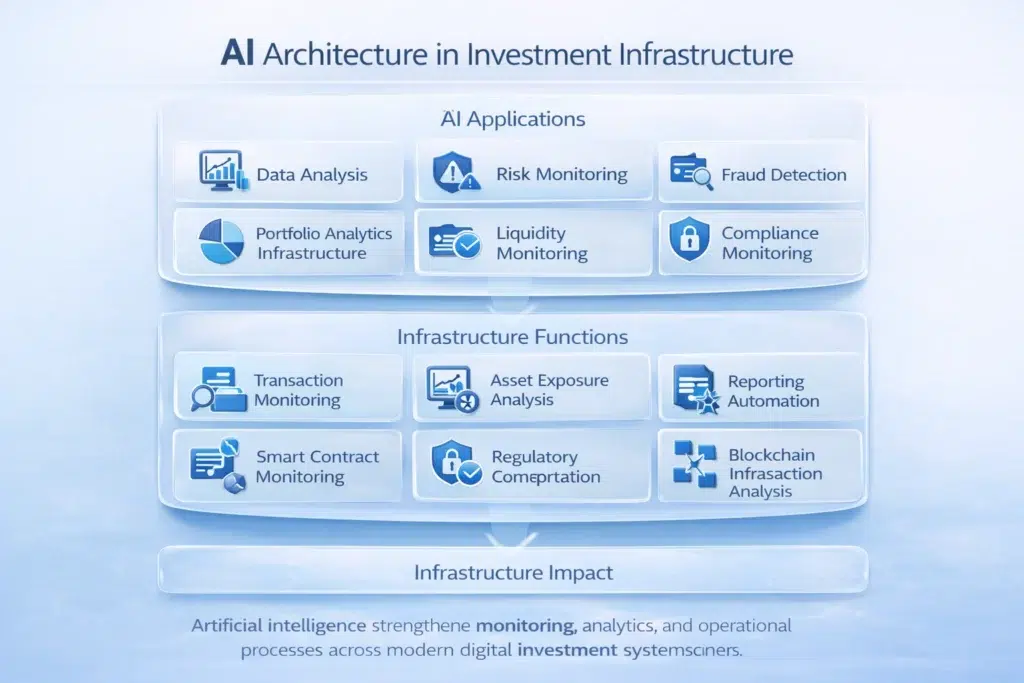
Architecture Snapshot: How AI Is Used in Investment Infrastructure
| Application Area | AI Function | Infrastructure Impact |
|---|---|---|
| Risk Monitoring (e.g. Aladdin) | Pattern detection and predictive analytics | Earlier signal detection across risk categories |
| Fraud Detection | Behavioral anomaly and transaction analysis | Adaptive detection beyond fixed rules |
| RegTech / Compliance | AML/KYC anomaly flagging at dataset scale | Consistent monitoring, reduced compliance cost |
| Legacy Modernization | AI analytical layer added via API to old systems | Modern analytics without full infrastructure rebuild |
| ESG Data Processing | Cross-referencing self-reported vs independent data | Objective ESG signal extraction at scale |
| Blockchain Analysis | Wallet behavior and flow pattern monitoring | On-chain transparency and compliance support |
| Predictive Analytics | Early warning signals 48 hours before events | Proactive prevention vs reactive response |
Why Understanding How AI Is Used in Investment Infrastructure Matters
Understanding how AI is used in investment infrastructure helps investors, regulators, and technology developers evaluate how modern financial platforms operate. Artificial intelligence influences several key infrastructure dimensions: financial data interpretation, risk monitoring capabilities, transparency mechanisms, operational efficiency, compliance consistency, and the integration of ESG data into investment decision frameworks. For governance considerations, see Why AI Requires Transparency in Financial Infrastructure. For structural constraints, see Limitations of AI in Investment Infrastructure Explained.
3 Steps to Start Using AI in Your Investment Infrastructure
Understanding how AI is used in investment infrastructure is one thing. Knowing where to start implementing it is another. Most institutions follow a practical three-step sequence when integrating AI into existing financial systems.
The first step is Audit and Prioritize. Before deploying any AI system, institutions identify which functions generate the most analytical pain: which monitoring tasks are consuming the most manual effort, which risk categories are producing the most false positives, and which compliance processes are creating the most bottlenecks. This audit maps directly to the 14 applications above and identifies the highest-value starting point for AI integration.
The second step is Start With Legacy Integration. Rather than rebuilding infrastructure from scratch, most institutions start by adding an AI analytical layer to their existing systems through APIs. This approach, covered in Application 13 above, delivers modern analytics without the cost and risk of a full system rebuild. It is the most common real-world entry point into how AI is used in investment infrastructure at institutional scale.
The third step is Implement Human-in-the-Loop Governance. Before any AI system goes live in a regulated financial environment, institutions establish HITL (Human-in-the-Loop: a governance model where AI provides analytical outputs but humans retain decision authority at defined checkpoints) oversight frameworks. This means AI flags, surfaces, and analyzes. Humans validate, decide, and bear accountability. The EU AI Act’s High-Risk classification of financial services AI makes this governance structure a legal requirement in the EU, not just a best practice.
Institutional Perspective
Institutions evaluating how AI is used in investment infrastructure typically examine transparency of AI models (can the system explain its outputs?), governance oversight mechanisms (who is accountable for automated decisions?), infrastructure security, regulatory compliance alignment including EU AI Act High-Risk requirements, and training data reliability. The BIS, IMF, and OECD all highlight that responsible deployment of how AI is used in investment infrastructure requires institutional governance frameworks that combine AI capabilities with human oversight.
Frequently Asked Questions
How is AI used in investment infrastructure?
How AI is used in investment infrastructure spans fourteen strategic applications: financial data analysis, risk monitoring (including real-world systems like BlackRock’s Aladdin), fraud detection, portfolio analytics, liquidity monitoring, smart contract oversight, RegTech compliance, market data interpretation, automated reporting, asset valuation, predictive analytics, blockchain transaction analysis, legacy system modernization, and ESG data processing. AI functions as an analytical and monitoring layer, not a replacement for governance or human oversight.
What is a real-world example of AI in investment infrastructure?
BlackRock’s Aladdin system is one of the most widely cited real-world examples of how AI is used in investment infrastructure at institutional scale. Aladdin processes portfolio and market data across trillions in assets managed by BlackRock and hundreds of institutional clients, generating risk signals that portfolio managers use for daily decision-making. It demonstrates how AI is used in investment infrastructure not as a theoretical concept but as core operational technology at the world’s largest asset manager.
What are the 3 steps to start using AI in investment infrastructure?
The three practical steps are: first, Audit and Prioritize (identify which monitoring functions generate the most analytical pain); second, Start With Legacy Integration (add an AI analytical layer to existing systems via APIs rather than rebuilding from scratch); third, Implement Human-in-the-Loop Governance (establish HITL oversight frameworks where AI flags and humans decide before going live in regulated environments).
Does AI replace human oversight in financial systems?
No. How AI is used in investment infrastructure is always within a Co-pilot model: AI provides the analytical layer and humans provide the governance, judgment, and accountability layer. The EU AI Act’s classification of financial services AI as High-Risk formalizes the requirement for human oversight as a legal standard, not just a best practice.
How is AI used in ESG data processing for investment infrastructure?
How AI is used in investment infrastructure for ESG data processing involves analyzing corporate sustainability reports, regulatory filings, supply chain disclosures, and third-party ESG ratings to extract genuine sustainability signals. AI can cross-reference self-reported ESG claims against independent data sources to identify discrepancies, providing institutional investors with a more objective analytical foundation for ESG-based allocation decisions than manual review could achieve at scale.
What are the limitations of AI in financial infrastructure?
AI models may suffer from model drift, generate hallucinations (fabricated outputs), produce false positives or false negatives, and face interpretability challenges. A complete analysis can be found in Limitations of AI in Investment Infrastructure Explained.
Conclusion
Understanding how AI is used in investment infrastructure requires examining the many operational roles artificial intelligence plays within modern financial platforms. The Paper Filing Cabinet has become a Smart Digital Brain. The infrastructure not only stores and retrieves information but actively analyzes it, flags suspicious patterns, predicts stress events 48 hours in advance, and processes ESG signals at scales no human team could match.
The fourteen applications in this guide span financial data analysis, risk monitoring, fraud detection, compliance, portfolio analytics, predictive analytics, legacy modernization, and ESG processing. Together they represent the current frontier of how AI is used in investment infrastructure. When implemented responsibly, with Human-in-the-Loop governance, Explainable AI transparency, and active monitoring for model drift, artificial intelligence can genuinely strengthen the stability, transparency, and operational efficiency of modern investment infrastructure.
Sources and Regulatory References
- Bank for International Settlements (BIS): https://www.bis.org
- International Monetary Fund (IMF): https://www.imf.org
- Organisation for Economic Co-operation and Development (OECD): https://www.oecd.org
Educational Disclaimer
This article is provided for educational purposes only and does not constitute legal, financial, or investment advice. The design and implementation of AI systems within financial infrastructure vary by jurisdiction and institutional framework. Professional advice should be sought before relying on any financial technology system.
Last updated: March 2026
Explore AI in Investment Infrastructure
- AI in Investment Infrastructure Explained
- What Role Does AI Play in Risk Management Infrastructure?
- Limitations of AI in Investment Infrastructure Explained
- Why AI Requires Transparency in Financial Infrastructure
- AI vs Rule-Based Systems in Investment Platforms
- On-Chain Transparency Explained (cross-pillar)
- Transparency Reduces Risk in Tokenized Assets (cross-pillar)
- Why Compliance Matters in Tokenized Finance (cross-pillar)
- How Regulation Improves Transparency in Tokenized Finance (cross-pillar)
- Investment Infrastructure Hub