


Why Blockchain Is Used for Transparency in Investment Systems: 13 Critical Reasons
Introduction
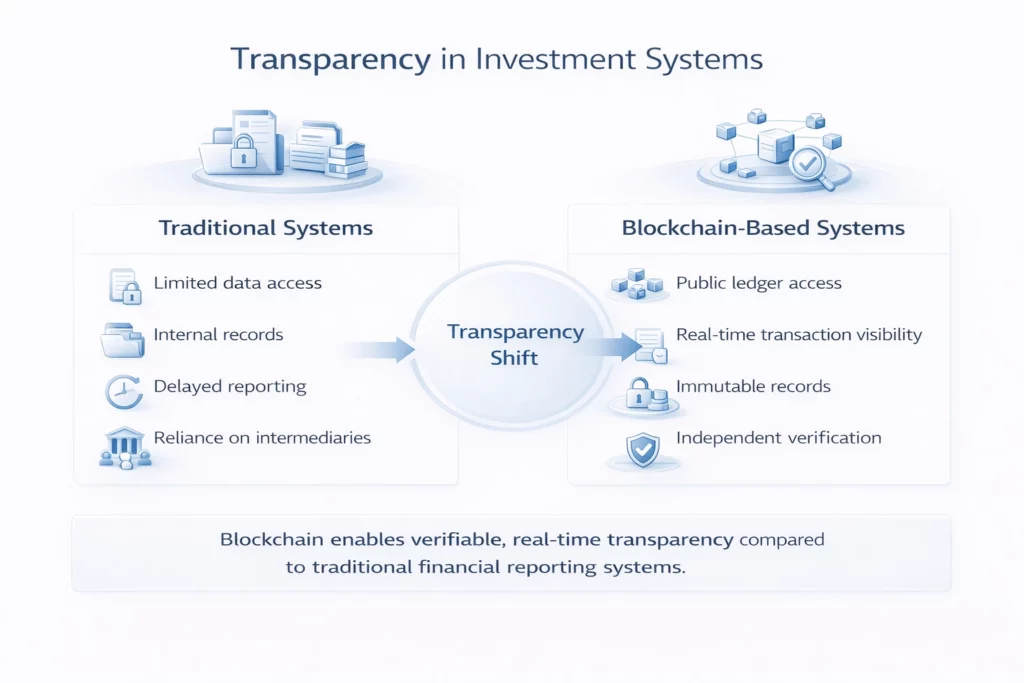
Understanding why blockchain is used for transparency in investment systems requires examining how distributed ledger technology changes the structure of financial recordkeeping. Transparency has long been a core principle of investment governance. Traditional systems usually rely on audits, regulatory filings, third-party administrators, institutional reporting, and internal controls to create oversight. Blockchain-based systems introduce a different transparency model, one rooted in public ledgers, cryptographic validation, and persistent transaction records.
The question of why blockchain is used for transparency in investment systems is not really about technological hype or marketing language. It is about structural design. Blockchain infrastructure changes how transactions are recorded, how data is verified, and how records are accessed. In tokenized finance and digital investment platforms, this shift affects accountability, auditability, supervisory visibility, and the way transaction history can be reviewed over time.
At the same time, blockchain transparency should not be misunderstood. Visibility at the ledger level does not eliminate regulatory obligations, legal risk, operational complexity, or market volatility. It functions as a transparency layer within broader governance and compliance frameworks rather than as a standalone solution.
For foundational context within the Infrastructure & Transparency pillar, see what is on-chain transparency, public ledgers and transparency in tokenized platforms, what is proof of reserve in blockchain systems, and how tokenized investment platforms are built.
This article explains why blockchain is used for transparency in investment systems through thirteen structured, authoritative reasons while maintaining a neutral and compliance-aware perspective.
In Simple Terms
Blockchain is used in investment systems because it can:
- record transactions on a shared ledger
- make historical records difficult to alter
- allow independent verification
- create structured audit trails
These characteristics strengthen transparency architecture, especially when investors, auditors, or supervisors need visibility into transaction history. However, blockchain does not replace regulation, governance discipline, legal enforceability, or proper reporting standards.
Reason 1: Immutable Record Keeping
The first structural reason explaining why blockchain is used for transparency in investment systems is immutability.
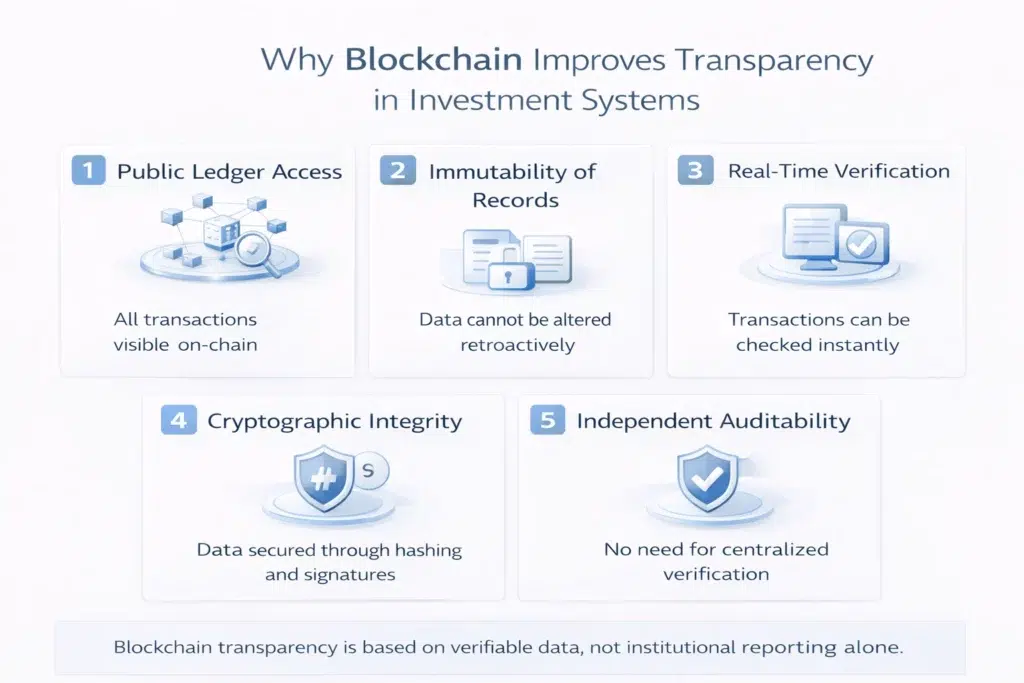
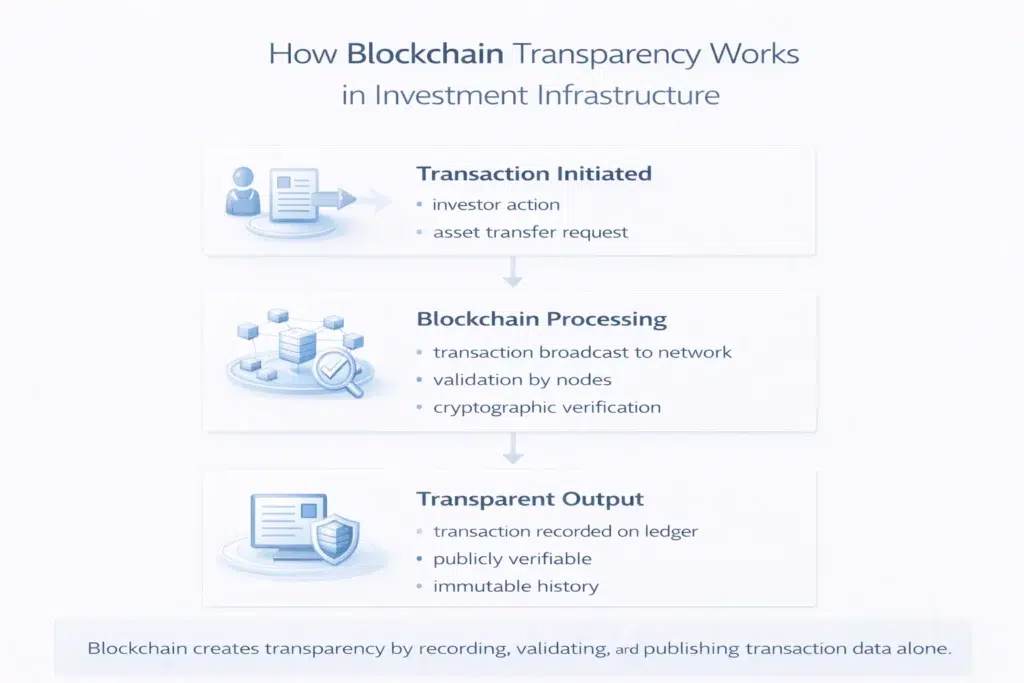
Blockchain ledgers operate as append-only systems. Once transactions are validated and added to a block, they become part of a sequential record linked to earlier entries. Altering historical records would require rewriting subsequent blocks and, in many systems, achieving consensus across network participants.
This immutability enhances:
- historical integrity
- audit trail permanence
- long-term accountability
In investment systems, immutable records reduce the risk of undisclosed retroactive modification. That matters in any environment where transaction history affects ownership claims, treasury accounting, or governance review.
Still, immutability has limits. It does not prevent mistakes, poor inputs, or flawed instructions. What it does is make corrections visible rather than silent. That distinction is important. Blockchain improves transparency of change; it does not guarantee perfection of process.
Reason 2: Distributed Verification
A second reason clarifying why blockchain is used for transparency in investment systems is distributed verification.
Instead of relying on a single centralized database, blockchain networks replicate transaction records across multiple nodes. Each node participates in validation through consensus mechanisms. This means transaction integrity is not dependent on one institution alone maintaining the ledger.
Distributed verification:
- reduces reliance on single-point control
- increases resilience against unilateral manipulation
- enables independent confirmation of transactions
This changes the transparency model from institution-dependent verification to network-based validation. In practical terms, it means a transaction can be confirmed through the architecture of the system itself rather than only through internal reporting by a single operator.
Reason 3: Real-Time Transaction Visibility
Traditional investment reporting often follows periodic disclosure cycles. Blockchain systems operate differently.
A third structural reason explaining why blockchain is used for transparency in investment systems is near real-time visibility. Transactions recorded on public blockchains can often be observed shortly after confirmation, allowing investors, analysts, and oversight participants to review activity continuously rather than waiting for periodic reports.
This continuous availability supports:
- immediate transaction tracking
- treasury monitoring
- token transfer analysis
Real-time visibility improves oversight capacity, especially in digital investment systems where transfers, allocations, and treasury movements may occur frequently. But visibility should not be confused with interpretation. Blockchain may show what moved and when, yet it does not automatically explain why a transaction occurred or whether it complied with off-chain obligations.
Reason 4: Cryptographic Integrity
Cryptographic security forms another critical reason why blockchain is used for transparency in investment systems.
Blockchain transactions rely on:
- digital signatures
- hash functions
- public-private key cryptography
These mechanisms help ensure that transactions cannot be forged without valid credentials and that record integrity can be checked mathematically. This strengthens confidence in the authenticity of the recorded data.
Transparency supported by cryptography is structurally different from transparency based only on institutional disclosure. In conventional systems, participants may trust the records because a regulated institution reports them. In blockchain systems, participants can also examine whether data integrity is supported by the underlying cryptographic model.
Reason 5: Independent Third-Party Auditability
Blockchain systems can enable independent analysis without requiring platform permission.
This independent auditability is a key factor in understanding why blockchain is used for transparency in investment systems. External observers can:
- review transaction histories
- analyze token movements
- verify smart contract activity
For deeper infrastructure explanation, see public ledgers and transparency in tokenized platforms.
Permissionless verification reduces reliance on centralized disclosure intermediaries. That said, it does not eliminate the need for formal audits. Audits examine broader accounting questions, control systems, liabilities, reconciliations, and off-chain obligations that raw transaction visibility alone cannot resolve.
Reason 6: Reduction of Information Asymmetry
Information asymmetry occurs when one party has access to more information than another.
Blockchain transparency may reduce asymmetry by providing shared visibility into transaction-level data. This reduction is another structural reason explaining why blockchain is used for transparency in investment systems.
Participants may be able to observe:
- governance transactions
- token transfers
- treasury movements
- execution activity from smart contracts
That visibility can improve confidence in the reporting environment, especially when combined with governance structures and formal disclosures. However, blockchain data does not automatically reveal strategic intent, off-chain agreements, or the legal meaning of every transaction. So while information asymmetry may be reduced, it is rarely removed entirely.
Reason 7: Support for Proof of Reserve Mechanisms
Proof of reserve systems depend heavily on blockchain visibility.
The ability to verify wallet balances publicly is a foundational reason why blockchain is used for transparency in investment systems. Proof of reserve mechanisms use public ledger data to confirm asset holdings or reserve balances associated with a platform or asset structure.
For detailed discussion, see what is proof of reserve in blockchain systems.
Without blockchain-based visibility, independent reserve verification would be more difficult and far more dependent on internal statements. Even so, proof of reserve has limitations. It may show assets, but not necessarily full liabilities, legal claims, or off-chain obligations. Blockchain supports the transparency mechanism, but it does not complete the full picture by itself.
Reason 8: Enhanced Treasury and Fund Flow Monitoring
In tokenized platforms, treasury wallets may hold funds allocated for investment, governance, liquidity, or operations.
Blockchain transparency makes it possible to:
- monitor treasury flows
- track governance-approved spending
- verify fund allocation
For architecture context, see how tokenized investment platforms are built.
Treasury transparency increases accountability because movement of funds can be reviewed directly rather than inferred only through reporting summaries. This can be particularly important in tokenized investment systems where fund movement and governance execution are closely connected.
At the same time, blockchain monitoring does not automatically determine whether fund usage complied with legal agreements or board-level mandates. It shows the movement. Governance and compliance still determine whether the movement was proper.
Reason 9: Programmable Transparency via Smart Contracts
Smart contracts automate logic directly on blockchain networks, which introduces a form of programmable transparency.
This is another reason why blockchain is used for transparency in investment systems. Smart contracts can:
- emit event logs
- enforce rule-based transfers
- record governance votes
- make execution outcomes visible on-chain
For further explanation, see how smart contracts support investment infrastructure.
Programmable transparency means that certain rules and outcomes are visible in the system itself rather than being reported only after the fact. This can improve auditability and reduce uncertainty around execution behavior. It is especially useful where financial processes are automated and repeated frequently.
Reason 10: Cross-Border Traceability
Investment systems often operate across jurisdictions, counterparties, and technical environments.
Blockchain networks function globally, allowing transactions to be observed across geographic boundaries. This cross-border traceability contributes to understanding why blockchain is used for transparency in investment systems because it standardizes transaction visibility in environments where reconciliation might otherwise be fragmented.
Cross-border traceability can help with:
- consistent transaction review
- multi-jurisdiction reporting support
- reduced reconciliation friction between institutions
Even so, legal jurisdiction remains tied to regulatory frameworks rather than to the network itself. Blockchain can improve shared visibility, but it does not resolve cross-border legal interpretation on its own.
Reason 11: Data Standardization and Interoperability
Blockchain protocols often rely on standardized transaction formats and data structures.
This standardization enhances interoperability across platforms, wallets, analytics tools, and supervisory systems. It is another structural reason why blockchain is used for transparency in investment systems.
Consistent formatting can support:
- automated analysis
- cross-platform verification
- machine-readable transaction monitoring
Uniform data structure makes transparency more useful because visibility alone is less powerful when data is inconsistent or difficult to compare. Standardization helps turn visible records into analyzable records.
That said, interoperability still depends on design choices. Different networks, token standards, and smart contract architectures may create differences in how well this works in practice.
Reason 12: Regulatory Reporting Support Potential
Regulators generally prioritize traceability, auditability, and record integrity.
The Bank for International Settlements emphasizes transparency and monitoring in digital finance environments. The International Monetary Fund highlights supervisory integration in financial innovation. The OECD has also examined governance coordination in blockchain-related systems.
Blockchain transparency may support regulatory objectives by providing detailed transaction histories and clearer traceability. This regulatory reporting support potential helps explain why blockchain is used for transparency in investment systems.
However, the distinction remains important: blockchain can support regulatory reporting, but it does not replace licensing, disclosure standards, supervisory enforcement, or legal compliance obligations.
Reason 13: Continuous Monitoring and AI Integration
Modern investment infrastructure increasingly incorporates automated monitoring systems.
Blockchain’s structured and traceable data format can support integration with AI-driven analytics and automated oversight tools. Continuous monitoring systems may:
- detect anomalies
- track transaction patterns
- flag unusual wallet behavior
- identify potential control breaches
For related discussion, see AI in risk management infrastructure.
This compatibility with automated oversight is another reason why blockchain is used for transparency in investment systems. Structured transaction data is often easier to analyze continuously than fragmented manual reports. In that sense, blockchain transparency can strengthen the technical basis for modern monitoring architecture.
Blockchain Transparency vs Traditional Reporting
Blockchain transparency complements rather than replaces traditional reporting.
For structured comparison, see on-chain vs off-chain transparency.
Traditional reporting provides structured financial statements, board-level disclosures, regulatory filings, and audited summaries. Blockchain provides transaction-level visibility, cryptographic audit trails, and a continuous record of activity. These are not identical functions.
Effective investment governance often combines both approaches. Institutional reporting remains essential because investors and regulators still require legal documents, liability analysis, financial statements, and compliance disclosures. Blockchain adds a visibility layer, but it does not substitute for the broader architecture of accountability.
Limitations and Structural Constraints
While explaining why blockchain is used for transparency in investment systems, its limitations must also be acknowledged.
Important constraints include:
- complex data interpretation
- pseudonymous identity structures
- off-chain contractual dependencies
- privacy trade-offs
- legal enforceability boundaries
Blockchain transparency enhances visibility, but it does not guarantee responsible governance, financial discipline, or market stability. Data may be public while still being difficult to interpret. Records may be visible while still failing to explain legal rights or economic intent. In other words, transparency improves oversight conditions, but it does not complete governance on its own.
Institutional Perspective
Institutions evaluating blockchain transparency tend to focus on several structural questions:
- verifiability
- reliability
- regulatory integration
- supervisory compatibility
- operational resilience
From an institutional perspective, transparency is one layer within comprehensive investment infrastructure. Its practical value depends on how it is integrated with compliance systems, reporting frameworks, governance discipline, and supervisory oversight.
This is why blockchain is often viewed not as a complete answer, but as a structural improvement in record visibility and traceability.
Frequently Asked Questions
Why is blockchain considered transparent?
Because transactions and smart contract activity can be publicly verified on distributed ledgers.
Does blockchain guarantee transparency in investment systems?
No. It provides structural visibility but does not eliminate off-chain opacity or governance risk.
Can blockchain replace financial audits?
No. Audits assess broader financial statements, controls, and liabilities beyond transaction records.
Why do regulators examine blockchain traceability?
Because traceability can support oversight, AML monitoring, and audit facilitation.
Is blockchain transparency always public?
Public blockchains provide open visibility. Permissioned networks may restrict access.
Conclusion
Understanding why blockchain is used for transparency in investment systems requires analyzing thirteen structural reasons, including immutability, distributed verification, cryptographic integrity, independent auditability, and near real-time visibility.
Blockchain strengthens transparency architecture within tokenized and digital investment infrastructure. It can improve transaction-level accountability, enhance auditability, and support oversight mechanisms in environments where visibility matters.
However, blockchain transparency does not eliminate regulatory, operational, or market risk. It functions as one structural component within broader governance, compliance, and supervisory frameworks.
Effective transparency in investment systems depends not only on ledger design, but also on disciplined implementation, regulatory integration, and institutional oversight.
Educational Disclaimer
This article is provided for informational and educational purposes only. It does not constitute legal, financial, or investment advice. Transparency frameworks, regulatory obligations, and reporting standards vary by jurisdiction and implementation design. Professional consultation should be sought before engaging with blockchain-based investment platforms.