

Examples of Real-World Assets Used in Tokenization: A Complete Educational Guide
This article is part of the broader Real-World Assets educational framework, providing a complete guide to the most important examples of real-world assets used in tokenization, organized by asset family with yield profile, liquidity characteristics, and institutional context for each category.
Educational Notice
This article is provided for informational and educational purposes only. It does not constitute financial, legal, or investment advice. Regulatory treatment of tokenized assets varies by jurisdiction and asset classification.
Introduction
Tokenization is not just for buildings. Almost anything with a legal title and a documented price can be mirrored on a blockchain as a Digital Twin. Examples of real-world assets used in tokenization span four major asset families: Real Estate, Commodities, Financial Instruments, and Luxury Collectibles. Each family has its own yield profile, liquidity characteristics, institutional audience, and tokenization structure.
Examples of real-world assets used in tokenization play a foundational role in understanding how blockchain infrastructure connects with traditional financial systems. Real-world assets include both tangible and intangible assets such as real estate, commodities, financial instruments, and business ownership rights that exist outside of blockchain systems. Tokenization records ownership and transfer rights on blockchain infrastructure without replacing the underlying legal frameworks that govern those assets.
For readers new to the concept, reviewing examples of real-world assets used in tokenization is one of the most effective ways to understand how tokenization connects traditional financial systems with modern digital infrastructure. Real-world asset tokenization does not create new assets. It creates a digital representation of assets that already exist in the physical or legal world.
If you are unfamiliar with the broader concept, start here:
The Bank for International Settlements (BIS) has noted that tokenization has the potential to modernize financial infrastructure by enabling more efficient recording and transfer of ownership rights.
In Simple Terms: Examples of Real-World Assets Used in Tokenization
Real-world assets are physical or legally recognized assets that exist outside of blockchain systems but can be represented digitally through tokenization. The most common examples of real-world assets used in tokenization include:
- Real estate properties: residential, commercial, and industrial buildings generating rental income
- Gold and commodities: physical goods with standardized value held in custody vaults
- Government bonds and financial instruments: legally enforceable debt and equity claims
- Business ownership shares: equity interests in private companies and ventures
- Infrastructure assets: energy, telecommunications, and transportation systems
- Luxury collectibles: fine art, rare vehicles, and high-value alternative assets
Tokenization involves creating a digital representation of ownership or rights associated with these assets. These digital representations, recorded on blockchain networks, can improve transparency, traceability, and efficiency in ownership tracking without replacing the legal systems beneath them.
Why Examples of Real-World Assets Used in Tokenization Matter
Understanding examples of real-world assets used in tokenization provides practical clarity on how ownership structures integrate with digital infrastructure. While the concept of tokenization can appear abstract, examining specific asset categories clarifies how traditional ownership systems interact with emerging digital frameworks. Examples help illustrate how ownership rights exist independently of technology, how blockchain can serve as a complementary record-keeping system, and how traditional asset classes are actively integrating with blockchain infrastructure.
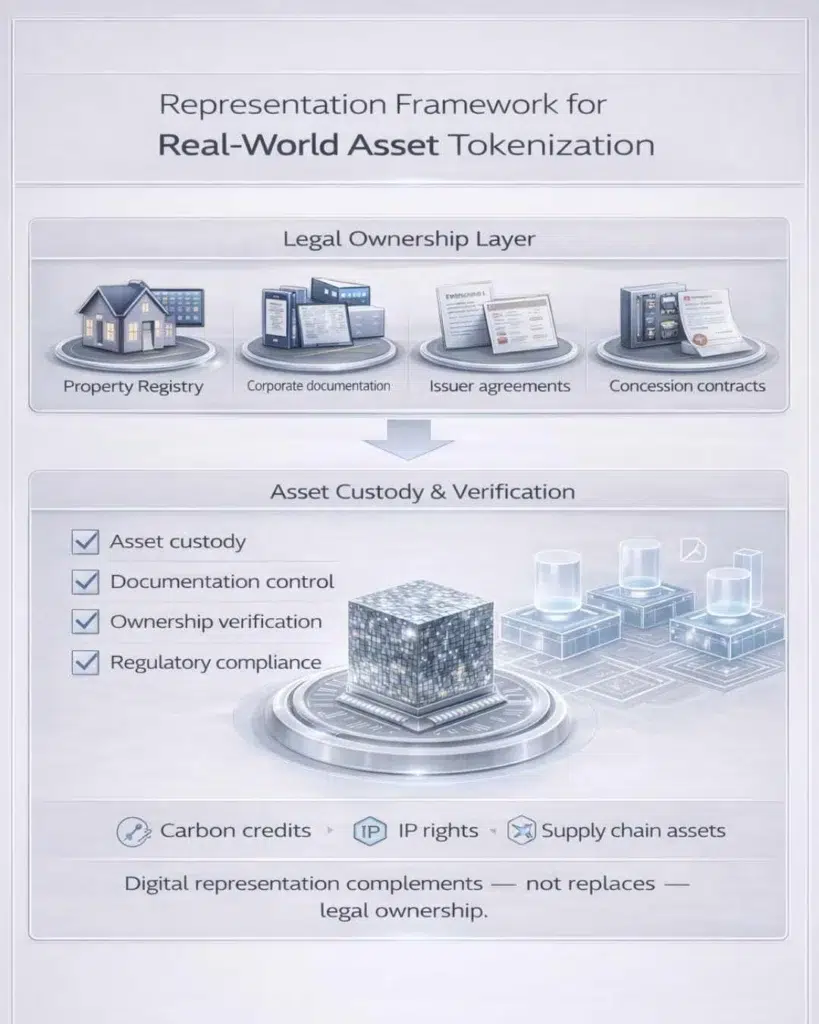
Real-world asset tokenization does not replace existing legal ownership structures. It functions alongside them to enhance transparency, verification, and transfer efficiency. The International Monetary Fund (IMF) has noted that digitization and tokenization represent part of a broader transformation in financial infrastructure. Many traditional assets can be represented digitally through real-world asset tokenization, which allows ownership or economic rights to be recorded on blockchain infrastructure.
Core Categories: Examples of Real-World Assets Used in Tokenization
The examples of real-world assets used in tokenization fall into six major categories, each with established ownership frameworks that can be represented digitally without altering their underlying legal or economic characteristics.
| Asset Category | Traditional Ownership | Real-World Yield Source | Primary Audience |
|---|---|---|---|
| Real Estate | Property registry | Rental income (NOI) | Retail and institutional |
| Commodities | Custody vault receipt | Capital appreciation / store of value | Retail and institutional |
| Bonds and Financial Instruments | Issuer contract / securities registry | Interest payments and coupons | Primarily institutional |
| Private Equity | Share registry / operating agreement | Dividends and capital gains | Primarily institutional |
| Infrastructure | Concession agreement | Contracted revenue streams | Primarily institutional |
| Luxury Collectibles | Provenance documentation | Capital appreciation on sale | Retail and high-net-worth |
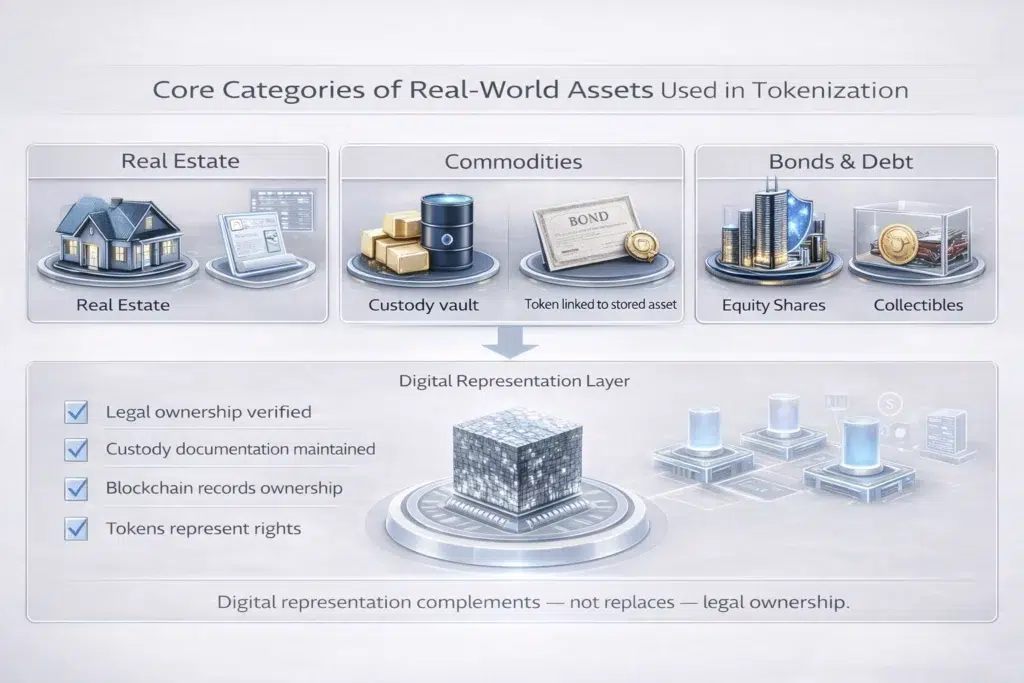
The most common examples of real-world assets used in tokenization fall into six major categories: real estate, commodities, financial instruments, business ownership and equity, infrastructure assets, and physical collectibles. Each category represents assets with established ownership frameworks that can be represented digitally without altering their underlying legal or economic characteristics.
Real Estate: The Heavyweight
Real estate is the most popular and widely discussed among examples of real-world assets used in tokenization. The reasons are straightforward: it is easy to understand, generates predictable income, and has well-established legal ownership frameworks. For context on the full range of real estate tokenization, see Tokenized Real Estate Explained.
What Makes Real Estate Suitable for Tokenization
Real estate is one of the most commonly discussed examples of real-world assets used in tokenization because ownership rights are clearly defined in government registries, legal documentation already exists in the form of title deeds and corporate ownership documents, and property valuation frameworks are well established through independent appraisers and market benchmarks.
The World Bank has emphasized that transparent property ownership systems are essential components of financial stability and economic development.
Real Estate Examples and Yield Profile
This is among the examples of real-world assets used in tokenization that appeals to both retail and institutional investors. The Real-World Yield comes from rental income: specifically NOI (Net Operating Income, total rent minus all operating expenses) distributed proportionally to token holders by smart contract.
Instead of needing $500,000 for a down payment on a building, a retail investor can buy a Digital Slice of a commercial property for as little as $50 and receive a proportional share of the monthly rental income. Specific real estate examples that may be represented digitally include apartment buildings, office towers, rental properties, hotels and hospitality facilities, and industrial warehouses.
Tokenization can represent ownership rights associated with these properties without changing the underlying asset itself. One of the most widely discussed examples of real-world assets used in tokenization is tokenized real estate, where property ownership can be divided into digital investment units through an SPV (Special Purpose Vehicle, a dedicated legal entity holding one asset).
How Real Estate Ownership Is Represented Digitally
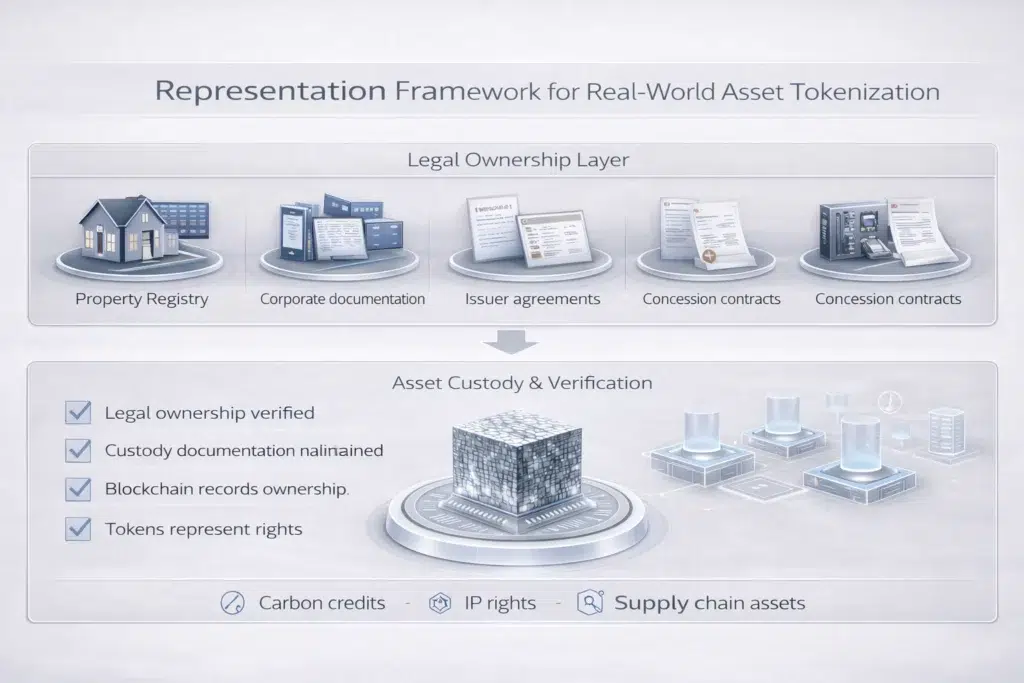
In a structured real estate tokenization model, legal ownership of a property is held by an SPV while digital tokens represent economic rights associated with that vehicle. Custody providers maintain documentation of legal ownership. Blockchain infrastructure records token transfers and ownership changes. In tokenized systems, ownership representation typically involves legal ownership verification, custody arrangements for ownership documentation, and blockchain recording of ownership rights. The blockchain acts as a digital ledger recording ownership transfers and maintaining a transparent record of transactions while the legal registry remains the Golden Record (the authoritative source of title).
Commodities: The Safe Haven
Commodities are among the most accessible examples of real-world assets used in tokenization for retail investors because they are easy to understand and have globally standardized valuations. These are physical goods with economic value traded in markets worldwide: gold, silver, crude oil, and agricultural products such as wheat or corn. For more detail, see Tokenized Commodities Explained.
Commodities possess characteristics that make them particularly compatible with tokenization: standardized valuation, physical existence with documented custody, and deep established market demand. The BIS has noted that tokenization may improve transparency in commodity ownership tracking.
Gold: The Flagship Commodity Example
Gold is the most widely referenced among commodity examples of real-world assets used in tokenization. Consider what tokenization makes possible: you can own 1 gram of a 999.9 purity gold bar (documented through Assay Metadata, the immutable record of a metal’s weight, purity grade, and serial identification) sitting in a vault and trade it instantly on your phone without ever touching the metal. Traditional gold ownership requires physical delivery, secure storage, and expensive insurance. Tokenized gold ownership requires none of that friction.
The Liquidity Profile of gold is High: it has deep global markets, standardized pricing via spot markets, and immediate demand. This contrasts directly with low-liquidity examples such as Vintage Ferraris or rare art, where finding a buyer can take months or years. The Real-World Yield from gold comes primarily from capital appreciation rather than income, making it a store-of-value holding rather than a yield-generating investment.
Other commodity examples include silver, crude oil, lithium (emerging as a critical battery metal), and agricultural products. Each follows the same tokenization structure: the physical commodity is held in a regulated custody vault, Assay Metadata documents its specifications, and tokens represent fractional ownership claims against the custodied physical asset.
Financial Instruments: The Institutional Play
Financial instruments represent the category among examples of real-world assets used in tokenization where institutional capital is most actively deploying. This is where the big money lives, and it is transforming how global banks, sovereign wealth funds, and asset managers operate.
Bonds: Government and Corporate
Bonds represent debt obligations issued by governments or corporations. Government bonds (particularly U.S. Treasury Bills or T-Bills), corporate bonds, and municipal bonds are all examples of real-world assets used in tokenization at institutional scale. Tokenized T-Bills are currently one of the most significant on-chain yield instruments: backed by the credit of national governments, they provide a near-Risk-Free rate of return accessible on blockchain infrastructure. The Real-World Yield comes from interest payments (coupons) distributed at defined intervals. The U.S. Securities and Exchange Commission (SEC) provides extensive regulatory guidance on bonds and securities ownership.
Private Credit and Loan Agreements
Private credit agreements (contracts between lenders and borrowers defining repayment obligations and ownership rights) represent another category of financial instrument examples of real-world assets used in tokenization. Corporate loans, structured financing agreements, and infrastructure financing arrangements can all be represented digitally. These are primarily Institutional-grade examples where minimum participation sizes remain high. The Real-World Yield comes from interest payments on the underlying loan.
Carbon Credits: The Fast-Growing Intangible RWA
Carbon credits are one of the fastest-growing examples of real-world assets used in tokenization. A carbon credit represents a verified right to emit one tonne of CO2 equivalent, issued under regulated schemes such as the EU Emissions Trading System or voluntary market standards. These are entirely intangible: no physical object backs them. Their value derives from legally recognized environmental compliance obligations. Tokenizing carbon credits improves market transparency, reduces double-counting fraud, and allows fractional trading of credits that were previously only accessible in large institutional lots.
Private Equity and Business Ownership
Private equity examples of real-world assets used in tokenization represent ownership shares in companies: shares in private companies, ownership stakes in startup ventures, and equity interests in established businesses. These ownership rights exist independently of blockchain systems and are primarily Institutional in their target audience, as securities regulations in most jurisdictions restrict private equity to accredited or professional investors.
The Real-World Yield comes from dividends and capital gains on eventual sale. Business ownership structures are already documented and regulated, making them structurally compatible with tokenization. The OECD has noted that corporate ownership transparency plays a critical role in financial accountability, and on-chain representation of equity provides precisely that transparency.
Intellectual Property (IP) rights including patents, trademarks, and music or film royalties represent an emerging sub-category of intangible business ownership examples of real-world assets used in tokenization. The Real-World Yield from IP royalties comes from licensing fees and usage payments that can be distributed automatically via smart contract to fractional token holders.
Infrastructure Assets
Infrastructure assets represent essential systems used in modern economies: energy facilities, telecommunications networks, and transportation infrastructure including toll roads and bridges. These assets generate predictable economic value through contracted revenue streams and are subject to established legal ownership frameworks. The IMF has emphasized that infrastructure investments play a central role in economic growth and development.
Infrastructure examples of real-world assets used in tokenization include toll road concession agreements, energy production contracts, and telecommunications infrastructure contracts. These are primarily Institutional examples given the scale of investment required and the complexity of the underlying concession structures. The Real-World Yield comes from the contracted revenue streams these assets generate over long periods.
Luxury Collectibles: The Passion Play
Physical collectibles represent examples of real-world assets used in tokenization that were once accessible only to ultra-wealthy individuals. Tokenization changes the accessibility equation dramatically. Fine art, rare watches, precious stones, and rare vehicles all share three characteristics that make them tokenizable: verifiable ownership through documented provenance, documented authenticity through expert certification, and established market value through specialist auction records.
The Liquidity Profile of luxury collectibles is Low to Very Low: finding a buyer for a specific Vintage Ferrari or a Banksy original can take months or years. This contrasts sharply with gold’s High Liquidity profile. However, the appreciation potential can be significant. A $1,000,000 classic Ferrari tokenized into 10,000 shares at $100 each means that if the car sells for $1,500,000, every token holder receives their proportional 50% gain automatically via smart contract distribution. The Real-World Yield is pure capital appreciation: no income stream, only the gain realized on eventual sale.
The Exit Liquidity challenge (finding buyers with cash at the right price) is more acute for collectibles than any other asset category. Anyone evaluating luxury collectible tokens must assess the secondary market depth of the specific platform before participating.
Emerging Examples of Real-World Assets Used in Tokenization
Beyond the established categories, emerging examples of real-world assets used in tokenization include carbon credits (covered above), intellectual property and royalty streams, supply chain assets (representing ownership of goods in transit or inventory), and data licensing agreements. These assets represent ownership rights or economic value and may be represented digitally under appropriate legal and regulatory frameworks. They signal that the RWA tokenization market is expanding beyond traditional asset classes into any legally recognizable ownership right with measurable economic value.
How These Examples Are Technically Represented
Across all examples of real-world assets used in tokenization, the technical representation follows the same four-component structure: a Token Standard (ERC-20 for fungible fractional units, ERC-721 for unique assets, ERC-1400/3643 for regulated securities with Identity-Gating), Metadata stored on decentralized systems linking the token to its legal documentation, an SPV Operating Agreement defining legal ownership rights, and a Smart Contract with Event Triggers managing income distribution and ownership transfers. For detailed technical context, see How Real-World Assets Are Represented on Blockchain.
Risks and Limitations
Examples of real-world assets used in tokenization involve important risk considerations. Regulatory risk means the classification of tokenized representations may vary depending on whether they qualify as securities, collective investment structures, or other regulated instruments under local financial law. Custody risk means ownership verification depends on secure custody of the underlying asset. Legal risk means ownership rights must remain legally enforceable independent of digital representation. Technical risk means digital systems require secure, audited smart contract infrastructure to maintain accurate ownership records. For comprehensive risk context, see Benefits and Risks of RWA Tokenization. The European Securities and Markets Authority (ESMA) provides guidance on financial asset regulation across EU markets.
FAQ: Examples of Real-World Assets Used in Tokenization
What are examples of real-world assets used in tokenization?
Examples of real-world assets used in tokenization include real estate (yield: rental income), commodities such as gold and silver (yield: capital appreciation), government bonds and T-Bills (yield: interest payments), private equity and business ownership (yield: dividends and capital gains), infrastructure concessions (yield: contracted revenue), carbon credits (intangible environmental rights), intellectual property and royalties (yield: licensing income), and luxury collectibles such as fine art and rare vehicles (yield: capital appreciation on sale).
Which RWA examples are for retail investors vs institutional investors?
Real estate fractional ownership and luxury collectibles are among the examples of real-world assets used in tokenization most accessible to retail investors, with entry points potentially as low as $50. Commodities such as gold are accessible to both. Government bonds, private equity, private credit, and infrastructure concessions are primarily Institutional examples, often restricted to accredited or professional investors under applicable securities law.
What is the liquidity difference between tokenized gold and tokenized art?
Tokenized gold has a High Liquidity profile: global spot markets, standardized pricing, and immediate buyer demand. Tokenized luxury collectibles such as Vintage Ferraris or rare art have Low Liquidity profiles: finding a buyer at the right price can take months, and the secondary market depth on most tokenization platforms for these assets is limited. Liquidity infrastructure does not create buyers where underlying market demand does not exist.
Are carbon credits real-world assets?
Yes. Carbon credits are intangible real-world assets: they have no physical form but carry legally recognized environmental compliance value within regulated schemes. They are among the fastest-growing examples of real-world assets used in tokenization because tokenization dramatically improves market transparency and reduces double-counting fraud in voluntary carbon markets.
Conclusion
The most common examples of real-world assets used in tokenization span six major categories: real estate generating rental income, commodities providing store-of-value and appreciation, financial instruments delivering interest yields, private equity and IP offering dividends and royalty income, infrastructure assets providing contracted revenue streams, and luxury collectibles offering appreciation potential with low liquidity profiles.
Understanding examples of real-world assets used in tokenization provides essential context for how ownership structures function and how financial infrastructure continues to evolve. Tokenization introduces new methods for recording ownership transparently, but the underlying assets and legal ownership frameworks remain central. Educational awareness of these asset categories and their specific yield profiles, liquidity characteristics, and institutional versus retail audience distinctions supports a clearer understanding of the full scope of the RWA tokenization market.
Sources
- Bank for International Settlements (BIS): https://www.bis.org
- World Bank: https://www.worldbank.org
- International Monetary Fund (IMF): https://www.imf.org
- U.S. Securities and Exchange Commission (SEC): https://www.sec.gov
- OECD: https://www.oecd.org
- European Securities and Markets Authority (ESMA): https://www.esma.europa.eu
Educational Disclaimer
This article is provided for educational purposes only and does not constitute financial, legal, or investment advice. Regulatory treatment of tokenized assets varies by jurisdiction and asset classification.
Last updated: March 2026
Continue Learning About Real-World Assets
- What Are Real-World Assets?
- Real-World Asset Tokenization Explained
- Tokenized Real Estate Explained
- Tokenized Commodities Explained
- Benefits and Risks of RWA Tokenization
- How Real-World Assets Are Represented on Blockchain (cluster)
- Who Verifies Real-World Assets in Tokenized Systems (cluster)
- What Is Proof of Reserve (cross-pillar)
- Why Compliance Matters in Tokenized Finance (cross-pillar)
- Real-World Assets Hub