

Why Real-World Assets Matter in Modern Finance
This article is part of the broader Real-World Assets educational framework, explaining why real-world assets matter in modern finance as the anchor and engine of global economic systems, from collateral frameworks and capital formation to institutional dependence and the $16 trillion tokenization opportunity.
Educational Notice
This article is provided for informational and educational purposes only. It does not constitute financial, legal, or investment advice. Regulatory treatment of real-world assets may vary by jurisdiction.
Introduction: The Anchor and the Engine
In a world of digital currencies and abstract algorithms, it is easy to forget what actually pays the bills. Real-world assets (RWAs) including real estate, sovereign bonds, infrastructure, commodities, and corporate equity are the Anchor and the Engine of the global economy. They are the Anchor because they provide measurable, legally enforceable value that prevents financial claims from floating free of economic reality. They are the Engine because they drive capital formation, investment, lending, and every major institutional portfolio on the planet.
Understanding why real-world assets matter in modern finance is essential for analyzing financial stability, capital markets, and institutional investment systems. These assets underpin lending systems, banking frameworks, pension portfolios, insurance structures, sovereign debt markets, and long-term capital formation. Modern financial systems do not operate independently from the real economy. Instead, they rely on asset-backed frameworks that provide measurable value, enforceable claims, and reliable collateral structures.
Why real-world assets matter in modern finance goes beyond academic classification. The world’s leading financial institutions, including BlackRock and Goldman Sachs, are no longer asking whether assets should be tokenized. They are asking when. Larry Fink, CEO of BlackRock, and analysts from Boston Consulting Group (BCG) have predicted the tokenized asset market will reach $16 trillion by 2030. That prediction is not driven by technology enthusiasm. It is driven by the recognition that real-world assets are the only foundation stable enough to support institutional-scale capital markets.
If you are new to the topic, begin with our foundational overview:
The Bank for International Settlements (BIS) has emphasized that strong collateral frameworks are central to maintaining systemic stability and reducing market fragility. That emphasis sits at the heart of why real-world assets matter in modern finance.
In Simple Terms: Why Real-World Assets Matter in Modern Finance
Why real-world assets matter in modern finance can be summarized simply: they provide the economic foundation that allows financial systems to function safely and predictably. Real-world assets are physical or legally enforceable assets such as property, bonds, infrastructure, and commodities that hold measurable value and can be owned, financed, or pledged as collateral. Without these assets, financial markets would lack enforceable claims tied to productive economic activity. They would become disconnected from economic reality, which is precisely what creates systemic fragility.
The Economic Foundation: Why Real-World Assets Matter in Modern Finance
Financial systems require assets that hold measurable economic value, can be legally owned and transferred, generate economic output, and serve as collateral for lending. Why real-world assets matter in modern finance at this foundational level is that they fulfill all four criteria simultaneously because they are embedded within legal and regulatory systems that enforce ownership rights.
Consider three concrete examples that illustrate this foundation. Sovereign bonds represent enforceable claims backed by national revenue systems: they are credible precisely because a government’s taxing authority and legal framework stand behind them. Corporate equity represents ownership in productive enterprises: its value derives from real business activity, not from an abstract claim. Real estate provides collateral that secures lending systems: the physical asset exists, can be legally claimed, and holds measurable value that lenders can assess and enforce.
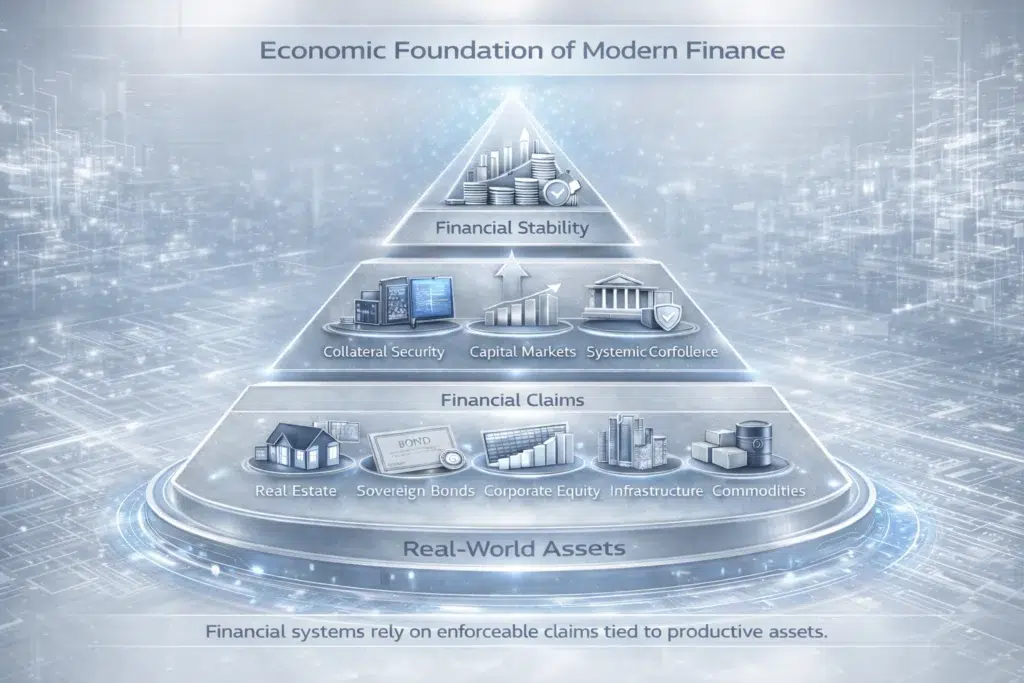
The World Bank has emphasized that asset-backed financing plays a central role in supporting economic development and infrastructure growth. These structures illustrate clearly why real-world assets matter in modern finance: they anchor financial claims to real economic productivity. Remove that anchor and the entire system risks drifting into speculation untethered from value.
Capital Formation and the $16 Trillion Engine
Capital formation enables economic expansion, infrastructure development, and business growth. Why real-world assets matter in modern finance in this context is that they are the instrument through which capital moves from savers to builders. Governments issue bonds to finance infrastructure. Corporations raise equity capital backed by productive assets. Developers secure property-backed financing to build the housing, offices, and logistics facilities economies depend on.
The International Monetary Fund (IMF) has highlighted that infrastructure and asset-backed investment are critical for long-term economic resilience. Capital markets depend on enforceable asset-backed claims to attract institutional investment at the scale required for national and global infrastructure. Without that asset foundation, the cost of capital rises and long-duration investment becomes harder to sustain.
Now add the tokenization dimension. The Yield Gap (the difference between volatile crypto-native yields and stable, high-quality RWA yields such as U.S. Treasury bonds) has driven a major institutional flight to quality. In a high-interest-rate environment, tokenized U.S. Treasuries and real estate income streams offer stable, predictable returns that crypto-native assets cannot replicate. This flight to quality is one of the primary drivers behind the $16 trillion tokenized RWA market prediction from BCG and BlackRock.
The efficiency gain that makes this shift so compelling is Capital Efficiency: the ability to move capital faster and at lower cost. Currently, settling a securities trade takes T+2 (two business days, meaning the transaction is legally completed and funds transfer two days after the trade is executed). Blockchain-based Atomic Settlement delivers T+0 (instant, simultaneous completion in a single transaction). Moving from T+2 to T+0 unlocks billions of dollars in capital that is currently “trapped” waiting for settlement windows to close. That trapped capital freed across global markets is the engine behind the $16 trillion prediction.
Collateral Frameworks and Systemic Stability
A central reason why real-world assets matter in modern finance is their role in collateralization. Collateral reduces counterparty risk (the risk that the other party in a financial transaction fails to deliver) by securing financial obligations with tangible economic value. Without enforceable collateral, lending becomes pure trust, which is not a stable foundation for a financial system.
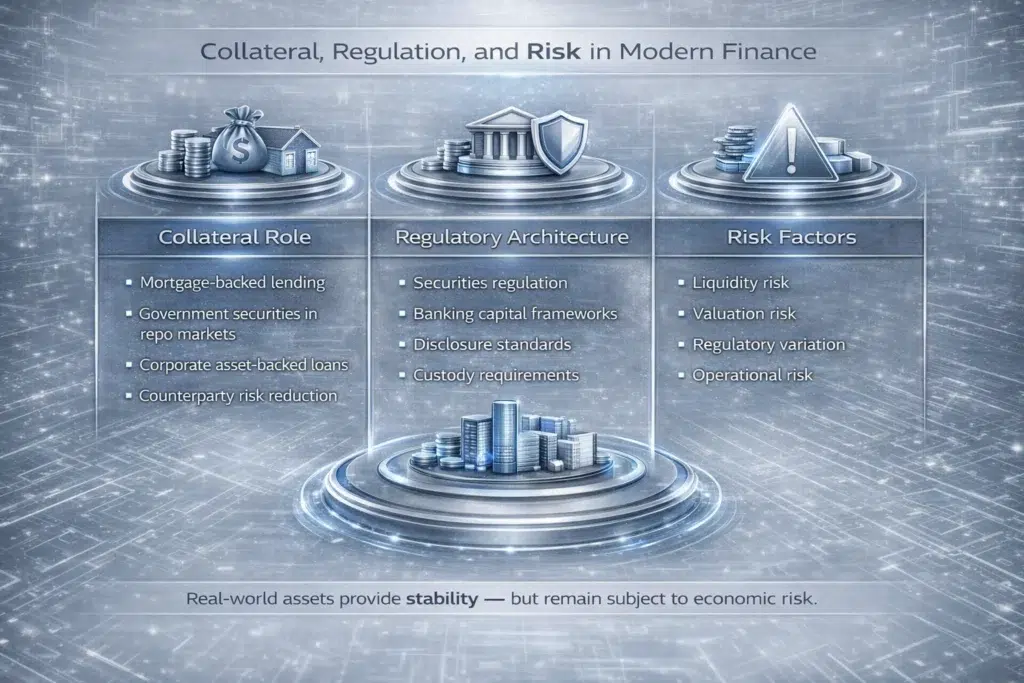
Common collateral examples that illustrate why real-world assets matter in modern finance include mortgage lending secured by property, government securities used in repo markets (short-term borrowing arrangements where securities are sold and repurchased at agreed prices), and corporate assets securing commercial loans. The BIS emphasizes that strong collateral frameworks are the only thing preventing global market crashes during periods of stress. The 2008 financial crisis demonstrated what happens when collateral frameworks are opaque and unverifiable: the blind spots in complex mortgage-backed securities created systemic failures that took years to resolve.
Tokenization addresses this directly. By bringing collateral on-chain, banks and financial institutions can manage risk in real-time rather than relying on periodic audits and opaque documentation. This is the shift from Shadow Banking (the old financial system where asset ownership and risk are often hidden in complex paperwork accessible only to insiders) to On-Chain Transparency (where ownership, collateral, and risk are visible 24/7 to all authorized participants). Asset-backed collateral systems increase institutional confidence and support orderly financial markets.
Institutional Dependence on Real-World Assets
Banking Systems
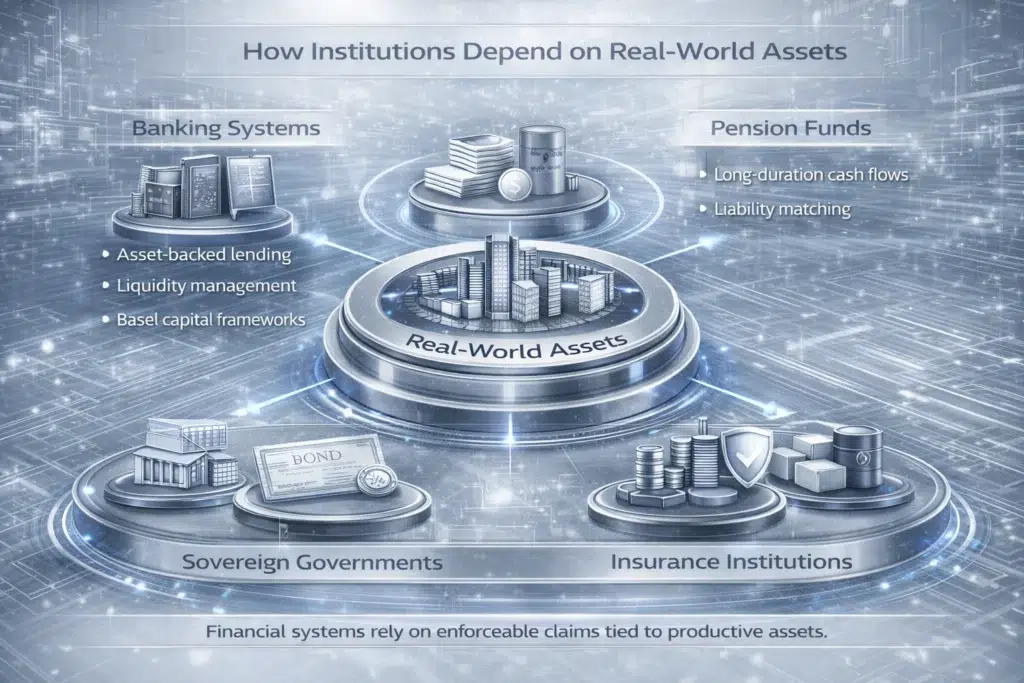
Banks rely on asset-backed structures to secure lending portfolios, manage liquidity, and meet capital adequacy standards. Why real-world assets matter in modern finance within banking systems is that they form the basis of every major capital adequacy calculation. Banking capital frameworks under Basel III (the international regulatory framework setting minimum capital requirements for banks, established by the Basel Committee on Banking Supervision) depend on legally enforceable collateral and asset valuation systems. A bank’s ability to lend, its capital ratios, and its regulatory compliance all rest on the quality and enforceability of its real-world asset holdings.
Pension Funds and Insurance Institutions
Pension funds and insurance companies allocate substantial capital to real-world assets because of their long-duration cash flow characteristics. A pension fund must match its assets to liabilities extending decades into the future. Real estate income, sovereign bond interest payments, and infrastructure concession revenues provide the long-duration, predictable cash flows that match these obligations. The OECD (Organisation for Economic Co-operation and Development) reports that institutional investors depend heavily on asset-backed investments to match long-term liabilities. This institutional allocation further explains why real-world assets matter in modern finance at a systemic level: remove them and the entire pension and insurance infrastructure loses its foundation.
Sovereign Financial Infrastructure
Governments structure sovereign debt markets around legally enforceable claims backed by national revenue systems. These frameworks support public services, infrastructure development, and economic stabilization programs. Sovereign bond markets function because real-world economic output (tax revenue, GDP growth, national resources) supports enforceable financial claims. Why real-world assets matter in modern finance at the sovereign level is that they are the collateral of nations: the productive capacity of entire economies expressed as transferable financial instruments.
Capital Markets and Asset-Backed Finance
Capital markets operate because financial instruments represent enforceable claims tied to real economic value. Bonds, equities, and structured products are viable only when anchored in productive underlying assets. Without asset-backed foundations, capital markets would lack enforceable economic substance. They would become disconnected from the real economy in precisely the way that created the conditions for the 2008 financial crisis: securitized instruments that had lost their connection to the underlying asset quality they were supposed to represent.
For a technical overview of how digital representation of these assets works, see Real-World Asset Tokenization Explained.
Legal Frameworks and Ownership Clarity
Real-world assets are governed by established legal systems that define ownership rights, transfer procedures, dispute resolution mechanisms, and regulatory oversight. Property registries, securities laws, and corporate governance frameworks ensure enforceability. The U.S. Securities and Exchange Commission (SEC) underscores that regulated ownership structures are fundamental to financial market integrity. Legal clarity is a primary reason why real-world assets matter in modern finance: without it, ownership claims become contested and financial infrastructure cannot function reliably.
Digital Systems and Asset Representation
Modern financial infrastructure increasingly integrates digital systems to record ownership and process transactions. Digital systems may improve transparency, administrative efficiency, and record integrity. However, digital infrastructure does not replace the underlying asset. It records ownership rights tied to legally enforceable economic claims. Why real-world assets matter in modern finance does not change as technology evolves: the real-world asset remains the anchor. The digital system is simply a better mirror of it.
The move from Shadow Banking to On-Chain Transparency is why real-world assets matter in modern finance more now than ever. The old financial system operates as a black box of paperwork and hidden risks. Tokenization replaces that opacity with 24/7 verifiable ownership records, real-time collateral visibility, and automatic compliance enforcement. It does not change what the assets are. It makes them dramatically more transparent, accessible, and efficiently managed.
For a deeper technical discussion of custody and infrastructure, see Custody Models Used in Real-World Asset Tokenization.
Risks and Limitations
A balanced analysis of why real-world assets matter in modern finance requires acknowledging where risks lie. These assets are not risk-free simply because they are real.
Liquidity Risk means certain assets such as infrastructure projects or private real estate may have limited liquidity, making rapid exit difficult or costly. Valuation Risk means interest rates, macroeconomic cycles, and geopolitical factors influence asset pricing, sometimes dramatically. Regulatory Risk means ownership and transfer rules vary by jurisdiction, and regulatory changes can affect asset values and transferability. Operational Risk means physical assets require maintenance, custody, and ongoing oversight that introduces costs and management complexity that purely financial instruments do not carry.
Recognition of these risks enhances transparency and regulatory alignment. Understanding why real-world assets matter in modern finance requires holding both the significance and the limitations in view simultaneously. The European Securities and Markets Authority (ESMA) provides regulatory guidance across EU markets that helps standardize how these risks are managed within regulated frameworks.
Regulatory and Compliance Considerations
Real-world assets operate within structured regulatory environments including securities regulation, banking capital frameworks such as Basel III, disclosure standards, and custody requirements. EU regulatory evolution under MiCA (Markets in Crypto-Assets Regulation) reflects the increasing integration of digital infrastructure with traditional asset-backed systems. Compliance-first frameworks contribute directly to financial stability and institutional trust. Why real-world assets matter in modern finance within regulatory systems is that they provide the verifiable, auditable foundation that regulators require for systemic oversight. For compliance context, see Why Compliance Matters in Tokenized Finance.
Market Research and Institutional Consensus
Research from the BIS, IMF, OECD, and World Bank consistently indicates that asset-backed systems contribute to economic resilience, capital efficiency, and institutional confidence. These findings further clarify why real-world assets matter in modern finance, particularly during periods of economic stress when investors seek verifiable value over speculative returns.
The institutional consensus is reinforced by the $16 trillion prediction from BCG and BlackRock, the integration of T+0 settlement technology into sovereign bond pilots across multiple jurisdictions, and the growing deployment of tokenized U.S. Treasuries as on-chain collateral. These are not theoretical developments. They are live institutional programs driven by the recognition that why real-world assets matter in modern finance is inseparable from why blockchain-based tokenization will reshape capital markets.
Common Misconceptions
Three misconceptions regularly arise when people encounter the question of why real-world assets matter in modern finance.
The first misconception is that real-world assets are outdated and will be replaced by digital-native alternatives. The reality is that they remain foundational to institutional finance. Digital systems enhance how they are managed and transferred. They do not replace the economic substance these assets represent.
The second misconception is that digital systems replace real-world assets. The reality is that digital systems record ownership but rely on the underlying legal and physical frameworks. The blockchain is the mirror. The real-world asset is what the mirror reflects.
The third misconception is that real-world assets are risk-free because they are backed by tangible resources. The reality is that they carry liquidity, valuation, and regulatory risks that must be actively managed. Their stability relative to crypto-native assets does not mean they are without risk.
FAQ: Why Real-World Assets Matter in Modern Finance
Why do real-world assets matter in modern finance?
Why real-world assets matter in modern finance is that they provide the enforceable economic backing that supports lending systems, capital markets, and institutional portfolios. They are the Anchor preventing financial claims from floating free of economic reality and the Engine driving capital formation, infrastructure development, and long-term investment. Without them, financial systems lack measurable value and enforceable claims.
What is the $16 trillion tokenized RWA prediction?
Analysts at Boston Consulting Group (BCG) and BlackRock CEO Larry Fink have predicted that the tokenized real-world asset market will reach $16 trillion by 2030. This prediction is driven by Capital Efficiency gains from T+0 Atomic Settlement replacing T+2 traditional settlement, the Yield Gap between stable RWA returns and volatile crypto-native yields, and institutional demand for on-chain transparency replacing Shadow Banking opacity.
How do real-world assets support financial stability?
They anchor financial claims in measurable economic value and legally enforceable ownership structures. Strong collateral frameworks built on real-world assets reduce counterparty risk, support orderly lending markets, and prevent the systemic blind spots that contributed to the 2008 financial crisis. Real-time risk management through tokenized collateral is one of the most significant improvements blockchain infrastructure offers.
What is T+0 Settlement and why does it matter?
T+0 Settlement (Atomic Settlement, where both sides of a trade complete simultaneously and instantly) replaces the current T+2 system (where settlement takes two business days). The capital freed from T+2 settlement delays across global markets represents billions of dollars unlocked through Capital Efficiency improvements. This is one of the primary institutional drivers behind tokenized RWA adoption.
What is Shadow Banking and how does tokenization address it?
Shadow Banking refers to financial activity where asset ownership and risk are hidden in complex, opaque paperwork accessible only to insiders. Tokenization replaces this opacity with On-Chain Transparency: 24/7 verifiable ownership records, real-time collateral visibility, and automatic compliance enforcement visible to all authorized participants. This is why tokenization is increasingly framed as a regulatory solution rather than a regulatory workaround.
Conclusion
Understanding why real-world assets matter in modern finance is essential for evaluating financial stability, capital markets, and institutional infrastructure. They are the Anchor that grounds financial claims in real economic productivity, and the Engine that drives capital formation, infrastructure investment, and long-term institutional allocation.
Why real-world assets matter in modern finance extends beyond their current role. The $16 trillion tokenization prediction, the Capital Efficiency gains from T+0 Settlement, and the shift from Shadow Banking to On-Chain Transparency all point to a future where these assets are more accessible, more efficiently managed, and more transparently governed than they have ever been. While digital systems may enhance efficiency and transparency, the economic and legal foundations tied to real-world assets remain central to modern financial systems. The anchor holds. The engine runs. The mirror reflects reality more clearly than ever before.
Sources and Regulatory References
- Bank for International Settlements (BIS): https://www.bis.org
- International Monetary Fund (IMF): https://www.imf.org
- World Bank Financial Sector: https://www.worldbank.org
- Organisation for Economic Co-operation and Development (OECD): https://www.oecd.org
- U.S. Securities and Exchange Commission (SEC): https://www.sec.gov
Educational Disclaimer
This article is provided for educational purposes only and does not constitute financial, legal, or investment advice. Regulatory treatment of real-world assets may vary by jurisdiction.
Last updated: March 2026
Explore Real-World Assets
- What Are Real-World Assets?
- Examples of Real-World Assets Used in Tokenization
- Are Real-World Assets the Same as Physical Assets?
- Real-World Assets vs Digital Assets
- Real-World Asset Tokenization Explained (cluster)
- Benefits and Risks of RWA Tokenization (cluster)
- What Is Proof of Reserve (cross-pillar)
- On-Chain Transparency Explained (cross-pillar)
- Why Compliance Matters in Tokenized Finance (cross-pillar)
- Real-World Assets Hub