

Real-World Assets vs Digital Assets: 7 Key Differences Explained
This article is part of the broader Real-World Assets educational framework, providing a clear, symmetric comparison of real-world assets vs digital assets across seven key dimensions including origin, counterparty risk, settlement mechanics, yield profiles, ownership structures, regulatory treatment, and how both categories can work together in a modern portfolio.
Educational Notice
This article is provided for informational and educational purposes only. It does not constitute legal, financial, or investment advice. Regulatory treatment of both real-world assets and digital assets varies by jurisdiction and continues to evolve. Professional advice should be sought before making any financial decisions.
Introduction: The Ultimate Duel for Modern Finance
A common mistake is thinking all tokens are the same. A Bitcoin, an NFT of a crypto-punk, and a token representing a digital slice of an apartment building are profoundly different types of property. The comparison of real-world assets vs digital assets has become increasingly relevant as financial systems integrate blockchain infrastructure, and understanding the difference is essential for investors, policymakers, and institutions alike.
The real-world assets vs digital assets duel is not about old versus new. It is about choosing between two fundamentally different models of value. Native Digital Assets offer Zero Counterparty Risk Sovereignty: if you hold your private keys, no bank, company, or government’s bankruptcy can touch your ownership. Real-World Assets offer a Real-World Anchor with Predictable Yield: your token is backed by a building generating rent, a government bond paying interest, or a gold bar sitting in a vault. The choice between these models depends on what you are trying to achieve.
The Bank for International Settlements (BIS) has examined how digital systems may interact with traditional financial markets, particularly from a stability and regulatory perspective. The OECD has emphasized that digital representation does not change the underlying nature of a real-world asset. Both observations highlight that real-world assets vs digital assets is not merely a technology comparison. It is a legal, economic, and risk architecture comparison.
To understand how these assets function within financial systems, see our guide on What Are Real-World Assets?
In Simple Terms: Real-World Assets vs Digital Assets
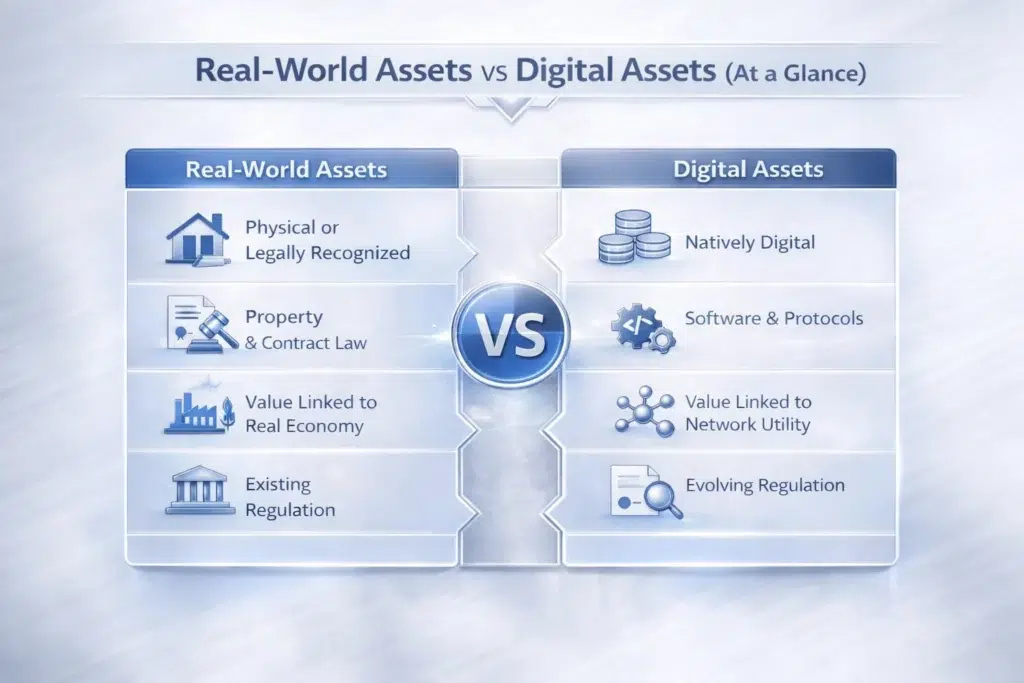
When comparing real-world assets vs digital assets, the core distinction is that real-world assets exist outside digital systems and have a physical or legally recognized form, while digital assets exist natively in digital environments and rely on software-based systems for ownership and transfer.
Think of it this way. Native Digital Assets like Bitcoin are Digital Natives: born on the computer, living only on the blockchain, with no connection to the physical world. If the internet disappeared, the code would still exist, but its value depends entirely on network demand and software rules. Real-World Assets like a tokenized apartment building or a gold bar are Digital Mirrors: physical objects or legally recognized instruments that already exist in the real world. The token is their digital reflection. If the internet disappeared, the building and the gold would still be there.
What Are Real-World Assets?
Real-world assets (RWAs) are assets that originate in the physical world or in traditional financial systems. They have established legal definitions, ownership frameworks, and valuation methods that predate digital infrastructure. Common examples include real estate and land, commodities such as gold and agricultural products, financial instruments like bonds and receivables, and infrastructure or equipment assets. Real-world assets exist independently of blockchain platforms. When referenced in digital contexts, they relate to how ownership rights can be represented using technology without changing the asset’s underlying legal or economic nature.
What Are Digital Assets?
Digital assets exist primarily or exclusively in digital form. Their creation, ownership, and transfer are defined by software, cryptography, and network rules rather than physical presence or traditional legal instruments. Examples include cryptocurrencies, utility tokens used within digital platforms, governance tokens in decentralized systems, and purely digital collectibles. Regulators analyze digital assets based on their function, structure, and use case. In the real-world assets vs digital assets comparison, digital assets are distinguished by the fact that they do not require a physical counterpart to exist or function.
7 Key Differences: Real-World Assets vs Digital Assets
Difference 1: Origin and Backing
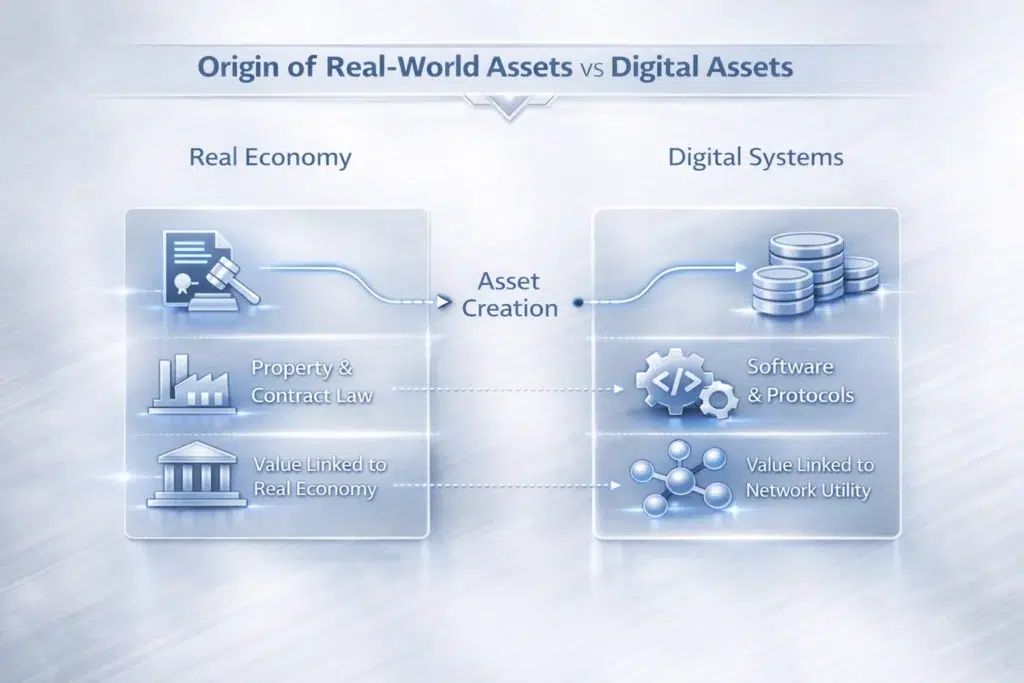
In the real-world assets vs digital assets comparison, origin is the most fundamental distinction. Native Digital Assets are born on the blockchain. Bitcoin, Ethereum, and other cryptocurrencies are not backed by anything physical. Their value derives entirely from network demand, software-defined scarcity, and utility within digital ecosystems. If the network protocol changed, the asset’s nature would change with it.
Real-World Assets are born in the physical or legal world and mirrored on blockchain. A piece of land already exists. A government bond already represents a legal obligation. A gold bar already sits in a vault. The token is a digital representation of ownership rights in these pre-existing assets. Even if the tokenization platform disappeared, the underlying asset would continue to exist and its legal title would remain enforceable through traditional legal systems.
Many real-world assets are increasingly represented digitally through real-world asset tokenization. The European Central Bank (ECB) has highlighted this distinction when discussing distributed ledger technologies in market infrastructure.
Difference 2: Counterparty Risk and Sovereignty
This is the most important financial difference in the real-world assets vs digital assets comparison. Ask yourself: who do you have to trust?
Native Digital Assets offer Zero Counterparty Risk for self-custody holders. If you hold your own Bitcoin private keys (not leaving them on an exchange), you have Total Sovereignty. No bank can freeze your account. No company’s bankruptcy can affect your ownership. No government can confiscate it through the financial system. The code governs your ownership, not any institution.
Real-World Assets carry Counterparty Risk by design. You are dependent on the entire Truth Stack: the SPV (Special Purpose Vehicle, the legal entity holding the asset) being properly structured and Insolvency Remote, the Qualified Custodian holding the title documentation independently, the Oracle providing accurate real-world data to the smart contract, the appraiser correctly valuing the asset, and the legal jurisdiction enforcing your ownership rights if a dispute arises. This counterparty dependency is not a flaw in RWA tokenization. It is an inherent feature of the fact that these assets exist in the physical, legal world. For a deeper examination of custody structures, see Custody Models Used in Real-World Asset Tokenization.
Difference 3: Settlement Speed and Mechanics
When comparing real-world assets vs digital assets, settlement mechanics differ significantly. Native Digital Assets enable Atomic Settlement (also called a Safe Swap): because both the asset and the payment instrument exist natively on the same blockchain ledger, a trade completes simultaneously and instantaneously in a single indivisible transaction. The ownership and the money exchange in the same microsecond. There is zero Settlement Risk (the risk that one party pays but the other fails to deliver) and no settlement delay.
Real-World Assets involve Mirror Synchronization: while the digital token can transfer rapidly on the blockchain, the underlying legal record in a physical land registry or corporate ownership system may take days or longer to update. The blockchain is waiting for an Oracle (an automated data messenger connecting real-world information to the smart contract) to synchronize physical reality with digital records. This creates Synchronization Risk that native digital assets simply do not face.
Difference 4: Underlying Value and Yield
The real-world assets vs digital assets yield comparison is one of the most strategically significant dimensions for investors. Native Digital Assets are Speculative: Bitcoin pays zero rent, zero interest, and zero dividends. Your profit depends entirely on someone else being willing to pay more than you paid. Value is determined by network demand, software-defined scarcity, and market sentiment.
Real-World Assets are Yield-Bearing: their value is anchored to real economic output. Tokenized real estate generates NOI (Net Operating Income, total rent minus operating expenses) distributed proportionally to token holders by smart contract. Tokenized government bonds (T-Bills) generate interest payments. In high-interest-rate environments, RWA yields from stable assets like U.S. Treasuries have become particularly attractive compared to the volatility of crypto-native DeFi yields, driving institutional flows into tokenized RWAs. The Yield Gap between stable RWA income and volatile crypto returns is one of the primary forces behind the $16 trillion tokenized RWA market prediction.
Difference 5: Ownership Structures
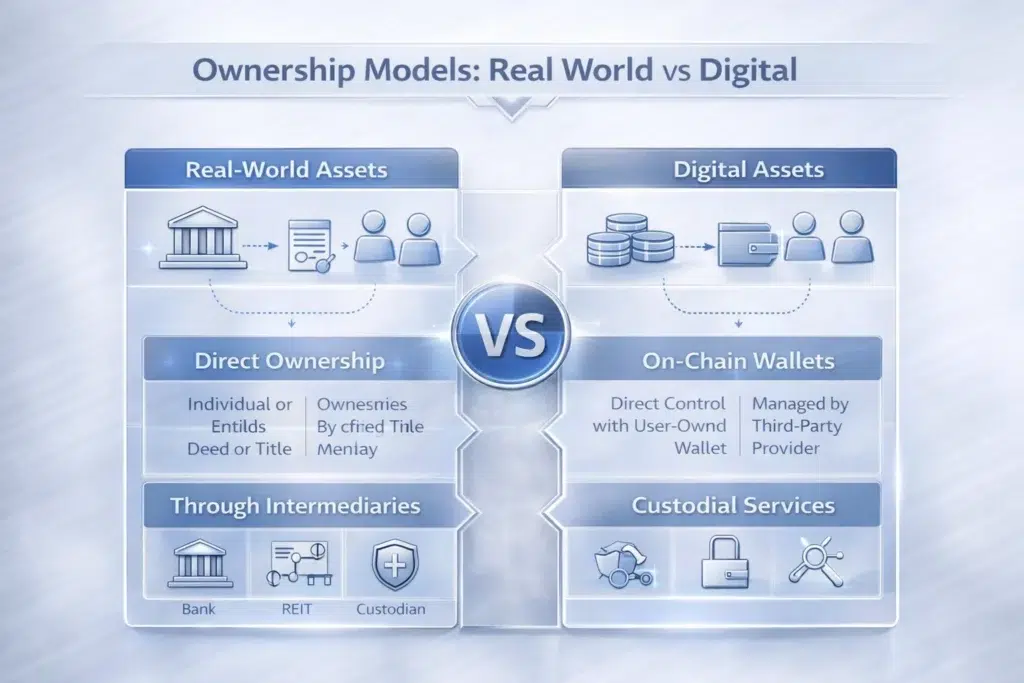
Ownership of real-world assets is governed by property law, contract law, and jurisdiction-specific regulations. Ownership of digital assets is represented by cryptographic private keys and enforced by software rules. In the real-world assets vs digital assets comparison, this distinction matters for enforceability: RWA ownership is enforceable in traditional courts through legal documentation, while digital asset ownership is enforced through cryptographic control of private keys.
There is also an important technical distinction within RWA tokenization itself: Fungible vs Non-Fungible. A tokenized share in a building using ERC-20 (the standard for fungible tokens, where every token is identical and interchangeable) makes each unit equally valuable and tradeable. A single property title tokenized as an ERC-721 (the non-fungible token standard, where each token is unique) represents one specific, indivisible legal instrument. Understanding which standard applies is essential for evaluating any tokenized asset structure.
Difference 6: Regulatory Treatment
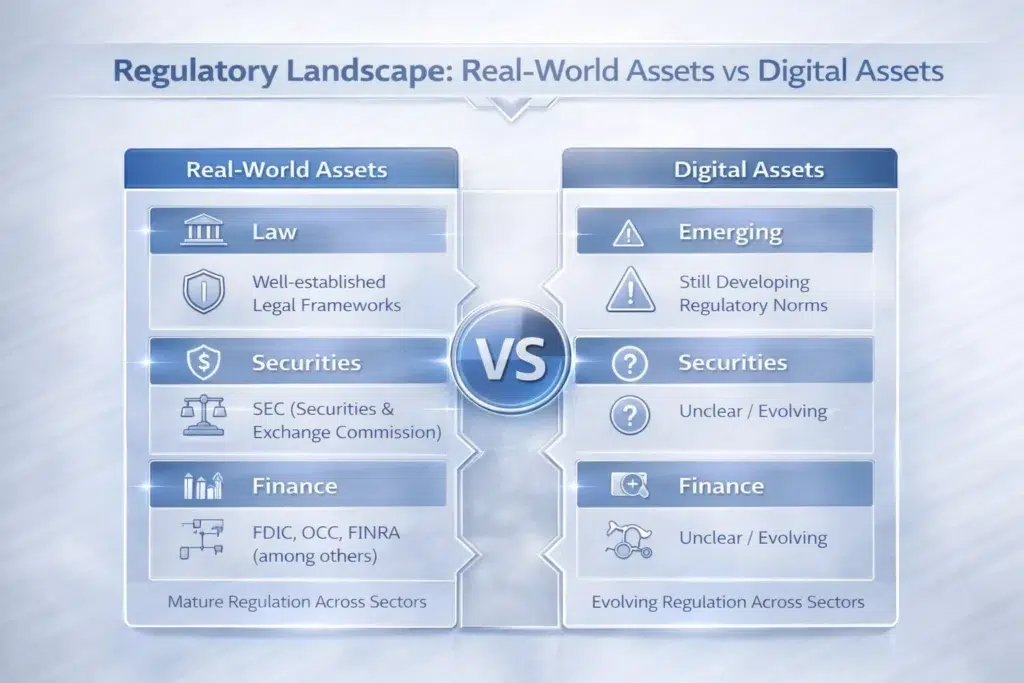
In the comparison of real-world assets vs digital assets, regulatory frameworks differ significantly. Real-world assets are covered by long-established legal and supervisory systems: property law, securities regulation, banking frameworks, and contract law. Digital assets may fall under evolving or newly defined regulatory categories depending on jurisdiction, structure, and use case. The European Union’s MiCA (Markets in Crypto-Assets Regulation) provides a formal framework for certain crypto-asset activities, while VARA (Virtual Assets Regulatory Authority) in Dubai provides jurisdiction-specific digital asset regulation. For compliance context, see Why Compliance Matters in Tokenized Finance.
Difference 7: Transparency and Recordkeeping
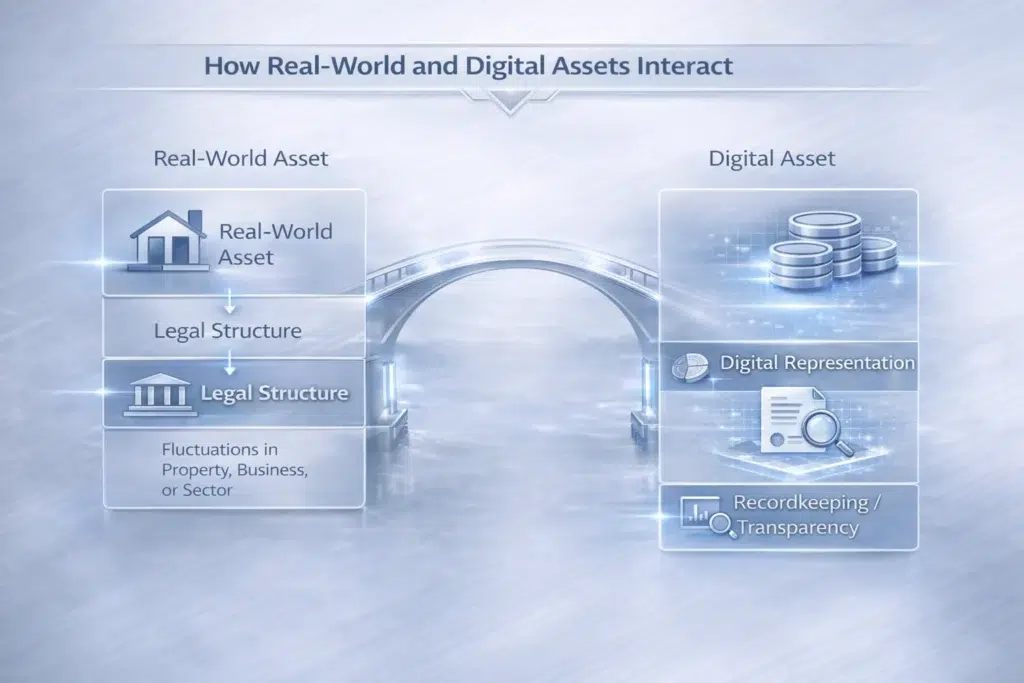
Real-world assets rely on registries and documentation systems: property records, custodial accounts, and contractual documentation. Transparency levels vary depending on jurisdiction and infrastructure quality. Digital assets rely on digital ledgers that can offer continuous, publicly verifiable transaction histories depending on system design and access permissions. Tokenized RWAs combine both: legal documentation for enforceability and on-chain records for operational transparency. Understanding the benefits and risks of real-world asset tokenization is important when evaluating tokenized asset systems.
Symmetric Comparison: Real-World Assets vs Digital Assets
| Dimension | Real-World Assets (RWA) | Native Digital Assets (Crypto) |
|---|---|---|
| Origin | Physical or legal world, Mirrored on blockchain | Created natively on blockchain, no physical counterpart |
| Counterparty Risk | High: SPV, custodian, Oracle, legal system all required | Zero for self-custody holders: code governs ownership |
| Settlement | Mirror Sync: token trades fast, legal record lags | Atomic Settlement: simultaneous, instant, zero delay |
| Yield | Real Yield: rent, interest, dividends (NOI-based) | Speculative: value from market demand, pays no income |
| Ownership | Property law, SPV Operating Agreement, court-enforceable | Cryptographic private key control, software-enforced |
| Regulation | Established legal frameworks: property, securities law | Evolving frameworks: MiCA, VARA, jurisdiction-dependent |
| Transparency | Legal documentation plus on-chain records combined | On-chain ledger, publicly verifiable by design |
Regulatory Considerations
From a regulatory standpoint, the distinction between real-world assets vs digital assets is significant. Key questions include which legal frameworks apply to ownership and transfer, how custody and control are defined, and which authorities have oversight responsibilities. Because regulatory treatment varies by jurisdiction and continues to evolve, educational discussions focus on general principles rather than jurisdiction-specific legal advice. The Financial Stability Board (FSB) assesses the systemic risk implications of digital assets from a global regulatory perspective.
Market Context and Research Trends
Research institutions increasingly analyze the relationship between traditional assets and digital infrastructure in the context of real-world assets vs digital assets. Common themes include standardization challenges in asset representation, legal alignment between digital systems and existing laws, and transparency mechanisms. Analysts at BCG and BlackRock predict the tokenized RWA market will reach $16 trillion by 2030, driven by the Yield Gap between stable RWA returns and volatile crypto-native yields, and by the Capital Efficiency improvements from T+0 Atomic Settlement replacing T+2 traditional settlement.
The Hybrid Portfolio Strategy
The real-world assets vs digital assets comparison does not have to produce a binary choice. For many modern portfolios, both categories serve complementary roles. Use native digital assets for foundational, sovereignty-preserving wealth where Zero Counterparty Risk is the priority: assets you want protected from institutional system failures. Use real-world assets for active portfolio rebalancing, stable income generation, instant collateralization, and efficient exposure to diversified, yield-generating asset classes like real estate and commodities. Understanding the Oracle Problem, the Insolvency-Remote SPV structure, and the Allocated nature of tokenized RWAs is mandatory for any informed participation in either category.
FAQ: Real-World Assets vs Digital Assets
What is the main difference between real-world assets vs digital assets?
The primary difference in real-world assets vs digital assets lies in origin and counterparty structure. Real-world assets originate in the physical economy or traditional financial systems and are governed by established legal frameworks. Digital assets originate within digital environments and rely on software-based systems. RWAs carry counterparty risk from the legal and custodial structures supporting them. Native digital assets held in self-custody carry zero counterparty risk.
Can real-world assets become digital assets through tokenization?
No. In the context of real-world assets vs digital assets, tokenization creates a digital representation of ownership, but it does not change the underlying nature of the real-world asset. The legal status, contractual rights, and economic characteristics remain determined by traditional legal frameworks. The token is the mirror. The asset is the reality the mirror reflects.
Which carries more risk: real-world assets or digital assets?
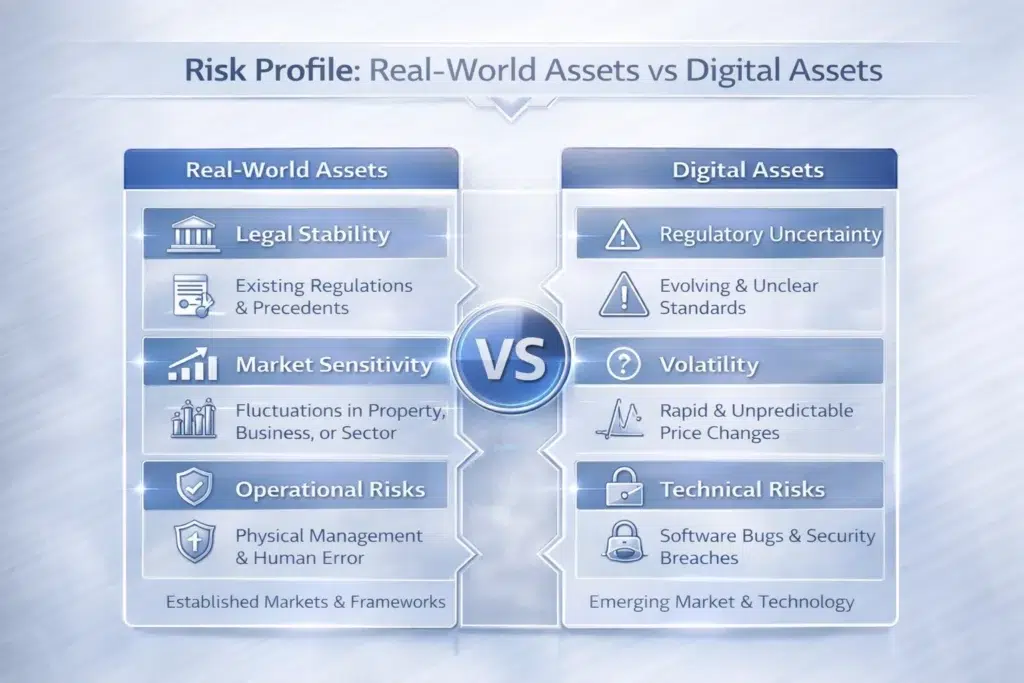
Risk profiles differ structurally rather than one being inherently safer. In the real-world assets vs digital assets comparison, RWAs carry counterparty risk from the legal and custodial stack but are backed by real economic output. Digital assets carry technical, governance, and regulatory risk but offer Zero Counterparty Risk for self-custody holders. Risk assessment depends on structure, custody model, and market conditions.
What is Atomic Settlement and why does it matter in this comparison?
Atomic Settlement is the simultaneous, instant completion of both sides of a blockchain transaction in a single indivisible step. It eliminates Settlement Risk. In the real-world assets vs digital assets comparison, native digital assets on the same blockchain ledger can settle atomically. Tokenized RWAs involve a Mirror Sync delay because the legal record update and Oracle synchronization cannot always match the speed of the token transfer.
Why does the real-world assets vs digital assets distinction matter?
The distinction matters because legal enforceability, valuation mechanisms, custody structures, counterparty risk, yield profiles, and regulatory oversight differ fundamentally between the two categories. Understanding real-world assets vs digital assets helps investors, policymakers, and institutions evaluate how digital infrastructure interacts with traditional financial systems without confusing technological representation with legal ownership or speculative value with real economic yield.
Conclusion
The real-world assets vs digital assets comparison reveals two complementary models of value with fundamentally different risk architectures. Native Digital Assets offer Zero Counterparty Risk Sovereignty and Atomic Settlement efficiency for digitally native instruments. Real-World Assets offer a Real-World Anchor with Predictable Yield, backed by legal enforceability and real economic output, at the cost of Truth Stack dependency and Mirror Synchronization complexity.
Neither model is universally superior. The real-world assets vs digital assets question is not about which is better. It is about understanding which properties each model offers, and how both can serve different functions in a modern, diversified portfolio. The future of finance increasingly involves both models working together: the sovereignty and efficiency of native digital systems combined with the stability and yield of real-world economic activity.
Sources and Regulatory References
- Bank for International Settlements (BIS): https://www.bis.org
- OECD: https://www.oecd.org
- International Monetary Fund (IMF): https://www.imf.org
- U.S. Securities and Exchange Commission (SEC): https://www.sec.gov
- European Securities and Markets Authority (ESMA): https://www.esma.europa.eu
- Financial Stability Board (FSB): https://www.fsb.org
- World Economic Forum (WEF): https://www.weforum.org
Educational Disclaimer
This article is provided for informational and educational purposes only. It does not constitute legal, financial, or investment advice. Regulatory treatment of both real-world assets and digital assets varies by jurisdiction and continues to evolve. Professional advice should be sought before relying on any financial technology system.
Last updated: March 2026
Continue Learning About Real-World Assets
- What Are Real-World Assets?
- Real-World Asset Tokenization Explained
- Tokenized Real Estate Explained
- Tokenized Commodities Explained
- Benefits and Risks of RWA Tokenization
- Are Real-World Assets the Same as Physical Assets? (cluster)
- Custody Models Used in Real-World Asset Tokenization (cluster)
- On-Chain Transparency Explained (cross-pillar)
- Why Compliance Matters in Tokenized Finance (cross-pillar)
- Real-World Assets Hub