

Main Risks of Real-World Asset Tokenization: 9 Serious Structural Challenges Explained
This article is part of the broader Real-World Assets educational framework, examining the main risks of real-world asset tokenization across nine structural challenges including legal enforceability, the Oracle Problem, synchronization risk, governance capture, and exit liquidity limitations.
Introduction: The Self-Driving Bus Analogy
Understanding the main risks of real-world asset tokenization is essential for evaluating the structural integrity of any tokenized ownership system. Traditional fund management is like a bus with a human driver. You trust the driver’s license, experience, and judgment. The driver can see the road, respond to changing conditions, and make contextual decisions that no pre-written rule could anticipate.
A DAO (Decentralized Autonomous Organization) is a self-driving bus programmed with a destination through smart contracts. A tokenized RWA (Real-World Assets) fund is a self-driving bus that is carrying a real, physical object, such as a building or gold bars. The main risks of real-world asset tokenization are therefore twofold. First, the code (the GPS) can be hacked or contain errors. Second, the sensor (the Oracle, which is the data feed connecting the real world to the blockchain) can get dirty, fail, or be manipulated, causing the bus to crash into a very real physical wall.
Tokenization does not eliminate risk. It translates risk into a new digital language. This article defines the nine serious structural challenges that professional investors and institutions must manage.
For foundational context:
- What Are Real-World Assets
- Real-World Asset Tokenization Explained
- Benefits and Risks of RWA Tokenization
- How Investors Assess Risk in Tokenized Real-World Assets
- Real-World Assets Hub
The International Monetary Fund has repeatedly emphasized that financial innovation must operate within enforceable legal systems to preserve stability. Understanding the main risks of real-world asset tokenization ensures that modernization does not undermine enforceability.
In Simple Terms: The Main Risks of Real-World Asset Tokenization
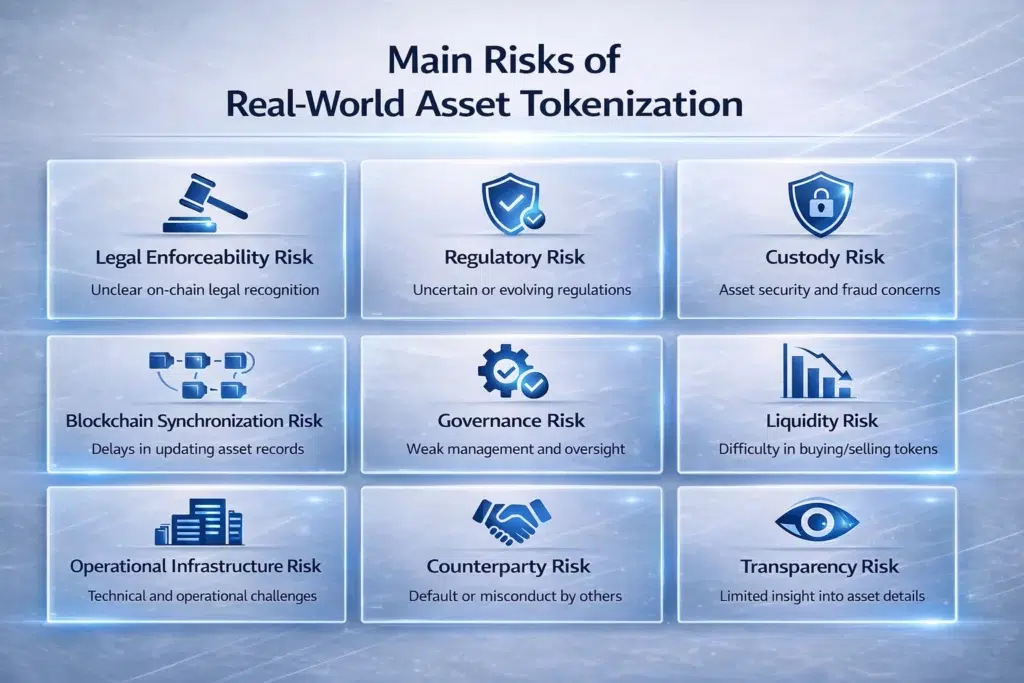
The main risks of real-world asset tokenization relate to how legal ownership, blockchain records, custody systems, and regulatory frameworks interact. Key challenges include legal enforceability gaps when digital tokens do not map cleanly to court-recognized ownership, regulatory uncertainty as classification frameworks evolve, custody misalignment when the party holding the physical asset fails or acts fraudulently, blockchain synchronization errors when digital records diverge from legal reality, governance design flaws that allow concentrated token holders to capture decision-making, liquidity limitations when exit liquidity (the ability to actually sell for cash, not just another token) does not materialize, operational infrastructure risk from smart contract bugs, counterparty exposure to third-party providers, and transparency weaknesses from incomplete disclosure. These risks are not inherent failures of tokenization. They are infrastructure challenges that must be properly structured and governed.
The Risk Hierarchy: How to Assess the Main Risks of Real-World Asset Tokenization
Professional investors assess the main risks of real-world asset tokenization using a bottom-up hierarchy. The foundation layer is legal and regulatory: if the legal structure is broken or fails insolvency remoteness (the guarantee that platform bankruptcy cannot reach investor assets), nothing else provides real protection. The core layer covers smart contract security and custody: can the code or the physical asset be stolen or misappropriated? The process layer covers governance, oracle integrity, and exit liquidity: is the voting fair, is the data accurate, and can investors actually exit? The outcome layer is systemic: if multiple layers fail simultaneously, does the entire structure collapse?
The 9 Structural Challenges: Main Risks of Real-World Asset Tokenization
1. Legal Enforceability Risk: The Paper Trail Problem
The first and most foundational of the main risks of real-world asset tokenization is that a blockchain proves you own a digital token, not that you own a physical building in the eyes of a court. If a legal dispute arises over a tokenized property, the immutable ledger may carry no weight in front of a judge who does not recognize digital tokens as legally valid ownership instruments in that jurisdiction.
Legal enforceability risk arises from cross-border jurisdiction conflicts, ambiguous token-holder rights documentation, weak contractual mapping between tokens and ownership, insufficient SPV (Special Purpose Vehicle, the legal entity holding the underlying asset) structuring, and lack of statutory recognition of digital records in certain jurisdictions. The institutional solution is a legal wrapper, an LLC (Limited Liability Company) or Foundation that creates a recognized legal entity actually holding the asset, with the DAO governance layer directing that entity through formally documented instruction mechanisms. For legal structure detail: Legal Structures Behind Tokenized Real Estate.
2. Smart Contract Risk: The Digital Heist
The rules for real-world asset tokenization are written in computer code called smart contracts. Code can have bugs. In traditional software, a bug is an inconvenience. In a smart contract controlling a treasury holding millions in tokenized assets, a bug is a digital heist that can drain the entire fund in a single transaction before anyone can intervene.
Smart contract risk includes vulnerabilities in ownership transfer logic, execution pathway errors, access control weaknesses, and upgrade mechanism flaws. The institutional standard is independent code audits from reputable security firms that specifically examine voting logic, execution pathways, and upgrade mechanisms before deployment. Critically, investors should check whether critical vulnerabilities identified in an audit report have actually been remediated. An audit that identified ten critical issues but shows no evidence of fixes provides false reassurance. For audit context: Risks and Safeguards in DAO Voting Systems.
3. Custody and Trust Risk: The Vault Middleman
Even the most technically sophisticated tokenized asset system still requires a human in the loop to hold the physical deed, the gold in a vault, the commodity in a warehouse, or the legal title at a property registry. The custodian holding the physical asset can commit fraud, act carelessly, face insolvency, or simply make operational errors. This is one of the main risks of real-world asset tokenization that blockchain technology cannot directly address.
Investors must verify insolvency remoteness (the legally structured guarantee that if the tokenization platform goes bankrupt, the platform’s creditors cannot claim the investors’ underlying assets). This requires assets to be held in a legally segregated SPV that is independent from the platform’s own balance sheet. Without insolvency remoteness, a platform bankruptcy event could sweep investor assets into the platform’s general creditor pool. For custody model analysis: Custody Models Used in Real-World Asset Tokenization.
4. The Oracle Problem: The Data Manipulation Risk
Blockchains are self-contained systems. They cannot independently read the price of gold, the appraised value of a property, or the current inventory of a commodity warehouse. They need an oracle (an external data feed) to bring real-world information onto the chain. This creates what computer scientists call the Oracle Problem, which is a fundamental challenge: how can a trustless, permissionless blockchain trust the data provided by a necessarily permissioned, centralized external source?
The Oracle Problem is not simply a data accuracy risk. It is an architectural vulnerability. If the oracle providing property valuations is controlled by the platform operator, they can manipulate reported values. If the oracle is a single external source, it represents a single point of failure for the entire valuation layer. A corrupted or failed oracle allows a smart contract to act on false information with perfect mathematical certainty, executing transactions based on a reality that no longer exists. The institutional solution is decentralized oracle networks (independent data aggregation systems that pull verified data from multiple independent sources simultaneously so no single party can manipulate the input). For oracle context: Who Verifies Real-World Assets in Tokenized Systems.
5. Synchronization Risk: The Reality Gap
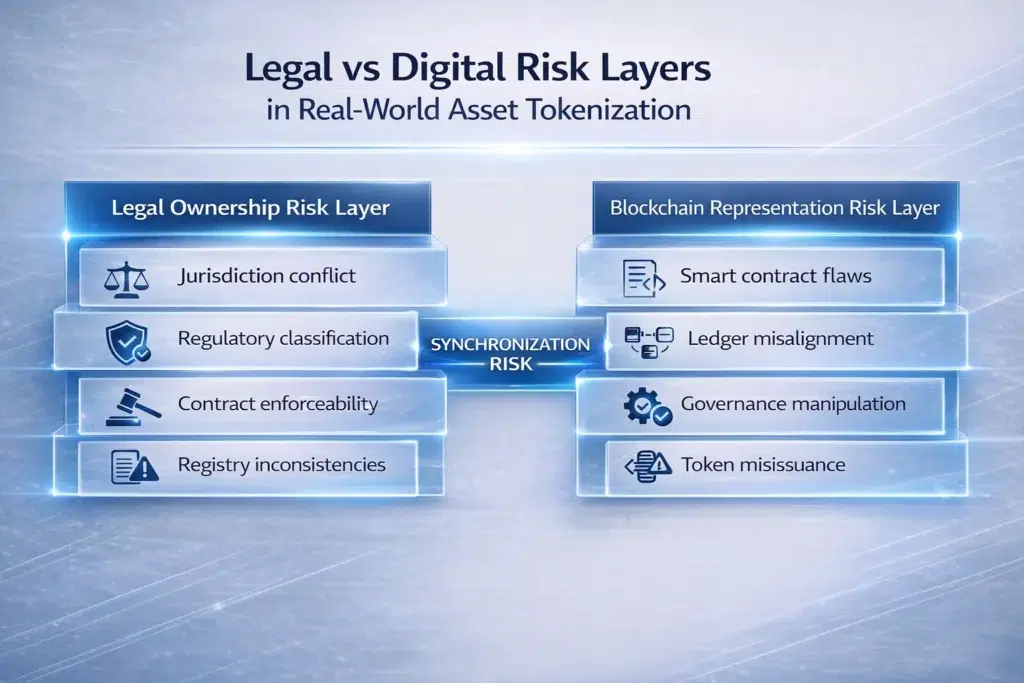
Synchronization risk is the danger that the digital token record and the physical asset reality diverge without investors being immediately aware. If a tokenized building burns down overnight, the token does not automatically update to reflect the change. The token continues to trade at its pre-fire valuation until a human (the oracle operator) updates the data feed. The same gap exists if a legal title dispute places a lien on the property, if a commodity shipment is lost, or if legal ownership transfers without a corresponding blockchain update.
This is one of the most underappreciated of the main risks of real-world asset tokenization because it can create a window of time where investors are trading tokens based on a physical reality that has already changed. For verification architecture: On-Chain vs Off-Chain Asset Tokenization Models.
6. Governance and Centralization Risk: The Whale Factor
In tokenized systems using DAO governance, decisions are made through voting. In token-weighted voting systems, a wealthy investor, often called a whale (a participant holding a disproportionately large share of governance tokens), can acquire 51% of voting power and unilaterally change the rules of the fund, the fee structure, the asset allocation strategy, or the governance parameters themselves. This is governance capture, and it is one of the main risks of real-world asset tokenization that nominally decentralized systems face in practice.
Safeguards include quadratic voting (which makes concentrated influence progressively more expensive to acquire), timelocks (mandatory delay periods between a vote passing and execution, giving investors time to exit before harmful changes implement), quorum requirements (minimum participation thresholds that prevent tiny minorities from passing major decisions), and delegation transparency tools that make power concentration visible. For governance risk detail: Risks and Safeguards in DAO Voting Systems.
7. Regulatory and Compliance Risk
Regulatory risks in real-world asset tokenization stem from evolving asset classification frameworks across jurisdictions. A tokenized asset that is fully compliant today may face mandatory restructuring, licensing requirements, or distribution restrictions as regulatory frameworks evolve. Securities classification disputes, AML (Anti-Money Laundering) and KYC (Know Your Customer) obligations, custody licensing requirements, cross-border compliance conflicts, and disclosure obligations all create compliance risk that pure blockchain infrastructure cannot resolve. For detailed coverage: Regulatory Risks in Real-World Asset Tokenization.
8. Liquidity and Exit Liquidity Risk
Tokenization is frequently described as a solution to the liquidity problem of real-world assets. This framing requires an important clarification. Tokenization creates the technical infrastructure for liquidity. It does not automatically create buyers. Exit liquidity (the ability to sell a token for cash at a fair price, not just exchange it for another token) depends entirely on secondary market depth: how many real buyers exist at any given time, what trading volumes are active, and whether regulatory restrictions allow free transfer.
A tokenized building is still a building. If the platform’s secondary market has low trading volumes or if regulatory restrictions limit who can hold the token, investors may find themselves holding a technically liquid token in a practically illiquid market. Price slippage (the gap between the expected sale price and the actual executed price in a thin market) can be substantial. Liquidity risk is structural, not technological, and it is one of the most practically significant of the main risks of real-world asset tokenization for retail and institutional investors alike. For market stability analysis: Real-World Asset Tokenization and Market Volatility.
9. Operational, Counterparty, and Transparency Risk
The final category of main risks of real-world asset tokenization covers the operational infrastructure that connects all other layers. Smart contract bugs in systems outside the primary governance contract, cybersecurity vulnerabilities in platform interfaces, node infrastructure failures, and platform outages can all disrupt the operational continuity of a tokenized asset system. Counterparty risk arises when token holders depend on third-party providers including the tokenization platform itself, custodians, legal counsel, auditors, and oracle operators: any of these parties can fail, act in self-interest, or become insolvent. Transparency risk arises when insufficient disclosure prevents accurate evaluation: incomplete asset valuation reporting, limited audit disclosure, opaque custody arrangements, and insufficient governance documentation all create information asymmetry that amplifies every other risk category on this list. For transparency mechanisms: Transparency Reduces Risk in Tokenized Assets.
Institutional Failure Mode Analysis: Main Risks of Real-World Asset Tokenization in Practice
| System Component | Traditional Failure | Tokenized Failure | Prevention Strategy |
|---|---|---|---|
| Asset Safety | Internal fraud or embezzlement | Smart contract bug or hack | Independent audits and Proof of Reserve (PoR) |
| Decision Making | Management incompetence or self-dealing | Voter apathy or whale governance capture | Quorums, delegation, and quadratic voting |
| Legal Status | Lawsuit against the company | Jurisdiction ambiguity and enforcement gaps | KYC (Know Your Customer) compliance and legal wrapper |
| Market Crisis | Gating (freezing withdrawals) | Price slippage and exit liquidity collapse | Algorithmic liquidity buffers and timelock safeguards |
| Data Integrity | Auditor negligence or data manipulation | Oracle Problem (corrupted data feed) | Decentralized oracle networks from multiple independent sources |
Risk Comparison Summary: Main Risks of Real-World Asset Tokenization
| Risk Category | Primary Source | Key Failure Mode | Mitigation Mechanism |
|---|---|---|---|
| Legal Risk | Jurisdictional uncertainty | Token unrecognized in court | Legal wrapper and SPV structuring |
| Smart Contract Risk | Code vulnerabilities | Treasury exploit or theft | Independent code audit with remediation verification |
| Custody Risk | Custodian failure or fraud | Asset loss or insolvency contamination | Insolvency remoteness via independent SPV |
| Oracle Problem | Data feed manipulation or failure | False valuations executed automatically | Decentralized oracle networks |
| Synchronization Risk | Record misalignment | Tokens trading on outdated physical reality | Real-time oracle updates and audit reconciliation |
| Governance Risk | Token concentration | Whale governance capture | Quadratic voting, timelocks, quorum requirements |
| Regulatory Risk | Securities classification | Enforcement action or shutdown | Compliance-by-design with KYC and AML |
| Liquidity Risk | Secondary market depth | Exit liquidity unavailable | Regulated secondary venues and market-making programs |
| Operational Risk | Infrastructure failure and counterparty exposure | System outage and provider insolvency | Segregation of duties and independent verification |
Institutional Safeguards That Address the Main Risks of Real-World Asset Tokenization
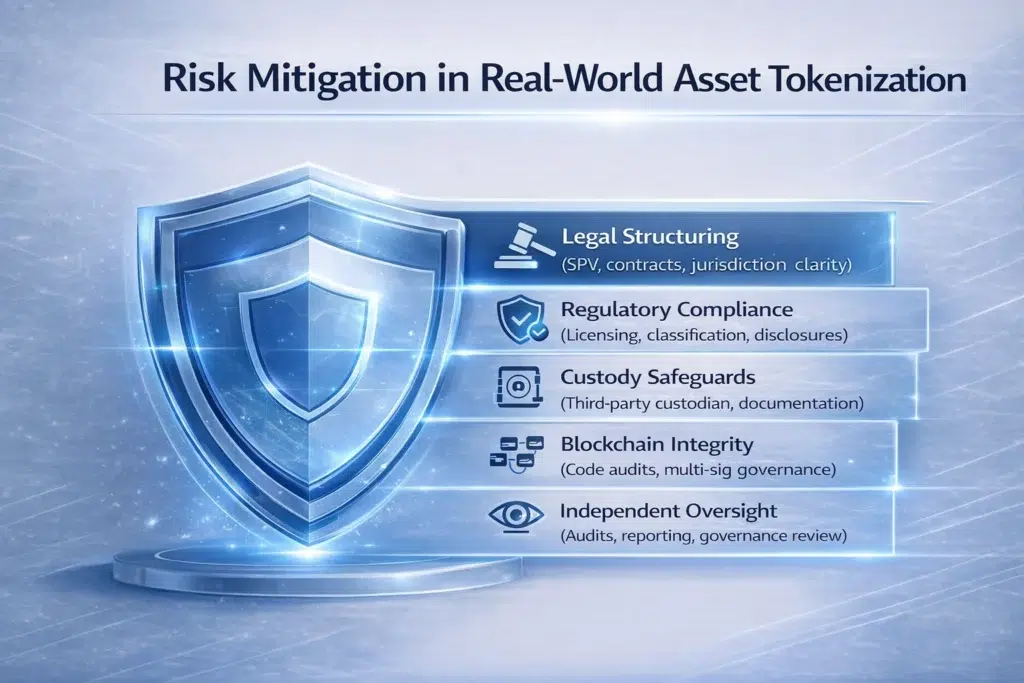
Professional risk mitigation for real-world asset tokenization requires layered institutional safeguards. SPV (Special Purpose Vehicle) isolation ensures insolvency remoteness. Third-party institutional custody with documented segregation protects physical and legal assets. Legal documentation clarity maps token rights to enforceable ownership. Regulatory compliance alignment through KYC and AML procedures maintains legal operation. Independent smart contract audits with verified remediation reduce code vulnerability exposure. Governance oversight structures with quorums, timelocks, and delegation transparency prevent concentration. Multi-layer synchronization protocols with decentralized oracle networks address the Oracle Problem. The Bank for International Settlements has noted that distributed ledger systems can modernize financial infrastructure when properly governed. Tokenization does not eliminate legal or regulatory risk. It transforms infrastructure design.
Frequently Asked Questions
What are the main risks of real-world asset tokenization?
The nine structural challenges are legal enforceability gaps, smart contract vulnerabilities, custody and trust risk, the Oracle Problem, synchronization risk between digital records and physical reality, governance capture, regulatory and compliance risk, exit liquidity limitations, and operational and counterparty risk.
What is the Oracle Problem in real-world asset tokenization?
The Oracle Problem is the fundamental computer science challenge of how a trustless blockchain can reliably verify real-world data provided by necessarily trusted external sources. A corrupted or manipulated oracle feed causes smart contracts to execute transactions based on false information with perfect mathematical certainty. Decentralized oracle networks that aggregate data from multiple independent sources mitigate but do not entirely eliminate this risk.
What is synchronization risk in tokenized assets?
Synchronization risk is the danger that digital token records diverge from physical asset reality without investors being immediately aware. If a building burns down or a commodity shipment is lost, tokens may continue trading at pre-event valuations until a human oracle operator updates the data feed, creating an information window where investors act on outdated information.
What is exit liquidity and why does it matter in real-world asset tokenization?
Exit liquidity is the practical ability to sell a token for cash at a fair price in the secondary market. Tokenization creates the technical infrastructure for liquidity but does not automatically create buyers. If secondary market depth is insufficient, investors may face significant price slippage or find themselves effectively unable to exit their position despite the token being technically transferable.
Can blockchain eliminate the main risks of real-world asset tokenization?
No. Blockchain enhances record integrity, transparency, and programmable execution, but it does not replace legal enforceability, resolve the Oracle Problem independently, prevent governance capture, create exit liquidity, or eliminate counterparty and operational risk. Properly managed tokenization infrastructure reduces certain risks while introducing new ones that require equally structured mitigation.
Conclusion: Beyond Hype
Understanding the main risks of real-world asset tokenization means treating the blockchain as one component of a larger trust architecture, not as a standalone safety guarantee. Institutions will not invest based on technological enthusiasm. They require insolvency remoteness, independently audited smart contracts, technically sound oracle infrastructure, compliant governance design, and realistic secondary market liquidity before deploying capital into tokenized real-world asset systems.
The main risks of real-world asset tokenization are not arguments against tokenization. They are the design requirements for doing it correctly. When properly structured with layered safeguards, tokenized ownership systems can modernize financial infrastructure while preserving the enforceability and accountability that institutional capital requires. The self-driving bus can carry precious cargo safely. But only if the GPS, the sensors, the road rules, and the insurance are all in order before it departs.
For related reading: How Investors Assess Risk in Tokenized Real-World Assets, Regulatory Risks in Real-World Asset Tokenization, and Transparency Reduces Risk in Tokenized Assets.
Explore Real-World Asset Risk and Tokenization Frameworks
- Benefits and Risks of RWA Tokenization
- How Investors Assess Risk in Tokenized Real-World Assets
- Regulatory Risks in Real-World Asset Tokenization
- Transparency Reduces Risk in Tokenized Assets
- Custody Models Used in Real-World Asset Tokenization
- On-Chain vs Off-Chain Asset Tokenization Models
- Who Verifies Real-World Assets in Tokenized Systems
- Why Compliance Matters in Tokenized Finance (cross-pillar)
- What Is Proof of Reserve (cross-pillar)
- Real-World Assets Hub
Glossary Terms
- Real-World Assets
- Asset Tokenization
- Smart Contract
- Smart Contract Audit
- Decentralized Oracle
- SPV (Special Purpose Vehicle)
- Custody
- Asset Custody
- Proof of Reserve
- Governance Framework
- Liquidity
- Secondary Market
- KYC (Know Your Customer)
- AML (Anti-Money Laundering)
- Regulatory Compliance
- Investor Protection
Educational Disclaimer
This article is provided for informational and educational purposes only. It does not constitute legal, financial, or investment advice. Regulatory treatment of tokenized assets may vary by jurisdiction and asset classification. Professional legal and financial consultation should be sought before making any investment decisions involving tokenized real-world assets.
Last updated: March 2026