


How Real-World Assets Support Ethical Investment Strategies: 13 Strategic Institutional Advantages
Introduction
Understanding how real-world assets support ethical investment strategies requires looking beyond broad investment labels and examining how capital connects to the real economy. In practice, ethical investing is not only about avoiding certain sectors or adopting a general values-based narrative. It also involves evaluating governance quality, transparency standards, regulatory compatibility, and the underlying economic activity that an investment supports.
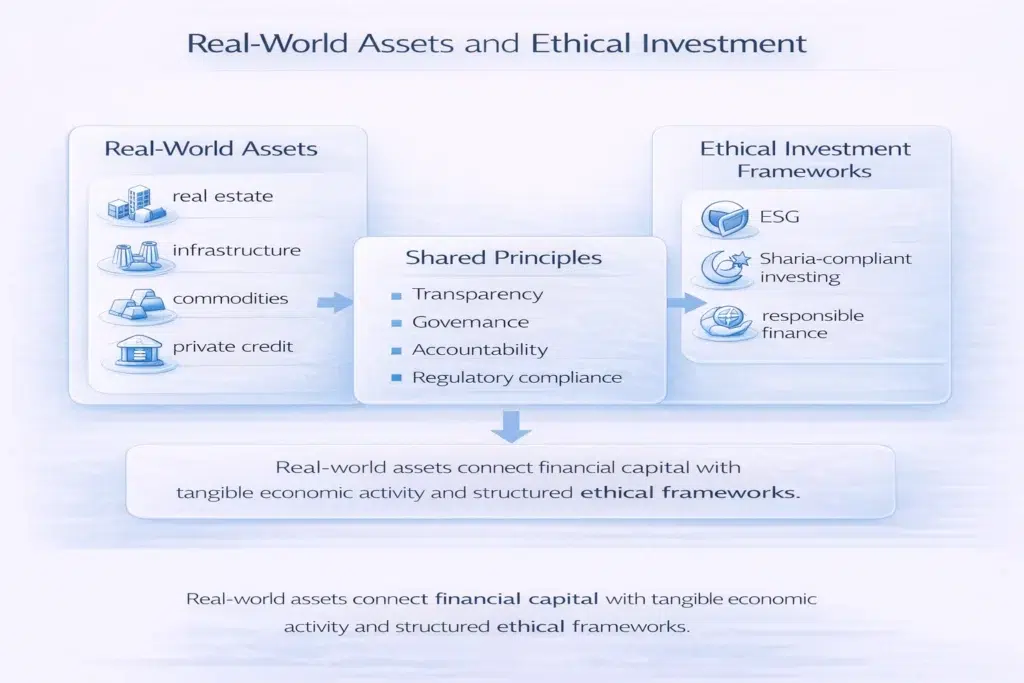
Real-world assets refer to tangible or contractually identifiable economic resources such as real estate, infrastructure, commodities, and private credit. Unlike purely synthetic or highly abstract financial exposures, these assets are connected to physical production, service delivery, or legally documented claims on productive activity. Because of that connection, real-world assets are often examined within responsible investment frameworks that place weight on transparency, accountability, reporting quality, and oversight.
Ethical investment strategies may include environmental, social, and governance considerations, Sharia-aligned investment principles, institutional responsible investment policies, and regulatory standards intended to improve investor protection and market integrity. These frameworks do not all use the same criteria, and they do not always reach the same conclusion. Still, they often share a common concern: whether capital is being allocated through structures that are understandable, governed, and linked to legitimate economic activity.
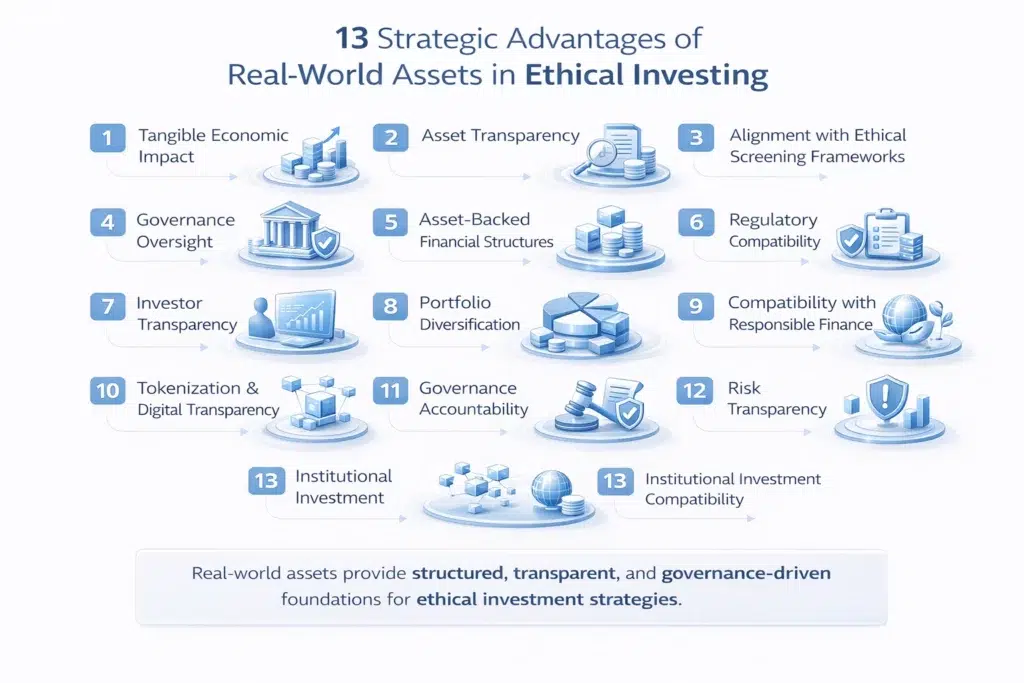
This article explains how real-world assets support ethical investment strategies by outlining thirteen institutional advantages that connect asset-backed investment structures with responsible finance principles.
For foundational context within the ethical investing cluster, see what is ethical investing in real-world assets, ESG vs Sharia-aligned investing, can tokenized real estate be considered ethical, and transparency requirements in ethical investment structures.
To understand how real-world assets support ethical investment strategies, it is necessary to examine the governance, transparency, and regulatory systems that allow investors to assess both the assets themselves and the structures used to hold, finance, and manage them.
In Simple Terms
Real-world assets support ethical investment strategies because they often have characteristics that are easier to evaluate within responsible finance frameworks.
They can:
- represent tangible economic activity
- provide identifiable sources of income
- allow verification of asset ownership
- support transparency and reporting
- operate within regulated financial markets
That does not mean every real-world asset automatically qualifies as ethical. It means these assets often provide a clearer basis for evaluation. Investors can ask practical questions: What does the asset do? Who owns it? How is income generated? What rules govern the structure? Those questions are central to ethical investment analysis.
Advantage 1: Tangible Economic Impact
One of the clearest reasons how real-world assets support ethical investment strategies is their direct connection to economic activity.
Real-world assets represent productive resources within the economy rather than purely abstract financial exposure. Examples may include:
- commercial real estate developments
- energy infrastructure projects
- transportation networks
- agricultural production assets
Because these assets are tied to identifiable economic functions, investors can examine how capital is being used and what type of activity it supports. That may seem obvious, but it matters. Responsible investment frameworks often place importance on whether capital contributes to productive systems rather than simply circulating through speculative trading structures.
For a broader introduction to this category, see what are real-world assets.
This connection between investment capital and visible economic output often gives real-world assets a clearer place within responsible finance analysis.
Advantage 2: Asset Transparency
Another factor explaining how real-world assets support ethical investment strategies is the transparency associated with physical or legally documented assets.
Real-world assets commonly involve:
- documented ownership structures
- legal title registration
- asset-level documentation
- valuation processes
These systems do not guarantee perfect transparency, but they do create a foundation for verification. In many cases, investors can review legal documentation, reporting materials, or valuation frameworks to better understand what sits behind the investment structure.
Transparency standards are discussed further in transparency requirements in ethical investment structures.
When records and reporting systems are properly maintained, investors gain a stronger basis for assessing not only ownership, but also governance quality and reporting discipline.
Advantage 3: Alignment with Ethical Screening Frameworks
Real-world assets can often be evaluated using multiple ethical investment frameworks.
These frameworks may include:
- ESG investing
- Sharia-aligned investing
- responsible investment policies
For comparison between two major approaches, see ESG vs Sharia-aligned investing.
Because real-world assets are linked to identifiable activities, they can often be screened using criteria related to governance, social utility, sector exposure, financing structure, or risk-sharing arrangements. That makes them easier to map against structured ethical criteria than some complex financial instruments whose economic substance is harder to interpret.
This does not mean all frameworks will classify the same asset in the same way. It means the asset often presents enough substance to be evaluated using more than one responsible finance lens.
Advantage 4: Governance Oversight
Governance oversight is another important factor when explaining how real-world assets support ethical investment strategies.
Investment structures involving real-world assets often include governance mechanisms such as:
- asset management boards
- compliance committees
- investor reporting structures
- independent audits
These governance systems help define who makes decisions, how those decisions are monitored, and what reporting obligations apply. In ethical investment analysis, that matters because responsible investing depends not only on what the asset is, but also on how it is administered.
In some frameworks, governance may also include specialized supervisory structures. For example, see how Sharia governance works in financial institutions.
Governance oversight strengthens accountability by giving investors a clearer picture of how authority and control are structured within the investment vehicle.
Advantage 5: Asset-Backed Financial Structures
Real-world assets also support ethical investment strategies because revenue generation is often linked to identifiable economic activity.
Income sources may include:
- rental income from real estate
- infrastructure service fees
- commodity production revenue
- business operations financed through private credit
Because the source of revenue can often be traced to a specific activity, investors can analyze not only how income is generated, but also whether that economic activity fits the principles of the investment framework being applied.
That degree of traceability can improve transparency compared with purely financial structures where returns depend mainly on pricing dynamics, leverage, or short-term market movement without a visible link to underlying productive output.
Advantage 6: Regulatory Compatibility
Another reason how real-world assets support ethical investment strategies relates to regulatory compatibility.
Real-world asset markets frequently operate within established legal and supervisory systems including:
- property law frameworks
- securities regulation
- licensing requirements
- investor protection rules
Digital asset markets may also interact with frameworks such as what is MiCA regulation in crypto and what is VARA Dubai Virtual Asset Regulatory Authority.
Regulatory oversight does not automatically make an investment ethical, but it does create a more structured environment for disclosure, supervision, and investor protection. In institutional responsible finance, those features are often treated as important components of ethical evaluation.
Advantage 7: Transparency for Investors
Transparency is an important factor when explaining how real-world assets support ethical investment strategies.
Investment structures involving real-world assets often include:
- financial reporting obligations
- asset-level disclosures
- independent auditing processes
- investor communication frameworks
These reporting systems help investors understand how assets are managed, how revenue is generated, and where risks may be concentrated. Ethical investing frameworks often rely on this type of visibility because decision-making is weaker when investors cannot examine the structure behind the capital allocation.
Transparency does not eliminate risk, but it improves the investor’s ability to identify it.
Advantage 8: Portfolio Diversification
Real-world assets may also support ethical investment strategies by providing diversification within investment portfolios.
Diversification can occur across several dimensions including:
- economic sectors
- geographic markets
- asset types
- revenue sources
Real-world assets may complement instruments such as equities or bonds by giving exposure to physical economic systems rather than only to listed market performance. For institutions using responsible finance frameworks, diversification matters because ethical investing is usually implemented within a broader portfolio context rather than as an isolated moral screen.
In practice, this means an investor may evaluate whether asset-backed exposure improves not only return structure, but also portfolio balance and resilience.
Advantage 9: Compatibility with Responsible Finance Frameworks
Another reason how real-world assets support ethical investment strategies is their compatibility with multiple responsible finance frameworks.
These may include:
- ESG investment policies
- Sharia-aligned investment rules
- institutional responsible investment guidelines
For further reading, see what is ethical investing in real-world assets.
Real-world assets can often be assessed using criteria tied to governance quality, permitted economic activity, transparency, financing structure, and investor protections. This cross-framework compatibility helps explain why they are frequently discussed in institutional conversations about ethical allocation.
Advantage 10: Tokenization and Digital Transparency
Technological innovation has introduced new ways to structure real-world asset investments.
Tokenization allows ownership interests in real-world assets to be represented digitally using blockchain infrastructure.
Examples include:
- tokenized real estate platforms
- digital commodity ownership systems
- blockchain-based infrastructure investment structures
For additional discussion of tokenized real estate, see tokenized real estate explained.
Certain systems may also incorporate verification mechanisms such as proof of reserve.
Digital infrastructure can improve transparency, traceability, and reporting discipline when it is integrated properly with legal, governance, and regulatory frameworks. The technological layer does not replace ethical analysis, but it may strengthen the visibility through which ethical analysis is performed.
Advantage 11: Governance Accountability
Governance accountability plays an important role in ethical investing frameworks.
Real-world asset investments often involve managers or operators who are responsible for maintaining, financing, or administering the underlying assets.
Accountability mechanisms may include:
- investor reporting obligations
- regulatory filings
- asset performance reviews
- governance oversight committees
These systems create structured accountability relationships between investors and asset managers. In ethical investment analysis, that matters because governance quality often determines whether transparency and compliance standards are actually meaningful in practice.
Advantage 12: Risk Transparency
Risk transparency is another important factor in explaining how real-world assets support ethical investment strategies.
Real-world assets allow investors to analyze several forms of risk including:
- asset valuation risk
- operational risk
- regulatory risk
- market demand risk
Because the underlying assets are identifiable, investors can often examine these risks through economic analysis, legal documentation, operational review, and cash flow modeling. That does not make the assets safe. It simply means the sources of risk are often more visible and easier to assess.
For example, digital asset investment platforms may face challenges discussed in regulatory risks in tokenized asset platforms.
Risk awareness remains an essential part of responsible investing. Ethical screening may shape the selection process, but it does not remove financial uncertainty.
Advantage 13: Institutional Investment Compatibility
Institutional investors frequently allocate capital to real-world assets.
Examples include:
- pension funds
- sovereign wealth funds
- insurance companies
- infrastructure investment funds
These institutions often assess real-world assets through governance standards, transparency requirements, legal controls, and reporting quality. That institutional behavior matters because large allocators typically use structured due diligence frameworks rather than simple thematic narratives.
Global financial organizations have examined governance and transparency issues within financial markets, including the Bank for International Settlements, the International Monetary Fund, and the OECD.
Institutional participation does not prove that an asset is ethical. It does, however, show that real-world assets can fit within broader frameworks where transparency, governance, and regulated market structure are treated as essential criteria.
Comparison Overview
| Investment Type | Transparency | Asset Backing | Governance Visibility |
|---|---|---|---|
| Public equities | Moderate | Not always required | Corporate governance |
| Real-world assets | Often high | Typically asset-backed | Asset-level oversight |
| Tokenized RWAs | Potentially high | Asset verification required | Blockchain-based transparency |
This comparison shows why real-world assets may offer structural characteristics that align more naturally with ethical investment frameworks than some forms of purely abstract financial exposure.
Risks and Limitations
Although real-world assets may support ethical investment strategies, several limitations remain.
These include:
- varying governance standards across markets
- inconsistent transparency requirements
- differences in regulatory frameworks
- complexity in asset valuation
Understanding these limitations is essential. Ethical investing frameworks do not function properly when investors ignore differences in jurisdiction, reporting quality, or governance strength.
Institutional Perspective
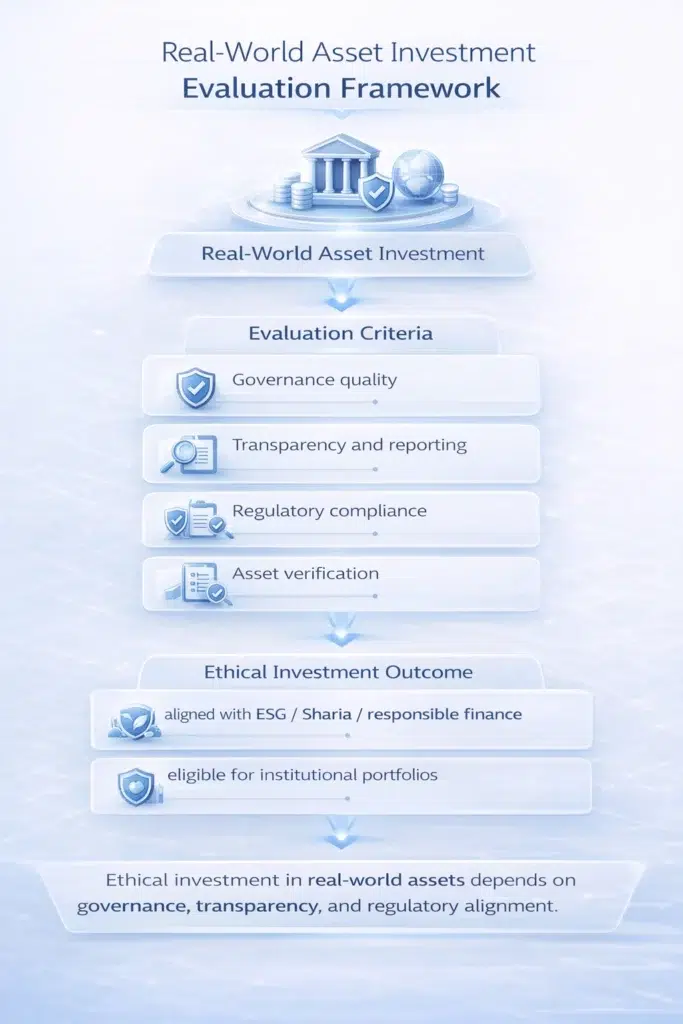
Institutional investors evaluating how real-world assets support ethical investment strategies often focus on several structural factors.
- governance transparency
- regulatory compliance
- asset verification systems
- reporting standards
Real-world assets may align with ethical investment frameworks when these structural elements are implemented effectively. However, ethical frameworks generally operate alongside traditional financial analysis rather than replacing it.
Frequently Asked Questions
What are real-world assets in ethical investing?
Real-world assets refer to tangible economic resources such as real estate, infrastructure, commodities, and private credit.
Why do real-world assets support responsible investing?
Because they represent identifiable economic activity and can often be evaluated using governance and transparency frameworks.
Can tokenized assets support ethical investment strategies?
Tokenized real-world assets may align with ethical frameworks when governance oversight and regulatory compliance are maintained.
Are real-world assets automatically ethical investments?
No. Governance quality, transparency, and regulatory compliance determine whether investments align with ethical frameworks.
Do ethical investing frameworks eliminate investment risk?
No. Ethical screening influences investment selection but does not remove financial risk.
Conclusion
Understanding how real-world assets support ethical investment strategies requires examining how asset-backed investments interact with governance frameworks, transparency standards, and regulatory compliance systems.
Real-world assets provide identifiable economic exposure that allows investors to evaluate how capital interacts with productive activity. In many cases, these assets can be integrated into responsible investment frameworks that emphasize transparency, governance oversight, and regulatory compatibility.
At the same time, real-world assets do not automatically qualify as ethical investments. Governance quality, reporting standards, and regulatory compliance remain central factors in determining whether an investment aligns with ethical finance principles.
For further reading within this cluster, see what is ethical investing in real-world assets, ESG vs Sharia-aligned investing, can tokenized real estate be considered ethical, and transparency requirements in ethical investment structures.
Educational Disclaimer
This article is provided for informational and educational purposes only. It does not constitute financial, legal, or investment advice. Ethical investing frameworks vary across jurisdictions and institutions. Professional advice should be sought before making investment decisions involving real-world assets.