


What Role Does AI Play in Risk Management Infrastructure? 12 Critical Strategic Functions
This article is part of the broader Investment Infrastructure educational framework, explaining what role does AI play in risk management infrastructure across twelve critical functions from fraud detection and market volatility monitoring to predictive analytics, stress testing, and RegTech compliance support.
Educational Notice
This article is provided for informational and educational purposes only. It does not constitute legal, financial, or investment advice. Implementation requirements vary by jurisdiction and platform design. Professional consultation should be sought for any regulated activity.
Introduction
Modern financial systems generate enormous volumes of transactional, behavioral, and market data every second. Investment platforms, banking systems, and digital financial networks cannot monitor all of it manually. Understanding what role does AI play in risk management infrastructure has therefore become one of the most practically important governance questions in institutional finance today.
Risk management infrastructure is a critical component of modern financial systems. It helps institutions detect fraud signals, evaluate market volatility, monitor liquidity conditions, and support compliance monitoring across investment environments. Historically, risk monitoring relied primarily on manual analysis and predefined rule-based algorithms (automated systems that follow fixed, pre-written rules to flag specific conditions). Today, many institutions integrate artificial intelligence into monitoring systems because AI can analyze large datasets and detect risk patterns that traditional methods may miss or identify too slowly.
This article explains what role does AI play in risk management infrastructure by outlining twelve critical functions. For the broader infrastructure environment where risk systems operate, see the Investment Infrastructure pillar. For a broader overview of AI usage across infrastructure systems, see How AI Is Used in Investment Infrastructure.
The Bank for International Settlements (BIS) and the IMF continue examining what role does AI play in risk management infrastructure and how AI affects financial supervision, stability, and governance.
In Simple Terms: What Role Does AI Play in Risk Management Infrastructure?
Here is the clearest way to think about what role does AI play in risk management infrastructure. Traditional risk systems are like a Security Camera (Rule-Based). The camera records everything that happens. If someone breaks a window, the camera sees it. But only if the window was already in the frame. And only after the damage is done.
AI in risk management is like a Smart Security Team. It does not just watch the window. It notices the person walking suspiciously in the parking lot before they even reach the building. It notices the hallway light flickering in a pattern that suggests a wire is about to short-circuit. It does not just tell you that you were robbed. It tells you how to prevent the robbery before it starts.
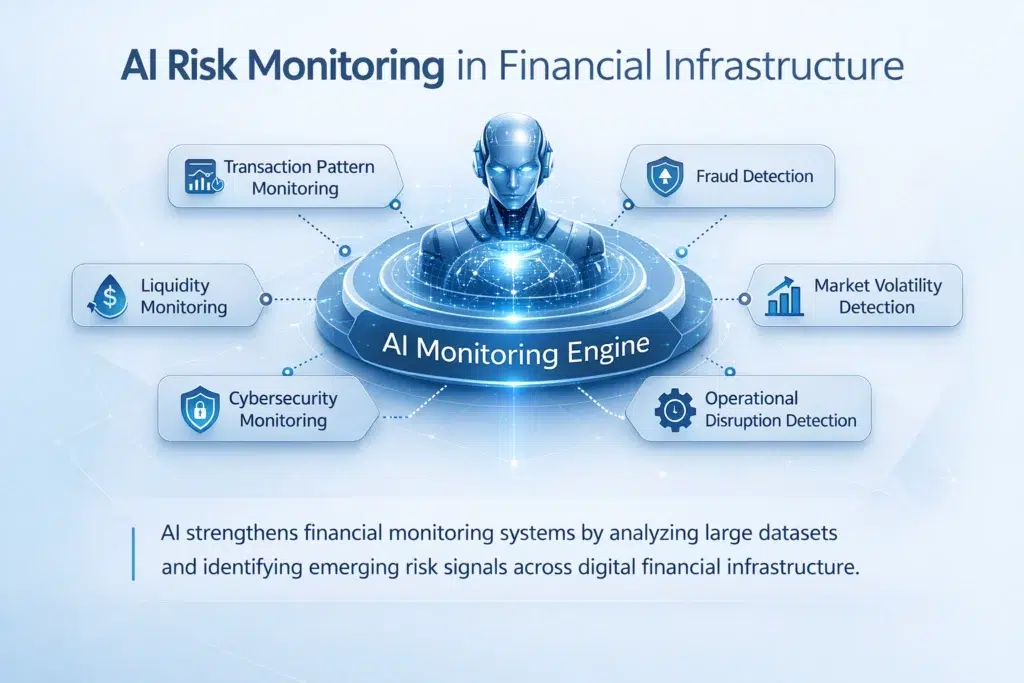
What role does AI play in risk management infrastructure can be explained simply: AI helps risk systems analyze large datasets and detect signals that may indicate emerging risks faster and more consistently than traditional monitoring alone. AI risk monitoring systems can support transaction pattern monitoring, fraud detection, liquidity monitoring, market volatility analysis, cybersecurity anomaly detection, predictive risk analytics, automated stress testing, and RegTech compliance support.
AI does not replace governance or regulatory oversight. Instead, what role does AI play in risk management infrastructure is mainly about strengthening analytical monitoring so institutions can identify risk signals earlier and reduce monitoring blind spots across complex data environments.
Why Risk Management Infrastructure Matters in Financial Systems
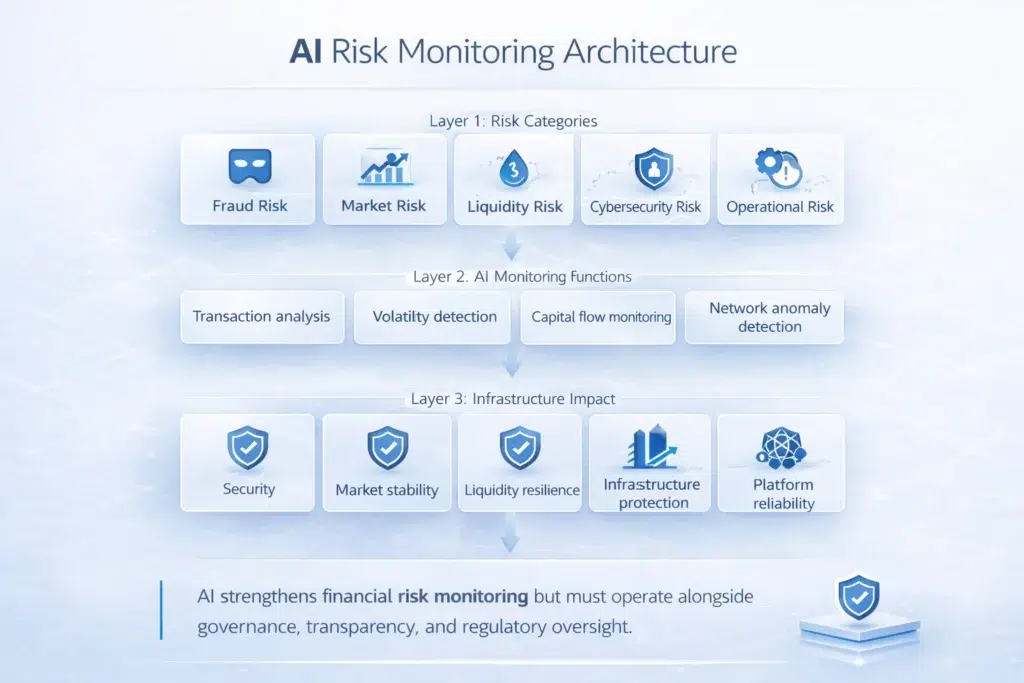
Risk monitoring is essential because financial systems face multiple risk categories simultaneously: market risk (exposure to price movements), liquidity risk (inability to meet financial obligations), operational risk (system failures and process errors), fraud risk (intentional misuse of financial systems), and cybersecurity risk (unauthorized access and data breaches). Each category requires continuous monitoring across large, fast-moving datasets.
Modern platforms process continuous transaction flows and market signals. This is why what role does AI play in risk management infrastructure becomes a question about data scale and monitoring consistency. Many institutions use Hybrid Architectures (systems that combine rule-based alerts with AI-based analytics, using each where it performs best). The structural comparison between these approaches is explained in AI vs Rule-Based Systems in Investment Platforms.
When asking what role does AI play in risk management infrastructure, institutions usually focus on three priorities: detecting risks earlier before they escalate into losses, reducing monitoring blind spots that fixed rules cannot cover, and improving oversight consistency across complex data environments that no human team could monitor at full scale.
What Role Does AI Play in Risk Management Infrastructure? 12 Critical Functions
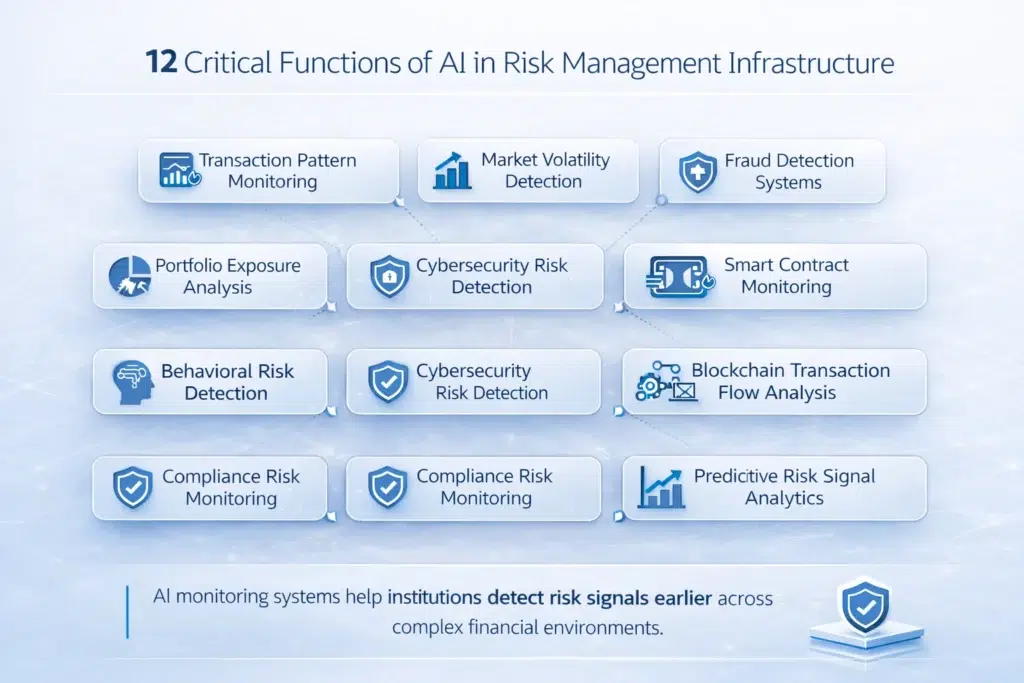
Function 1: Transaction Pattern Monitoring
A major part of what role does AI play in risk management infrastructure is transaction monitoring. AI systems can analyze transaction histories across platforms, compare current behavior with historical patterns, and identify unusual activity for further review. A large institution may process millions of transactions daily, far beyond the practical capacity of manual review teams. AI reduces the monitoring burden by surfacing only the transactions that deviate meaningfully from established behavioral norms, improving detection of irregular flows, abnormal timing patterns, or structurally unusual transfers that may indicate fraud, money laundering, or other financial crime.
Function 2: Market Volatility Detection
Another dimension of what role does AI play in risk management infrastructure is monitoring market volatility. AI models can analyze market data streams in real time and detect Volatility Signals (statistical indicators suggesting that price movements are becoming unusually rapid or unpredictable) that may require risk teams to review exposures or adjust monitoring thresholds. This function is particularly relevant in multi-asset environments where volatility signals in one market can propagate across correlated markets, creating systemic exposure that single-market monitoring would miss.
Function 3: Liquidity Risk Monitoring
Liquidity risk monitoring is a practical example of what role does AI play in risk management infrastructure. AI systems can analyze transaction volumes, capital flow patterns, and Liquidity Movement Signals (indicators of cash or asset flows that suggest stress in meeting short-term financial obligations) to identify potential liquidity imbalances before they become critical. Liquidity monitoring helps institutions detect early stress signals that could affect operational stability. The 2008 financial crisis demonstrated how rapidly liquidity stress can cascade through interconnected financial systems when monitoring is delayed or incomplete.
Function 4: Fraud Detection Systems
Fraud detection is one of the most commonly cited answers to what role does AI play in risk management infrastructure. Machine learning models (AI systems that improve their detection accuracy by learning from new data rather than following fixed rules) can identify Behavioral Anomalies (patterns of account or transaction behavior that deviate significantly from established baselines) indicating account takeover, payment fraud, or suspicious transaction activity. AI models strengthen detection by identifying complex multi-step patterns that fixed rules cannot capture. A simple rule might flag a transaction over a certain amount. An AI model might flag a sequence of small transactions across multiple accounts at unusual times that individually appear innocuous but collectively suggest structured fraud.
Function 5: Predictive Risk Signal Analytics
Predictive Analytics (the use of historical data patterns to generate probabilistic forecasts about future events) is one of the most valuable answers to what role does AI play in risk management infrastructure. This is the difference between Reactive Monitoring (seeing that a crash happened) and Predictive Monitoring (seeing the signals that lead to a crash 48 hours before it happens).
AI models can analyze historical data and identify Early Warning Signals (patterns in market behavior, transaction flows, or counterparty activity that have historically preceded stress events) that give risk teams actionable advance notice. A predictive AI system might detect that a specific combination of rising short positions, declining liquidity in a sector, and increasing correlation between previously uncorrelated assets is the same signature that preceded previous volatility events. This is the Smart Security Team model in practice: identifying the suspicious behavior in the parking lot before anyone reaches the window. Predictive analysis must be used carefully because financial systems remain influenced by unpredictable events, and model drift (degradation of accuracy as market conditions change) requires active monitoring.
Function 6: Portfolio Exposure and Concentration Analysis
In institutional settings, what role does AI play in risk management infrastructure includes evaluating portfolio exposure patterns. AI systems can help monitor Asset Correlations (statistical relationships between different investment returns that determine how much diversification a portfolio actually provides), Concentration Risks (situations where too much capital is exposed to a single asset, sector, or counterparty), and portfolio behavior under different market conditions. This supports continuous evaluation of portfolio risk signals and potential vulnerability points that traditional periodic reporting cycles might identify too late to prevent material harm.
Function 7: Automated Stress Testing and Scenario Analysis
Automated Stress Testing (the systematic evaluation of how a financial system or portfolio would perform under extreme but plausible adverse conditions) is a core element of what role does AI play in risk management infrastructure. Regulators require institutions to demonstrate that their infrastructure can withstand adverse scenarios. Traditionally, stress tests were run quarterly by quantitative analysts and produced results over days or weeks.
AI changes this fundamentally. AI can run Scenario Analysis (systematic “What-if” modeling across thousands of simultaneously varied parameters: What if oil prices double? What if the Euro drops 20%? What if three major counterparties default simultaneously?) at a scale and speed that human teams cannot approach. Running 10,000 scenario variations in seconds means risk teams can stress-test their positions continuously rather than quarterly, identifying vulnerabilities before they become crises rather than discovering them during a regulatory review. This is one of the highest-impact answers to what role does AI play in risk management infrastructure for institutional compliance teams.
Function 8: Cybersecurity Risk Detection
Cybersecurity monitoring is another operational dimension of what role does AI play in risk management infrastructure. AI systems can analyze network activity patterns and detect Network Anomalies (deviations from normal traffic patterns, access behaviors, or system interactions that may indicate unauthorized access or active intrusions) that may indicate system vulnerabilities or active threats. Traditional signature-based security systems struggle with novel attack methods. AI-based anomaly detection can identify previously unseen attack patterns by recognizing that the behavior is statistically abnormal, even if the specific attack type has never been catalogued before.
Function 9: AI in RegTech (Regulatory Technology)
RegTech (Regulatory Technology: the application of technology, particularly AI, to help financial institutions meet regulatory compliance requirements more efficiently and accurately) represents one of the fastest-growing dimensions of what role does AI play in risk management infrastructure. The global RegTech market is measured in billions, driven by the increasing complexity of financial regulation across jurisdictions.
In practical terms, AI in RegTech supports compliance teams by detecting unusual transaction patterns that may trigger AML (Anti-Money Laundering) or KYC (Know Your Customer: identity verification requirements for financial system participants) reporting obligations, flagging anomalies for human review, and maintaining consistent monitoring across large datasets that would overwhelm manual compliance teams. AI does not replace regulatory obligations or governance oversight. Compliance decisions still require human accountability. But AI dramatically reduces the cost and improves the consistency of the monitoring that feeds those decisions. For regulatory context, see Why Compliance Matters in Tokenized Finance.
Function 10: Smart Contract Risk Monitoring
In blockchain-enabled investment environments, what role does AI play in risk management infrastructure can include monitoring Smart Contract Execution Patterns (the automated processes that execute on blockchain when predefined conditions are met). AI tools can analyze execution logs or on-chain activity patterns to identify anomalies: contracts executing under unexpected conditions, or execution sequences that deviate from established behavioral baselines. For transparency tools that support this monitoring, see On-Chain Transparency Explained and What Is Proof of Reserve in Blockchain Systems?
Function 11: Behavioral Risk Detection
Behavioral risk detection is a core element of what role does AI play in risk management infrastructure. AI can evaluate Behavioral Patterns (the statistical fingerprint of how a specific account, trader, or system typically behaves over time) such as transaction frequency, timing anomalies, and repeated structural sequences that deviate from established baselines. Behavioral monitoring supports early detection of insider threats, account compromise, and market manipulation across accounts and system environments.
Function 12: Operational Disruption and System Anomaly Monitoring
Finally, what role does AI play in risk management infrastructure includes operational monitoring. AI can analyze System Metrics (performance indicators such as latency, error rates, throughput, and resource utilization across infrastructure components) and detect anomalies that may indicate outages, performance instability, or infrastructure disruptions before they escalate into service failures. This supports resilience and reliability in digital financial platforms, where infrastructure downtime can itself constitute a significant operational risk event.
Architecture Snapshot: AI Functions Across Risk Categories
| Risk Type | AI Monitoring Function | Infrastructure Impact |
|---|---|---|
| Fraud Risk | Transaction and behavioral anomaly analysis | Early detection before losses crystallize |
| Market Risk | Volatility signal detection and predictive analytics | 48-hour advance warning vs reactive response |
| Liquidity Risk | Capital flow and stress pattern monitoring | Early stress signals before operational impact |
| Stress Testing | 10,000 scenario simulations in seconds | Continuous vs quarterly regulatory compliance |
| Compliance/RegTech | AML/KYC anomaly flagging across large datasets | Consistent monitoring, reduced compliance cost |
| Cybersecurity Risk | Network anomaly and novel intrusion detection | Infrastructure protection and resilience |
| Operational Risk | System metric anomaly monitoring | Platform reliability and uptime protection |
Limitations and Why Governance Still Matters
A complete answer to what role does AI play in risk management infrastructure must include limitations. AI models can be affected by data bias, incomplete datasets, model drift (when market conditions change away from what the model was trained on), and monitoring blind spots. Some models may be difficult to interpret, creating governance and oversight challenges when institutions need to explain why a risk signal was or was not flagged. AI hallucinations (fabricated outputs confidently presented as fact) represent a specific risk for compliance and reporting functions.
A detailed limitations analysis is explained in Limitations of AI in Investment Infrastructure Explained. Governance and transparency are also essential when AI supports risk systems. For transparency requirements, see Why AI Requires Transparency in Financial Infrastructure. What role does AI play in risk management infrastructure is always incomplete without acknowledging that AI functions as a monitoring Co-pilot, not a governance replacement.
Frequently Asked Questions
What role does AI play in risk management infrastructure?
What role does AI play in risk management infrastructure is primarily analytical and monitoring-focused. AI helps analyze data patterns, detect anomalies, generate predictive early warning signals, run automated stress tests, and support RegTech compliance monitoring at a scale and speed that traditional approaches cannot match. It does not replace the governance and accountability frameworks that financial regulation requires.
What is Predictive Analytics in risk management?
Predictive Analytics uses historical data patterns to generate probabilistic forecasts about future risk events. In risk management infrastructure, this means AI can identify the warning signals that have historically preceded market volatility, liquidity stress, or fraud patterns up to 48 hours before the event materializes. This is the shift from reactive monitoring (seeing the crash) to predictive monitoring (seeing the signals that lead to the crash). It is one of the highest-value answers to what role does AI play in risk management infrastructure.
What is Automated Stress Testing and why does it matter?
Automated Stress Testing uses AI to run thousands of “What-if” scenario simulations simultaneously: What if oil prices double? What if a major counterparty defaults? What if three markets drop at once? AI can run 10,000 such scenarios in seconds, enabling continuous stress testing rather than the traditional quarterly regulatory exercise. This is one of the most impactful answers to what role does AI play in risk management infrastructure for institutional compliance teams, giving regulators and risk officers continuous visibility into portfolio resilience.
What is RegTech and how does AI support it?
RegTech (Regulatory Technology) is the application of AI and other technologies to help financial institutions meet regulatory compliance requirements more efficiently. AI in RegTech supports AML (Anti-Money Laundering) and KYC (Know Your Customer) monitoring, flags anomalies for human review, and maintains consistent compliance surveillance across large datasets. What role does AI play in risk management infrastructure in the RegTech context is primarily about reducing the cost and improving the consistency of the monitoring that feeds human compliance decisions.
Does AI replace risk management teams?
No. What role does AI play in risk management infrastructure is the role of a Co-pilot, not the pilot. AI provides the analytical layer: detecting patterns, flagging anomalies, generating predictive signals, running stress tests. Humans provide the judgment, accountability, and regulatory compliance layer. Governance, accountability, and regulatory oversight remain human and institutional responsibilities that AI supports but cannot substitute for.
Why do regulators evaluate AI-based monitoring systems?
Regulators evaluate transparency, accountability, governance, and risk controls when assessing AI monitoring systems. The EU AI Act classifies AI used in financial services as High-Risk, requiring documentation, explainability, and human oversight. Regulatory evaluation of what role does AI play in risk management infrastructure reflects the systemic importance of ensuring automated monitoring systems operate reliably and transparently within markets where failures can cause systemic harm.
Conclusion
Understanding what role does AI play in risk management infrastructure requires examining how AI supports monitoring across financial systems at a scale and speed no traditional approach can match. AI can analyze large datasets, detect transaction anomalies, identify fraud signals, monitor liquidity conditions, generate predictive early warning signals 48 hours before events materialize, run 10,000 stress test scenarios in seconds, support RegTech compliance monitoring, and provide operational risk detection continuously.
However, what role does AI play in risk management infrastructure is never about replacing oversight. AI systems must operate alongside governance frameworks, transparency mechanisms, and regulatory supervision. The answer is always the Co-pilot model: AI is the Smart Security Team that sees the suspicious behavior in the parking lot before it reaches the window. The risk officers, compliance teams, and governance frameworks are still the Library Directors who validate the work and bear accountability for the decisions. When implemented responsibly, AI can strengthen the consistency and scalability of risk monitoring across modern investment infrastructure.
Sources and Regulatory References
- Bank for International Settlements (BIS): https://www.bis.org
- International Monetary Fund (IMF): https://www.imf.org
- Organisation for Economic Co-operation and Development (OECD): https://www.oecd.org
Educational Disclaimer
This article is provided for educational purposes only and does not constitute legal, financial, or investment advice. Implementation requirements vary by jurisdiction and platform design. Professional consultation should be sought for any regulated activity.
Last updated: March 2026
Explore AI in Investment Infrastructure
- AI in Investment Infrastructure Explained
- How AI Is Used in Investment Infrastructure
- Limitations of AI in Investment Infrastructure Explained
- Why AI Requires Transparency in Financial Infrastructure
- AI vs Rule-Based Systems in Investment Platforms
- On-Chain Transparency Explained (cross-pillar)
- Transparency Reduces Risk in Tokenized Assets (cross-pillar)
- Why Compliance Matters in Tokenized Finance (cross-pillar)
- How Regulation Improves Transparency in Tokenized Finance (cross-pillar)
- Investment Infrastructure Hub