

Are Tokenized Commodities Backed by Real Assets? How Verification, Custody, and Legal Structure Work
This article is part of the broader Real-World Assets educational framework, examining whether tokenized commodities are backed by real assets through four pillars of backing integrity: physical custody standards, legal enforceability, Proof of Reserve verification, and physical redemption rights.
Introduction: The Coat Check vs The Photograph
Are tokenized commodities backed by real assets? This is one of the most important trust-related questions in digital commodity markets. To answer it correctly, imagine you go to a theater and leave your jacket at the coat check desk.
A backed token (allocated backing) is like a coat check ticket. You gave them your specific jacket, they gave you a numbered ticket, and when you return the ticket, you get your exact jacket back. A synthetic token is like someone giving you a photograph of a jacket. It represents the value of a jacket, and you can trade that photograph for money, but you can never actually wear it.
When asking whether tokenized commodities are backed by real assets, you are asking whether you hold a ticket or a photograph. This article explains the technical and legal architecture that determines whether a digital token represents a physical bar in a vault or simply exposure to a commodity price. The answer depends entirely on legal structure, custody integrity, reserve verification, and regulatory oversight, not simply on the existence of blockchain technology.
For foundational context:
- Tokenized Commodities Explained
- How Commodity Tokenization Works on Blockchain
- Benefits and Risks of Tokenized Commodities
- Main Risks of Real-World Asset Tokenization
- Real-World Assets Hub
The Bank for International Settlements has emphasized that distributed ledger technologies enhance financial infrastructure but do not replace legal systems. Whether tokenized commodities are backed by real assets is therefore a legal and institutional question, not a technical one.
In Simple Terms: Are Tokenized Commodities Backed by Real Assets?
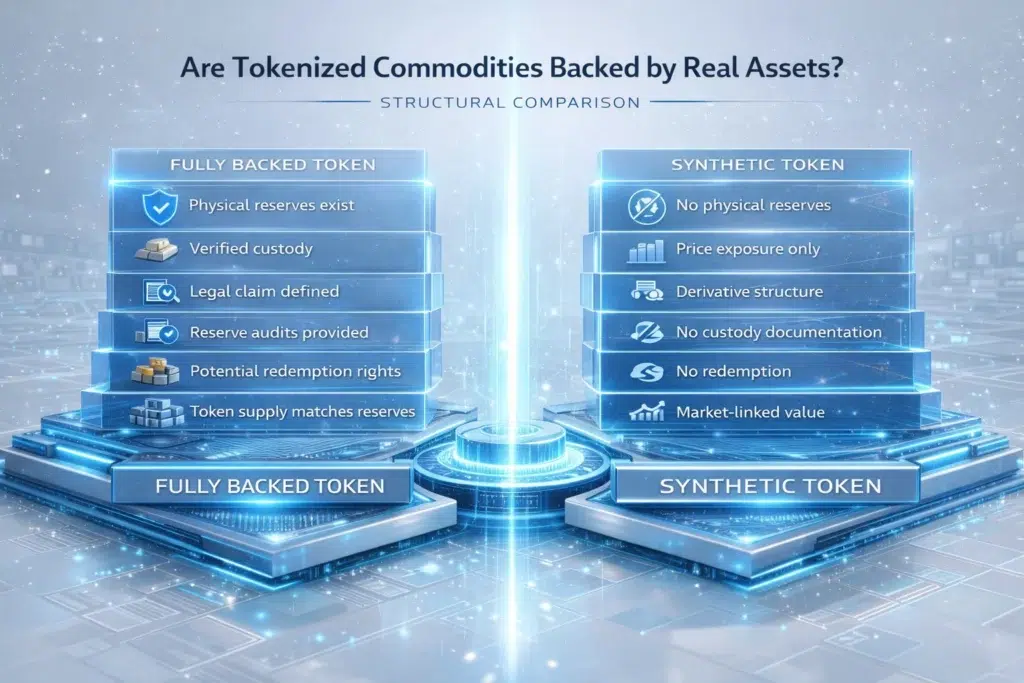
Some tokenized commodities are fully backed by physical reserves stored in custody and matched to the issued token supply. Others may provide synthetic or derivative exposure without any direct physical backing. Blockchain alone does not guarantee backing. Legal documentation and independent reserve verification do. The key question for any investor is not whether a token exists on a blockchain but whether the chain of custody from the physical commodity to the digital token is legally enforceable, independently verified, and practically redeemable.
The Three Degrees of Backing: Are Tokenized Commodities Backed by Real Assets?
| Backing Type | Physical Reality | Redeemability | Institutional Trust Level |
|---|---|---|---|
| Allocated Backing | You own specific, numbered bars (e.g., LBMA bars with serial numbers) | Full. You can request physical delivery of your specific bars | Highest. Used by institutional investors |
| Unallocated Backing | You own a share of a general pool of metal, not specific bars | Partial. Often cash-settled only, no specific bar delivery | Medium. You are a general creditor of the pool |
| Synthetic or Derivative | No physical commodity exists. Price exposure only | None. Cash-settled only. The photograph, never the jacket | Lowest. High market and counterparty risk |
When synthetic exposure is used, the answer to whether tokenized commodities are backed by real assets is no, because price tracking does not equal physical reserve backing. Understanding this distinction is the foundational requirement for any due diligence on tokenized commodity products.
The 4 Pillars of Backing Integrity: How Tokenized Commodities Are Backed by Real Assets
1. LBMA Standards and Chain of Custody
In the professional gold market, institutional trust comes from the LBMA (London Bullion Market Association, the global standard-setting body for the gold and silver markets). For a tokenized gold product to be considered institutionally backed, the gold must meet LBMA (London Bullion Market Association) good delivery standards, typically 99.5% purity, and must be stored in LBMA-approved vaults operated by institutions such as HSBC, JP Morgan, or Brinks. If the gold is not LBMA-certified, institutional investors will not consider it genuinely backed regardless of the blockchain technology applied to it.
Beyond storage, chain of custody (the documented, unbroken trail of physical possession from refinery to vault) is critical. Professional platforms track the commodity from the point of refinement through transportation to secure storage, ensuring the material has never been substituted, diluted, or tampered with. The LBMA provides international guidance on these standards: London Bullion Market Association. For commodity tokenization mechanics: How Commodity Tokenization Works on Blockchain.
2. Proof of Reserve and Independent Attestations
Knowing that gold was in a vault at the time of token issuance does not answer whether tokenized commodities are backed by real assets today. Reserves must be continuously verified. This is where PoR (Proof of Reserve, the independent cryptographic or auditor-verified confirmation that physical reserves match issued token supply at a given point in time) becomes the institutional standard.
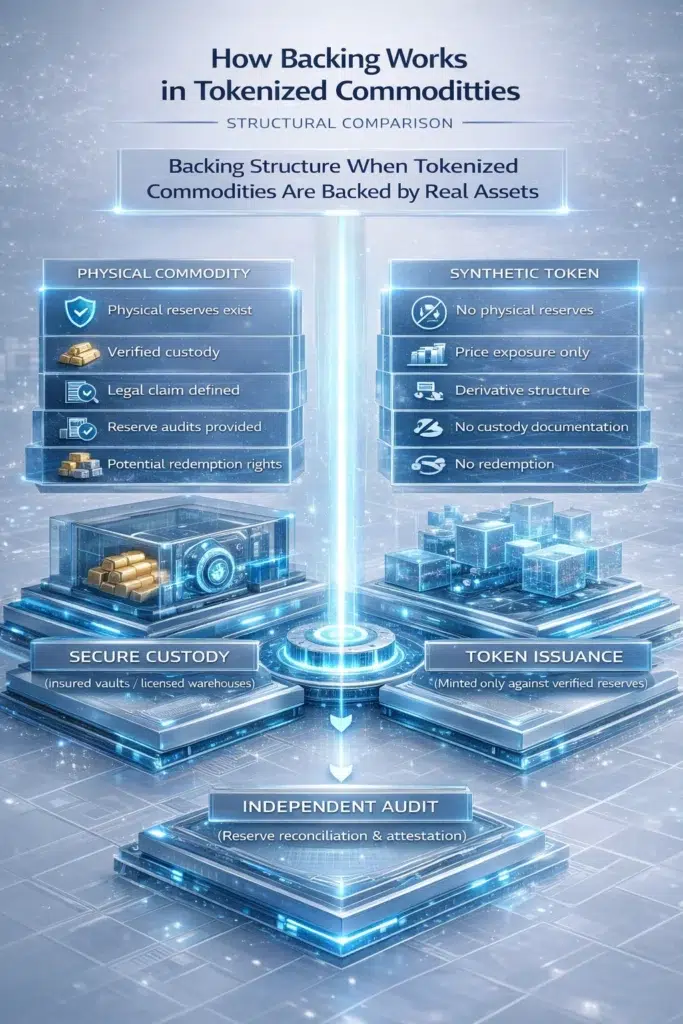
Top-tier platforms provide real-time or regularly updated attestations, where an independent auditor such as a Big Four accounting firm or a specialized commodity inspector such as Inspectorate (a globally recognized commodity verification firm) physically visits the vault, counts and weighs the specific bars, and signs a digital certificate that is published on the blockchain. This process eliminates double-spending risk (the possibility that a platform sells the same physical gold bar to two different token holders simultaneously) by creating a publicly verifiable, timestamped record of actual physical inventory. For Proof of Reserve context: What Is Proof of Reserve.
3. Legal Insolvency Remoteness: Your Ticket Remains Valid Even If the Theater Closes
One of the most critical questions in determining whether tokenized commodities are backed by real assets is what happens if the company issuing the tokens goes bankrupt. In many unallocated structures, the gold held by the platform is technically the company’s asset. If the company fails, its creditors can claim that gold before token holders receive anything. The coat check desk closes, and your ticket is worthless.
High-authority platforms solve this through insolvency remoteness (the legal structuring that ensures the underlying commodity is held in a legally separate entity, typically an SPV (Special Purpose Vehicle), that is ring-fenced from the issuing company’s balance sheet). Your coat check ticket remains valid even if the theater itself closes because the coats are held by a legally separate custodian that the theater’s creditors cannot reach. For investors evaluating whether tokenized commodities are backed by real assets, this is the single most important legal check: is the backing held in an insolvency-remote structure? For legal structure context: Custody Models Used in Real-World Asset Tokenization.
4. Physical Redemption: The Ultimate Proof
The strongest possible proof that tokenized commodities are backed by real assets is physical redemption: the ability to burn (permanently remove from circulation) the digital token and receive the actual physical commodity. Can you request delivery of a specific gold bar to a vault of your choice, or order a courier to bring it to you? If yes, the platform is demonstrating at the highest level that the asset exists, is legally yours, and is accessible.
Physical redemption distinguishes allocated backing from every other structure. In an unallocated or synthetic structure, redemption returns cash equivalent at current market price. In a fully allocated structure with physical redemption rights, redemption returns the actual commodity. This is the difference between holding a ticket and holding a photograph: only the ticket gives you back the jacket.
How to Verify Whether Tokenized Commodities Are Backed by Real Assets
Determining whether tokenized commodities are backed by real assets requires structured due diligence across the following questions. Is the backing allocated (specific, numbered bars) or unallocated (a general pool)? Is the custodian clearly identified and independently regulated? Is the storage location disclosed and auditable? Are Proof of Reserve attestations publicly available and independently signed? Does token supply match reported physical reserves? Is the legal structure documented with insolvency remoteness confirmed? Are redemption rights defined and practically exercisable? Does the commodity meet recognized standards such as LBMA good delivery? Are insurance disclosures provided for vault storage risks? Transparency across all these dimensions is what institutional investors require before treating a tokenized commodity as genuinely backed.
Backing Risk vs Market Risk: A Critical Distinction
Investors frequently confuse two fundamentally different types of risk when asking whether tokenized commodities are backed by real assets.
Market risk is the price of gold dropping from $2,000 to $1,800 per ounce due to macroeconomic conditions. This is normal commodity price volatility. It affects all gold investors equally and cannot be eliminated by any tokenization structure. Backing risk is the price of gold sitting at $2,000, but the vault only holding 50% of the gold that the outstanding token supply represents. This is systemic structural failure. A platform may tell investors their tokens are backed while operating a fractional reserve scheme, in which case investors are exposed to catastrophic loss that has nothing to do with gold prices and everything to do with governance failure.
Even if tokenized commodities are backed by real assets on day one, governance weaknesses, custodian insolvency, audit failures, or fraudulent reporting can create backing failure over time. Continuous verification through Proof of Reserve is the mechanism that closes this gap. For risk framework context: How Investors Assess Risk in Tokenized Real-World Assets.
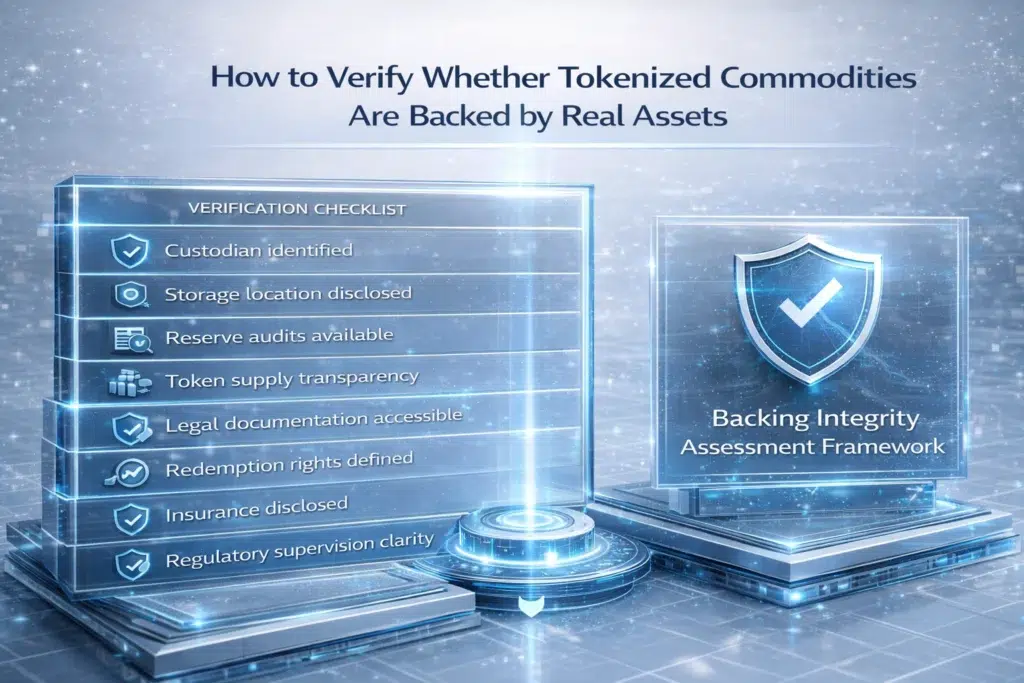
The Verification Checklist: Are Tokenized Commodities Backed by Real Assets?
| Verification Check | Green Flag (Backed) | Red Flag (Unverified) |
|---|---|---|
| Backing type | Allocated with specific bar serial numbers | Unallocated pool or synthetic only |
| Custodian | Independent, licensed, regulated custodian disclosed | Platform self-custody or undisclosed |
| Commodity standard | LBMA good delivery or equivalent recognized standard | No stated standard or unverified purity |
| Proof of Reserve | Regular independent attestations publicly available | Self-reported only or no audit documentation |
| Legal structure | SPV with confirmed insolvency remoteness | Platform balance sheet with no ring-fencing |
| Redemption rights | Physical delivery available and documented | Cash-only settlement or redemption undefined |
| Supply matching | Token supply publicly verifiable against reserve reports | No public supply or reserve disclosure |
Regulatory Oversight and Whether Tokenized Commodities Are Backed by Real Assets
Regulatory oversight strengthens the credibility of backing claims by requiring disclosure, licensing, and compliance that independent platforms might otherwise avoid. In the United States, the SEC (Securities and Exchange Commission) and CFTC (Commodity Futures Trading Commission, the US regulator for commodity derivative markets) both have jurisdiction over certain tokenized commodity products depending on their structure. In Europe, the ESMA (European Securities and Markets Authority) has examined DLT (Distributed Ledger Technology) integration within regulated commodity markets. The MiCA (Markets in Crypto-Assets) regulation addresses asset-referenced tokens that include commodity-backed instruments.
Regulatory alignment means platforms must meet specific disclosure, custody, and compliance standards that add an additional verification layer beyond self-attestation. For compliance context: Regulatory Risks in Real-World Asset Tokenization.
Common Misconceptions About Whether Tokenized Commodities Are Backed by Real Assets
Three misconceptions frequently distort investor understanding in this area. First, blockchain does not guarantee backing. Blockchain records token transfers with perfect accuracy, but it cannot independently verify vault contents. A blockchain can record that a token was issued and transferred, but it cannot confirm that the corresponding gold bar still exists in the vault. Second, not all tokenized gold is redeemable. Redemption rights depend entirely on the issuer’s structure. Unallocated and synthetic products typically offer cash settlement only. Third, backed does not mean risk-free. Even a fully allocated, physically backed, LBMA-certified tokenized commodity carries custody risk, custodian counterparty risk (the risk that the vault operator itself fails), regulatory risk, and commodity market price volatility. Backing addresses reserve integrity. It does not eliminate all investment risk.
Frequently Asked Questions
Are tokenized commodities backed by real assets in every case?
No. Some are fully backed with verified physical custody, LBMA-standard commodities, and independent Proof of Reserve attestations. Others provide unallocated pool exposure or synthetic price tracking without any direct physical backing. The structure of the specific product determines the answer.
What is the difference between allocated and unallocated backing?
Allocated backing means you own specific, identified, numbered commodity units such as specific gold bars with serial numbers recorded in your name. Unallocated backing means you own a proportional share of a general pool of the commodity, making you a general creditor of the pool rather than the owner of specific physical units. Allocated backing provides stronger legal claim and typically stronger insolvency protection.
What is Proof of Reserve in tokenized commodities?
Proof of Reserve (PoR) is independent verification confirming that physical reserves match the outstanding token supply at a given point in time. In commodity tokenization, this typically involves an independent auditor or commodity inspection firm physically visiting storage facilities, counting and weighing the commodity units, and publishing a signed attestation that can be matched against the token supply on-chain.
What is insolvency remoteness and why does it matter?
Insolvency remoteness is the legal structuring that ensures the underlying commodity is held in an SPV (Special Purpose Vehicle) that is legally separate from the issuing platform’s balance sheet. If the platform goes bankrupt, its creditors cannot claim the assets held in the SPV. Without insolvency remoteness, a platform bankruptcy could leave token holders with no legal recourse to the underlying commodity.
What is the strongest proof that tokenized commodities are backed by real assets?
Physical redemption rights are the strongest proof. If a platform allows token holders to burn their tokens and receive specific, identified physical commodity units in return, this confirms that the assets exist, are legally owned by the token holder, and are physically accessible. Cash-only settlement does not provide the same confirmation.
Conclusion: Trust, but Verify
Are tokenized commodities backed by real assets? Some are, when structured with allocated physical custody meeting recognized standards such as LBMA, insolvency-remote SPV legal structures, independently verified Proof of Reserve attestations, publicly disclosed token supply matching, and practical physical redemption rights. Others provide unallocated pool exposure or synthetic price tracking that does not constitute genuine physical backing.
Blockchain improves transfer transparency and supply verifiability but does not independently verify vault contents. Determining whether tokenized commodities are backed by real assets requires evaluating custody integrity, backing type, legal structure, audit quality, and redemption rights. Without all three institutional pillars, LBMA certification, an SPV structure, and real-time Proof of Reserve, you are not holding a coat check ticket. You are holding a photograph.
For related reading: Tokenized Commodities Explained, How Investors Assess Risk in Tokenized Real-World Assets, and Main Risks of Real-World Asset Tokenization.
Explore Tokenized Commodities and Real-World Asset Backing
- Tokenized Commodities Explained
- How Commodity Tokenization Works on Blockchain
- Benefits and Risks of Tokenized Commodities
- Tokenized Gold vs Physical Gold
- Custody Models Used in Real-World Asset Tokenization
- How Investors Assess Risk in Tokenized Real-World Assets
- Main Risks of Real-World Asset Tokenization
- What Is Proof of Reserve (cross-pillar)
- Why Compliance Matters in Tokenized Finance (cross-pillar)
- Real-World Assets Hub
Glossary Terms
- Real-World Assets
- Tokenized Commodities
- Asset Tokenization
- Proof of Reserve
- Custody
- Asset Custody
- SPV (Special Purpose Vehicle)
- Commodity Tokenization
- Underlying Asset
- Regulatory Compliance
- Investor Protection
Educational Disclaimer
This article is provided for informational and educational purposes only. It does not constitute legal, financial, or investment advice. Regulatory treatment varies by jurisdiction and asset classification. Professional legal and financial consultation should be sought before making any investment decisions involving tokenized commodity products.
Last updated: March 2026